Virginia SOL 7.MG.2
SOL Standard (Knowledge and Skills Cluster)
The student will solve problems and justify relationships of similarity using proportional reasoning.
Virginia Standards of Learning for Mathematics
Cluster contents
Knowledge and Skills in This Standard
7.MG.2 is a Standards of Learning standard. These are the knowledge and skills expectations under it.
- 7.MG.2.a
Identify corresponding congruent angles of similar quadrilaterals and triangles, through the use of geometric markings.
- 7.MG.2.b
Identify corresponding sides of similar quadrilaterals and triangles.
- 7.MG.2.c
Given two similar quadrilaterals or triangles, write similarity statements using symbols.
- 7.MG.2.d
Write proportions to express the relationships between the lengths of corresponding sides of similar quadrilaterals and triangles.
- 7.MG.2.e
Recognize and justify if two quadrilaterals or triangles are similar using the ratios of corresponding side lengths.
- 7.MG.2.f
Solve a proportion to determine a missing side length of similar quadrilaterals or triangles.
- 7.MG.2.g
Given angle measures in a quadrilateral or triangle, determine unknown angle measures in a similar quadrilateral or triangle.
- 7.MG.2.h
Apply proportional reasoning to solve problems in context including scale drawings. Scale factors shall have denominators no greater than 12 and decimals no les...
Teacher's field guide
What This Cluster Means
What Students Need to Do
- Students match corresponding angles and sides in similar triangles and quadrilaterals, then write similarity statements in the correct order. They use equal side ratios and scale factors to justify similarity and find missing lengths. They also transfer angle measures and solve scale drawing problems.
What Mastery Looks Like
- A student correctly matches vertices, angles, and sides, then writes the similarity statement in corresponding order. The student uses one consistent scale factor to find missing lengths and uses matching angles to find unknown measures. The student can justify similarity with equal corresponding side ratios.
Common Misconceptions
- Students often match sides by position on the page instead of using angle markings and vertex order. They may mix the order of corresponding sides within a proportion or use addition instead of a scale factor. Some assume figures are similar because they look alike, or confuse similar figures with congruent figures.
How to Assess It
- Exit ticket: Triangles ABC and DEF have A congruent to D, B congruent to E, AB = 6, BC = 9, and DE = 10. Ask students to write a similarity statement, set up a proportion, and find EF.
Lesson moves
Ways to Teach It
Give students cutout triangle pairs to rotate, match, mark corresponding parts, and write a correct similarity statement.
Ask students to explain in writing whether triangles with sides 4, 6, 8 and 6, 9, 12 are similar.
Run a card sort matching diagrams, similarity statements, proportions, scale factors, and missing side lengths.
Use a school floor plan with scale 1 centimeter to 2 meters, then calculate actual hallway and classroom dimensions.
Free download
Printable 7.MG.2 Worksheet
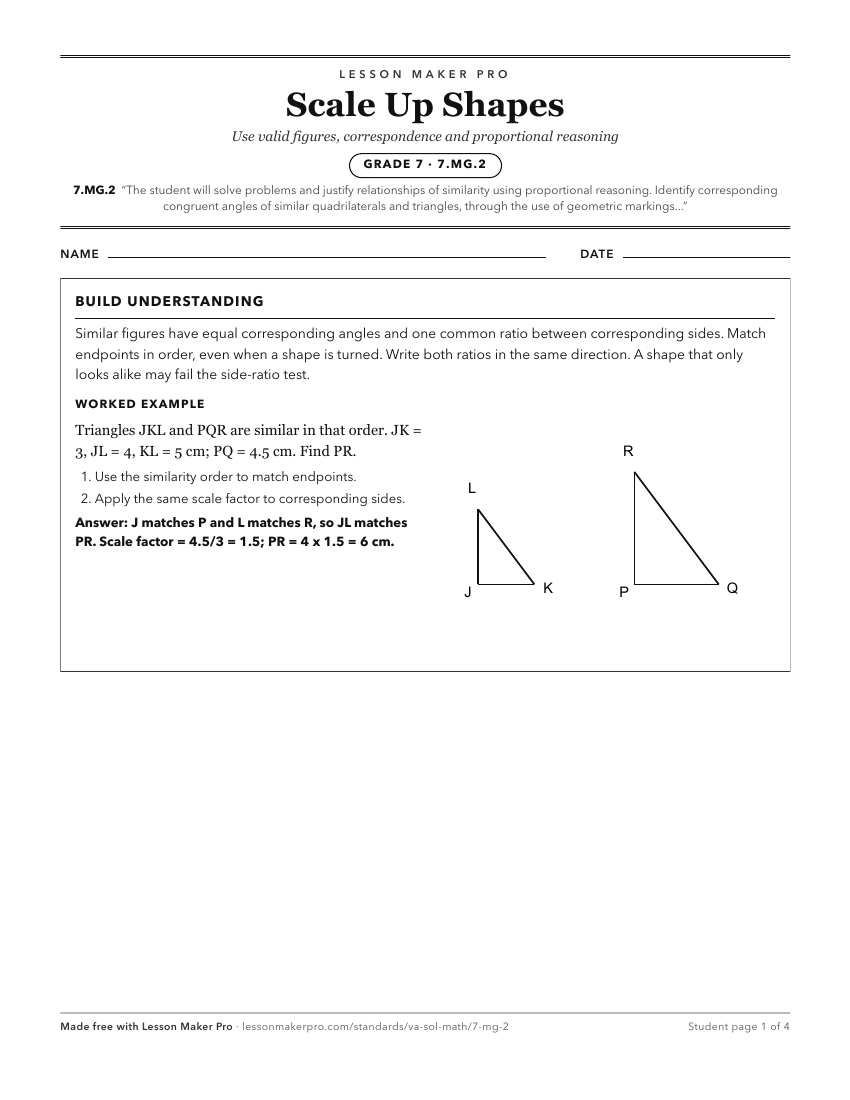
A ready-to-print activity worksheet aligned to 7.MG.2, with an answer key for the teacher on its own page. No account needed.
PDF, US Letter, prints cleanly in black and white.
Download the worksheetKeep exploring
Related Standards
- 6.PFA.2
The student will identify and represent proportional relationships between two quantities, including those in context (unit rates are limited to positive values...
- 8.CE.1
The student will estimate and apply proportional reasoning and computational procedures to solve contextual problems.
- 7.CE.2
The student will solve problems, including those in context, involving proportional relationships.
- 7.PFA.1
The student will investigate and analyze proportional relationships between two quantities using verbal descriptions, tables, equations in y = mx form, and grap...
Turn this cluster into a lesson
Grade, subject, topic, and the complete cluster are prefilled. Create one free, no account needed.
Also for this cluster:Make a WorksheetMake a QuizMake a Sub Lesson