Virginia SOL 5.MG.1
SOL Standard (Knowledge and Skills Cluster)
The student will reason mathematically to solve problems, including those in context, that involve length, mass, and liquid volume using metric units.
Virginia Standards of Learning for Mathematics
Cluster contents
Knowledge and Skills in This Standard
5.MG.1 is a Standards of Learning standard. These are the knowledge and skills expectations under it.
- 5.MG.1.a.i
length (millimeters, centimeters, meters, and kilometers)
- 5.MG.1.a.ii
mass (grams and kilograms)
- 5.MG.1.a.iii
liquid volume (milliliters and liters).
- 5.MG.1.b.i
length (millimeters, centimeters, and meters)
- 5.MG.1.b.ii
mass (grams and kilograms)
- 5.MG.1.b.iii
liquid volume (milliliters and liters).
- 5.MG.1.c.i
length (millimeters, centimeters, meters, and kilometers)
- 5.MG.1.c.ii
mass (grams and kilograms)
- 5.MG.1.c.iii
liquid volume (milliliters and liters).
Teacher's field guide
What This Cluster Means
What Students Need to Do
- Students select metric units that fit an object and situation. They estimate and measure length, mass, and liquid volume with common tools. They use given unit relationships to convert measures and solve context problems.
What Mastery Looks Like
- A student can explain why a road uses kilometers while a pencil uses centimeters or millimeters. The student estimates reasonably, measures accurately, converts using a supplied equivalence, and labels each answer with the correct unit.
Common Misconceptions
- Students may choose units by size alone, such as kilograms for a paper clip or milliliters for a bathtub. They often confuse factors of 10, 100, and 1,000 or move the decimal in the wrong direction. Some begin measuring at the ruler's edge instead of the zero mark.
How to Assess It
- Set out a small filled bottle and a graduated cylinder. Ask students to estimate and measure its volume in milliliters, convert it to liters using 1 liter = 1,000 milliliters, and choose the better label unit.
Lesson moves
Ways to Teach It
Set up ruler, balance, and graduated cylinder stations where students estimate and measure a pencil, apple, and cup of water, then record units.
Have students answer the prompt, Choose millimeters or meters for a hallway, then justify when the other unit would make sense.
Play a card match with equivalent measures, such as 3 kilograms and 3,000 grams, using a provided conversion chart to check matches.
Bring grocery labels showing grams, kilograms, milliliters, and liters; students choose three products and rewrite each amount in the paired unit.
Free download
Printable 5.MG.1 Worksheet
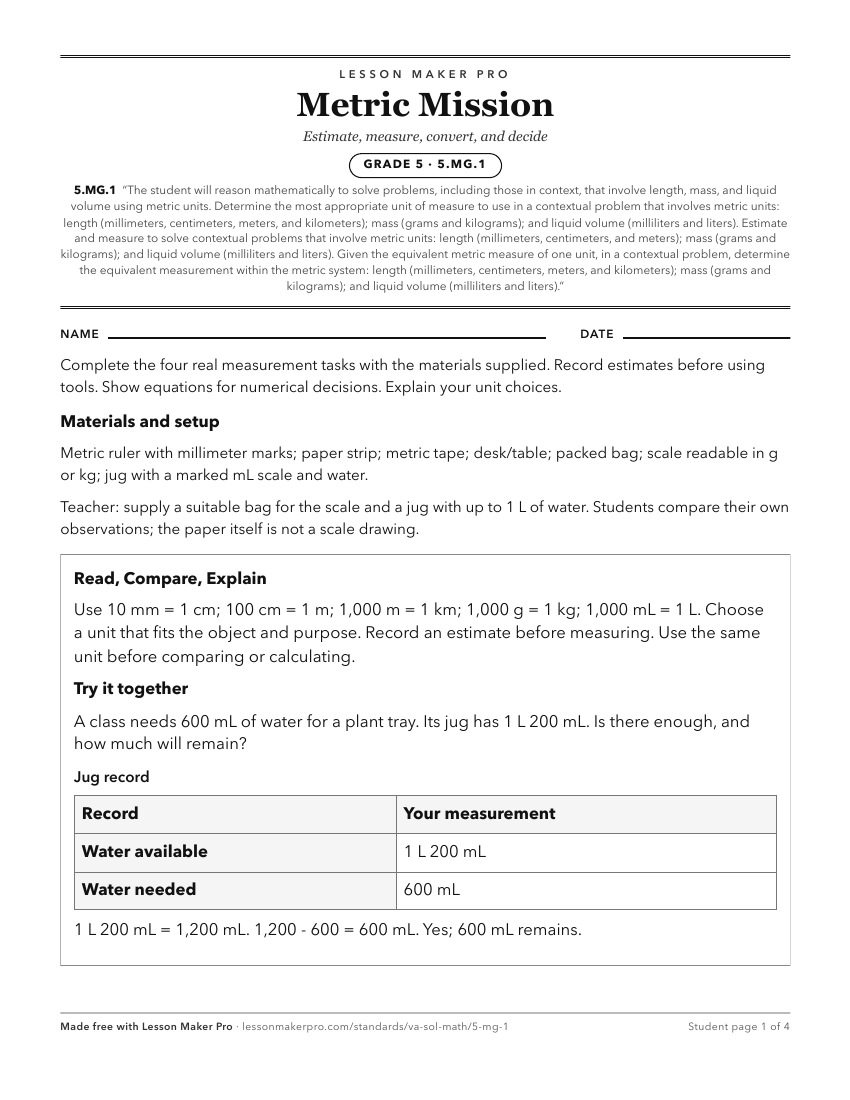
A ready-to-print activity worksheet aligned to 5.MG.1, with an answer key for the teacher on its own page. No account needed.
PDF, US Letter, prints cleanly in black and white.
Download the worksheetKeep exploring
Related Standards
- 3.MG.1
The student will reason mathematically using standard units (U.S. Customary and metric) with appropriate tools to estimate and measure objects by length, weight...
- 1.MG.1
The student will reason mathematically using nonstandard units to measure and compare objects by length, weight, and volume.
- 4.MG.1
The student will reason mathematically to solve problems, including those in context, that involve length, weight/mass, and liquid volume using U.S. Customary a...
- 2.MG.1
The student will reason mathematically using standard units (U.S. Customary) with appropriate tools to estimate, measure, and compare objects by length, weight,...
Turn this cluster into a lesson
Grade, subject, topic, and the complete cluster are prefilled. Create one free, no account needed.
Also for this cluster:Make a WorksheetMake a QuizMake a Sub Lesson