Virginia SOL 4.MG.1
SOL Standard (Knowledge and Skills Cluster)
The student will reason mathematically to solve problems, including those in context, that involve length, weight/mass, and liquid volume using U.S. Customary and metric units.
Virginia Standards of Learning for Mathematics
Cluster contents
Knowledge and Skills in This Standard
4.MG.1 is a Standards of Learning standard. These are the knowledge and skills expectations under it.
- 4.MG.1.a.i
length in both U.S. Customary (inch, foot, yard, mile) and metric units (millimeter, centimeter, meter)
- 4.MG.1.a.ii
weight/mass in both U.S. Customary (ounce, pound) and metric units (gram, kilogram)
- 4.MG.1.a.iii
liquid volume in both U.S. Customary (cup, pint, quart, gallon) and metric units (milliliter, liter).
- 4.MG.1.b.i
length of an object to the nearest U.S. Customary unit (1 2 inch, 1 4 inch, 1 8 inch, foot, yard) and nearest metric unit (millimeter, centimeter, or meter)
- 4.MG.1.b.ii
weight/mass of an object to the nearest U.S. Customary unit (ounce, pound) and nearest metric unit (gram, kilogram)
- 4.MG.1.b.iii
liquid volume to the nearest U.S. Customary unit (cup, pint, quart, gallon) and nearest metric unit (milliliter, liter).
- 4.MG.1.c
Compare estimates of length, weight/mass, or liquid volume with the actual measurements.
- 4.MG.1.d.i
length (inches and feet, feet and yards, inches and yards)
- 4.MG.1.d.ii
weight/mass (ounces and pounds)
- 4.MG.1.d.iii
liquid volume (cups, pints, quarts, and gallons).
Teacher's field guide
What This Cluster Means
What Students Need to Do
- Students choose sensible customary or metric units for length, mass, and liquid volume. They estimate, measure, and compare their estimates with actual results. They use supplied unit relationships to solve conversion problems within the customary system.
What Mastery Looks Like
- A student selects centimeters for a pencil, kilograms for a backpack, and liters for a pitcher. They estimate, measure to the requested precision, and compare the two results. Given 1 foot equals 12 inches, they can find the inches in 5 feet.
Common Misconceptions
- Students may confuse mass with liquid volume or choose units that are far too large or small. They may start measuring at the ruler’s edge instead of zero. When converting, they may divide when they should multiply or mix units from different systems.
How to Assess It
- Use this exit ticket: choose units for a pencil’s length, a backpack’s mass, and a juice bottle’s volume, then estimate and measure the pencil. Solve: 1 quart equals 2 pints, so 4 quarts equals how many pints?
Lesson moves
Ways to Teach It
Set up ruler, balance, and measuring-cup stations where students estimate, measure, and record results in customary and metric units.
Ask students to defend which unit best measures a hallway, an apple, and a fish tank, then explain why other units are awkward.
Play Conversion Match with cards showing equivalent quantities such as 3 feet, 36 inches, 2 pints, and 4 cups.
Give students a picnic packing list and have them choose units for sandwich mass, drink volume, and walking distance.
Free download
Printable 4.MG.1 Worksheet
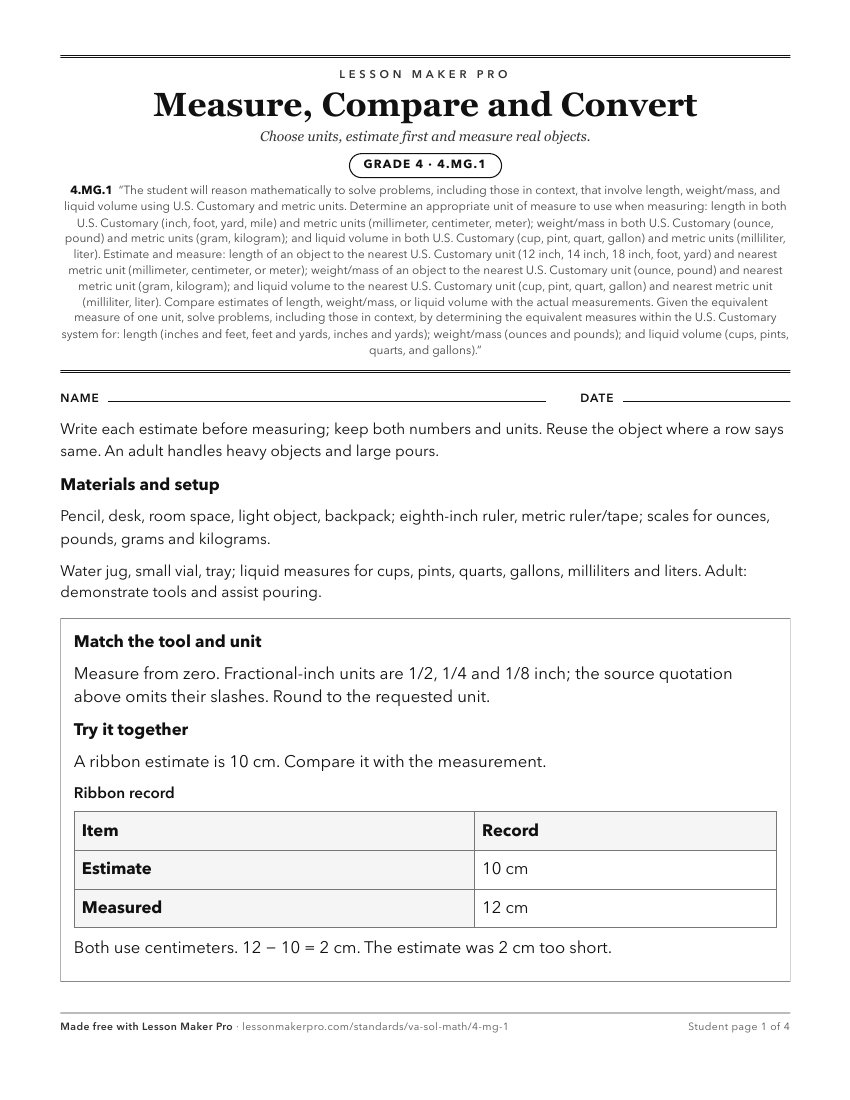
A ready-to-print activity worksheet aligned to 4.MG.1, with an answer key for the teacher on its own page. No account needed.
PDF, US Letter, prints cleanly in black and white.
Download the worksheetKeep exploring
Related Standards
- 3.MG.1
The student will reason mathematically using standard units (U.S. Customary and metric) with appropriate tools to estimate and measure objects by length, weight...
- 5.MG.1
The student will reason mathematically to solve problems, including those in context, that involve length, mass, and liquid volume using metric units.
- 1.MG.1
The student will reason mathematically using nonstandard units to measure and compare objects by length, weight, and volume.
- 2.MG.1
The student will reason mathematically using standard units (U.S. Customary) with appropriate tools to estimate, measure, and compare objects by length, weight,...
Turn this cluster into a lesson
Grade, subject, topic, and the complete cluster are prefilled. Create one free, no account needed.
Also for this cluster:Make a WorksheetMake a QuizMake a Sub Lesson