Virginia SOL 1.MG.1
SOL Standard (Knowledge and Skills Cluster)
The student will reason mathematically using nonstandard units to measure and compare objects by length, weight, and volume.
Virginia Standards of Learning for Mathematics
Cluster contents
Knowledge and Skills in This Standard
1.MG.1 is a Standards of Learning standard. These are the knowledge and skills expectations under it.
- 1.MG.1.a.i
lengths of two objects (units laid end to end with no gaps or overlaps) and compare the measurements using the terms longer/shorter, taller/shorter, or the same...
- 1.MG.1.a.ii
weights of two objects (using a balance scale or a pan scale) and compare the measurements using the terms lighter, heavier, or the same as
- 1.MG.1.a.iii
volumes of two containers and compare the measurements using the terms more, less, or the same as.
- 1.MG.1.b
Measure the length, weight, or volume of the same object or container with two different units and describe how and why the measurements differ.
Teacher's field guide
What This Cluster Means
What Students Need to Do
- Students measure length with equal units placed in one straight, gap-free row. They measure weight by balancing objects against equal units and capacity by counting equal scoops. They compare results and explain why changing the unit changes the count.
What Mastery Looks Like
- A student measures accurately, records the number and unit, and makes a correct comparison for length, weight, or capacity. When using a second unit, the student explains that smaller units require more pieces while the object or container stays unchanged.
Common Misconceptions
- Students may leave gaps, overlap pieces, mix unit sizes, or begin away from an endpoint. They may assume a bigger object is heavier or a taller container holds more. They may think a new unit count means the object itself changed.
How to Assess It
- Set out two pencils with cubes, two small objects with a balance and counters, and two cups with dry rice and one scoop. Have each student measure and compare each pair, then remeasure one pencil with paper clips and explain why the count changed.
Lesson moves
Ways to Teach It
Set up three stations with cube rows, a pan balance and counters, and containers filled by equal scoops; students record each result.
Show one book measured with large tiles and small cubes; ask students to explain why the counts differ without the book changing.
Play Measure and Compare: partners pick two bagged items, use one kind of unit, and score for a correct comparison sentence.
Let students test two lunch containers with equal scoops of rice and recommend which one should hold a larger snack.
Free download
Printable 1.MG.1 Worksheet
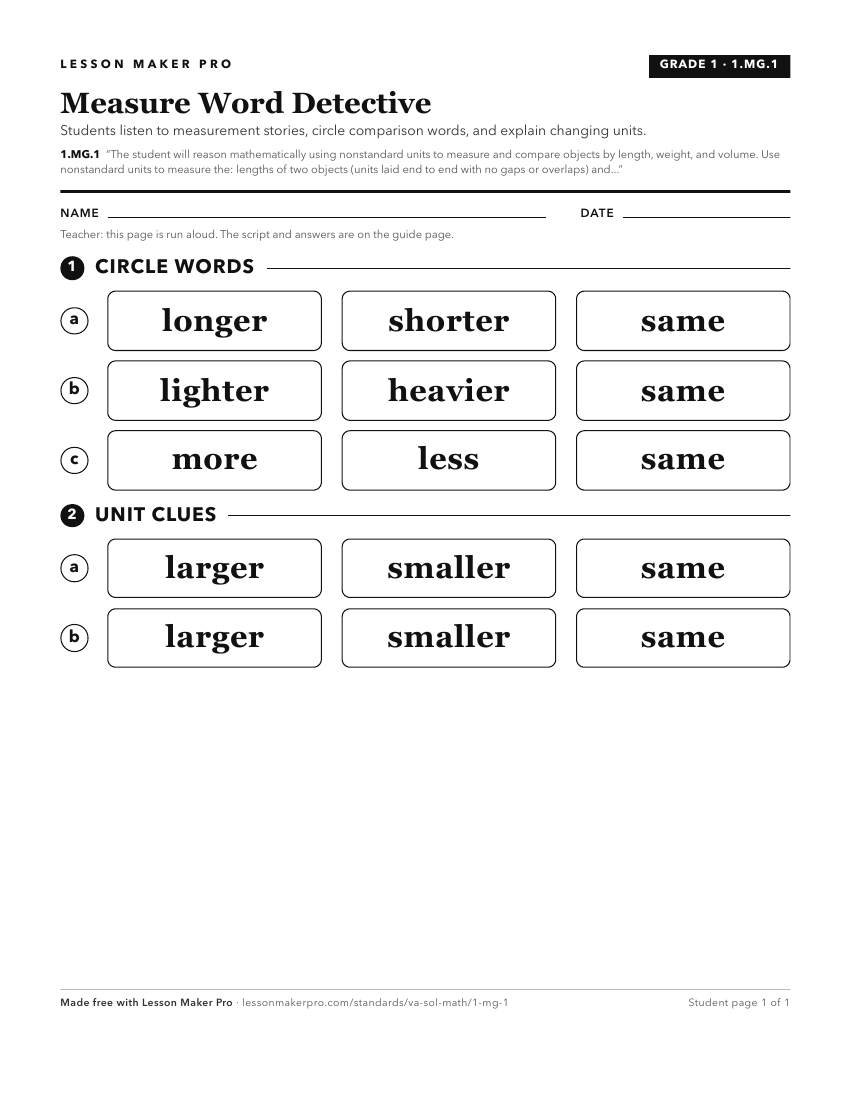
A ready-to-print activity worksheet aligned to 1.MG.1, with an answer key for the teacher on its own page. No account needed.
PDF, US Letter, prints cleanly in black and white.
Download the worksheetKeep exploring
Related Standards
- K.MG.1
The student will reason mathematically by making direct comparisons between two objects or events using the attributes of length, height, weight, volume, and ti...
- 3.MG.1
The student will reason mathematically using standard units (U.S. Customary and metric) with appropriate tools to estimate and measure objects by length, weight...
- 5.MG.1
The student will reason mathematically to solve problems, including those in context, that involve length, mass, and liquid volume using metric units.
- 2.MG.1
The student will reason mathematically using standard units (U.S. Customary) with appropriate tools to estimate, measure, and compare objects by length, weight,...
Turn this cluster into a lesson
Grade, subject, topic, and the complete cluster are prefilled. Create one free, no account needed.
Also for this cluster:Make a WorksheetMake a QuizMake a Sub Lesson