Virginia SOL 3.MG.1
SOL Standard (Knowledge and Skills Cluster)
The student will reason mathematically using standard units (U.S. Customary and metric) with appropriate tools to estimate and measure objects by length, weight/mass, and liquid volume to the nearest half or whole unit.
Virginia Standards of Learning for Mathematics
Cluster contents
Knowledge and Skills in This Standard
3.MG.1 is a Standards of Learning standard. These are the knowledge and skills expectations under it.
- 3.MG.1.a
Justify whether an estimate or an exact measurement is needed for a contextual situation and choose an appropriate unit.
- 3.MG.1.b.i
length of an object to the nearest U.S. Customary unit (1 2 inch, inch, foot, yard) and metric unit (centimeter, meter)
- 3.MG.1.b.ii
weight/mass of an object to the nearest U.S. Customary unit (pound) and metric unit (kilogram)
- 3.MG.1.b.iii
liquid volume to the nearest U.S. Customary unit (cup, pint, quart, gallon) and metric unit (liter).
- 3.MG.1.c
Compare estimates of length, weight/mass, or liquid volume with the actual measurements.
Teacher's field guide
What This Cluster Means
What Students Need to Do
- Students estimate and measure length, weight or mass, and liquid volume with suitable tools. They choose customary or metric units and read measurements to the nearest half or whole unit. They compare estimates with results and decide when an exact measurement is needed.
What Mastery Looks Like
- A student selects a sensible unit and tool for the object or liquid. They measure accurately to the nearest half or whole unit and label the answer. They compare the estimate with the result and explain whether the situation needs an estimate or an exact value.
Common Misconceptions
- Students may confuse length, weight, and volume units, such as measuring a desk in pounds. They may start at the ruler’s edge instead of zero or report more precision than the tool shows. Some treat an estimate as a random guess rather than a reasonable value with a unit.
How to Assess It
- Give each student a pencil and ruler. Ask them to estimate its length, choose inches or centimeters, measure it, record the difference, and explain when an exact length would be needed.
Lesson moves
Ways to Teach It
Set up stations with a ruler, yardstick, scale, and measuring cups; students estimate, measure, and record the difference at each station.
Ask: “A baker measures water for one recipe, while a painter plans paint for a room. Which measurements must be exact, and why?”
Play Unit Match: students pair object cards with tool and unit cards, then earn a point by explaining each choice.
Have students plan a class drink cooler by choosing a container size in gallons or liters and explaining their estimate.
Free download
Printable 3.MG.1 Worksheet
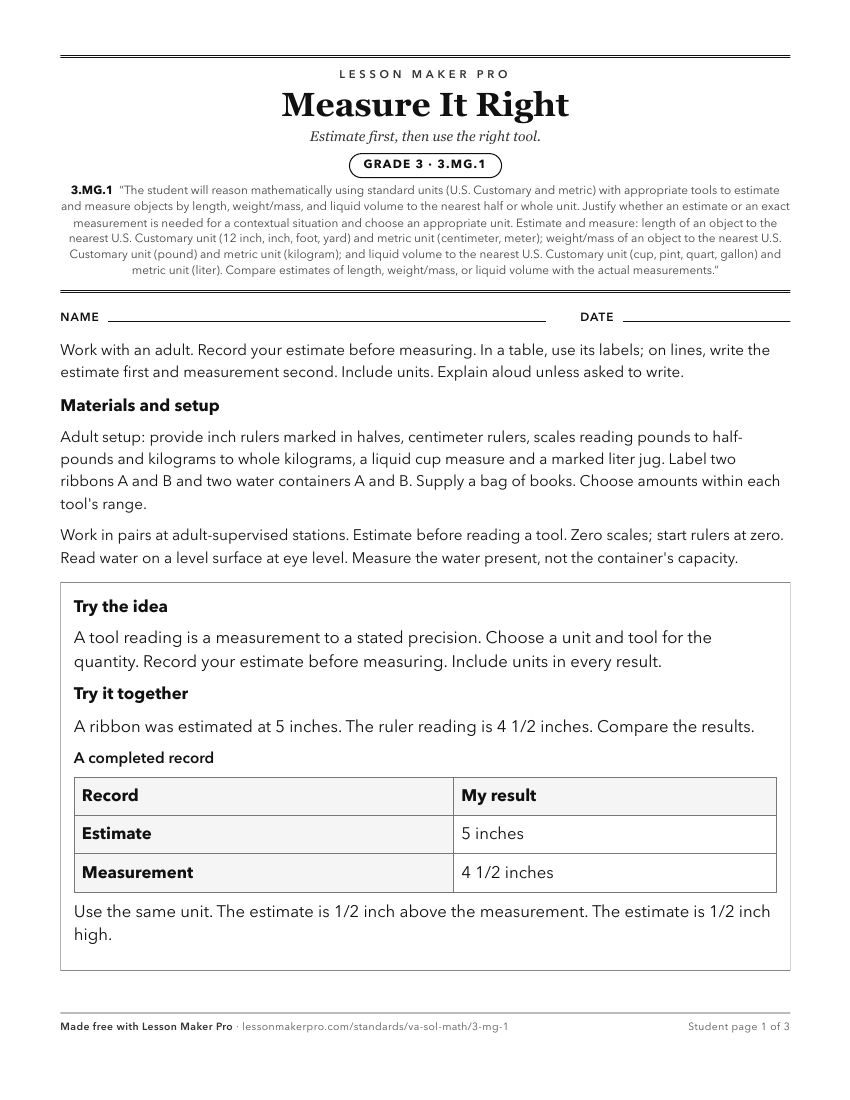
A ready-to-print activity worksheet aligned to 3.MG.1, with an answer key for the teacher on its own page. No account needed.
PDF, US Letter, prints cleanly in black and white.
Download the worksheetKeep exploring
Related Standards
- 5.MG.1
The student will reason mathematically to solve problems, including those in context, that involve length, mass, and liquid volume using metric units.
- 1.MG.1
The student will reason mathematically using nonstandard units to measure and compare objects by length, weight, and volume.
- 4.MG.1
The student will reason mathematically to solve problems, including those in context, that involve length, weight/mass, and liquid volume using U.S. Customary a...
- 2.MG.1
The student will reason mathematically using standard units (U.S. Customary) with appropriate tools to estimate, measure, and compare objects by length, weight,...
Turn this cluster into a lesson
Grade, subject, topic, and the complete cluster are prefilled. Create one free, no account needed.
Also for this cluster:Make a WorksheetMake a QuizMake a Sub Lesson