Virginia SOL 3.MG.1.a
The Standard
Justify whether an estimate or an exact measurement is needed for a contextual situation and choose an appropriate unit.
Virginia Standards of Learning for Mathematics · The student will reason mathematically using standard units (U.S. Customary and metric) with appropriate tools to estimate and measure objects by length, weight/mass, and liquid volume to the nearest half or whole unit.
Teacher's field guide
What This Standard Means
What Students Need to Do
- Students decide whether a situation calls for a close estimate or a measured value. They select a unit that matches the attribute and size, then explain both choices using the context.
What Mastery Looks Like
- A student can decide whether a close value is enough or a measured value is needed, then explain why. The student chooses a sensible unit, such as inches for a pencil or liters for a pitcher.
Common Misconceptions
- Students often think an estimate is a random guess rather than a close value based on a benchmark. They may measure every time or choose a unit that is too large or too small. Some confuse attributes, such as using pounds for liquid volume.
How to Assess It
- Exit ticket: “A cook needs milk for a cake recipe. Should the milk be estimated or measured? Choose cups or gallons and explain.”
Lesson moves
Ways to Teach It
Place a pencil, backpack, and water bottle at stations; students read task cards, then choose Estimate or Measure, a tool, and a unit.
Ask: “A baker is making one cake. Should the milk be estimated or measured, and should the unit be cups or gallons? Explain.”
Play Unit Match: teams pair situation cards with Estimate or Measure and a unit card, then defend one match for a point.
Give students a school fair planning sheet for tablecloth length, lemonade volume, and pumpkin weight; they choose estimate or measure and suitable units.
Free download
Printable 3.MG.1.a Worksheet
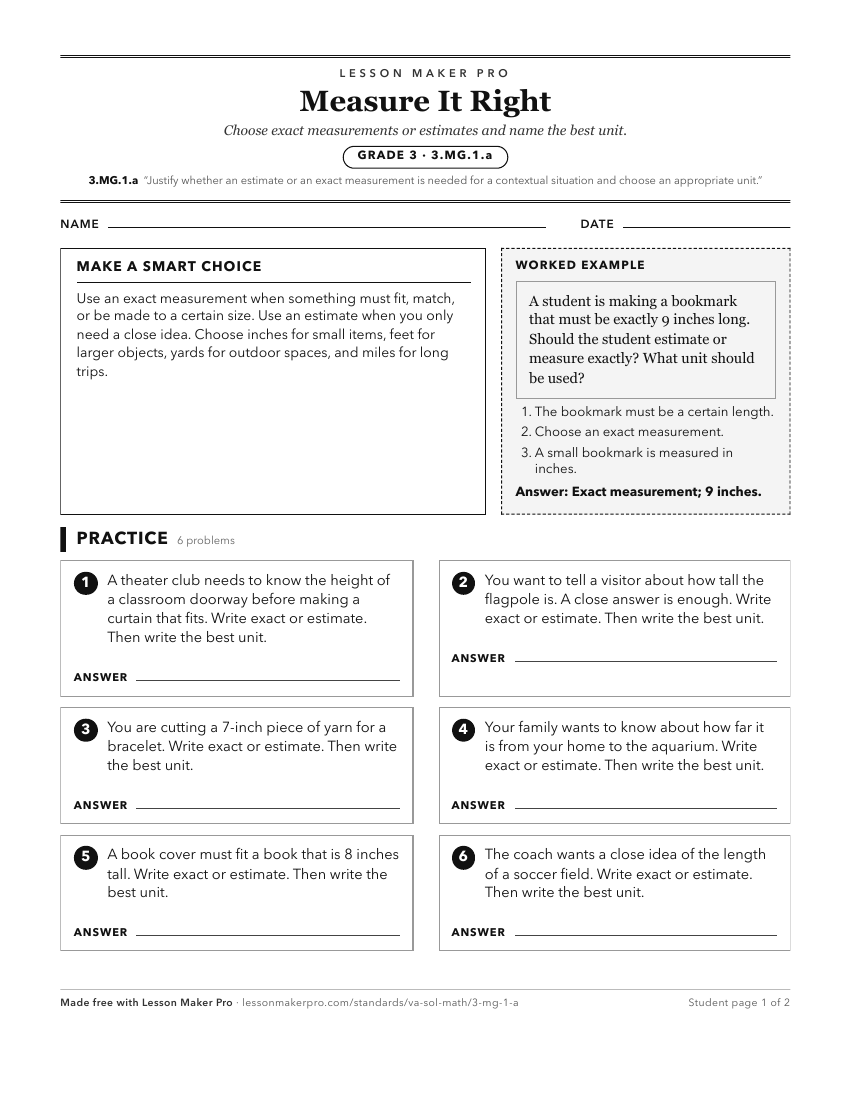
A ready-to-print activity worksheet aligned to 3.MG.1.a, with an answer key for the teacher on its own page. No account needed.
PDF, US Letter, prints cleanly in black and white.
Download the worksheetKeep exploring
Related Standards
- 2.NS.1.g
Choose a reasonable estimate up to 1,000 when given a contextual problem (e.g., What would be the best estimate for the number of students in our school – 5, 50...
- 4.CE.2.a
Determine and justify whether an estimate or an exact answer is appropriate when solving contextual problems involving multiplication and division of whole numb...
- 3.CE.1.a
Determine and justify whether an estimate or an exact answer is appropriate when solving single-step and multistep contextual problems involving addition and su...
- 4.CE.1.a
Determine and justify whether an estimate or an exact answer is appropriate when solving contextual problems involving addition and subtraction with whole numbe...
Turn this exact standard into a lesson
Grade, subject, topic, and the complete standard are prefilled. Create one free, no account needed.
Also for this standard:Make a WorksheetMake a QuizMake a Sub Lesson