Virginia SOL 4.CE.2.a
The Standard
Determine and justify whether an estimate or an exact answer is appropriate when solving contextual problems involving multiplication and division of whole numbers. Refine estimates by adjusting the final amount, using terms such as closer to, between, and a little more than.
Virginia Standards of Learning for Mathematics · The student will estimate, represent, solve, and justify solutions to single-step and multistep problems, including those in context, using multiplication with whole numbers, and single-step problems, including those in context, using division with whole numbers; and recall with automaticity the multiplication facts through 12 × 12 and the corresponding division facts.
Teacher's field guide
What This Standard Means
What Students Need to Do
- Students decide whether a rough answer will do or an exact product or quotient is needed. They estimate with friendly numbers, adjust up or down, and explain how close the result should be.
What Mastery Looks Like
- Given a word problem, the student chooses an estimate or exact calculation for a reason tied to the situation. The student computes correctly and revises a rough estimate up or down. Explanations use comparisons such as between 400 and 450 or a little more than 400.
Common Misconceptions
- Students may estimate whenever numbers look large, even when a head count or purchase requires an exact answer. Some round too much, treat an estimate as exact, or adjust in the wrong direction.
How to Assess It
- Exit ticket: A coach orders 19 boxes of 24 water bottles. Decide whether an estimate or exact answer is appropriate for planning for about 450 players and for serving exactly 455 players, then solve and justify.
Lesson moves
Ways to Teach It
Give pairs counters, bag labels, and context cards; students build equal groups, choose estimate or exact, then adjust the estimate.
Discuss 23 boxes of 18 markers: when is 400 enough information, and when must students calculate 414?
Play Estimate or Exact: teams sort multiplication and division problem cards, solve each, and earn a point for a sound justification.
Use whole-dollar grocery prices to estimate costs for equal quantities, then calculate exact totals to check whether a $100 budget is enough.
Free download
Printable 4.CE.2.a Worksheet
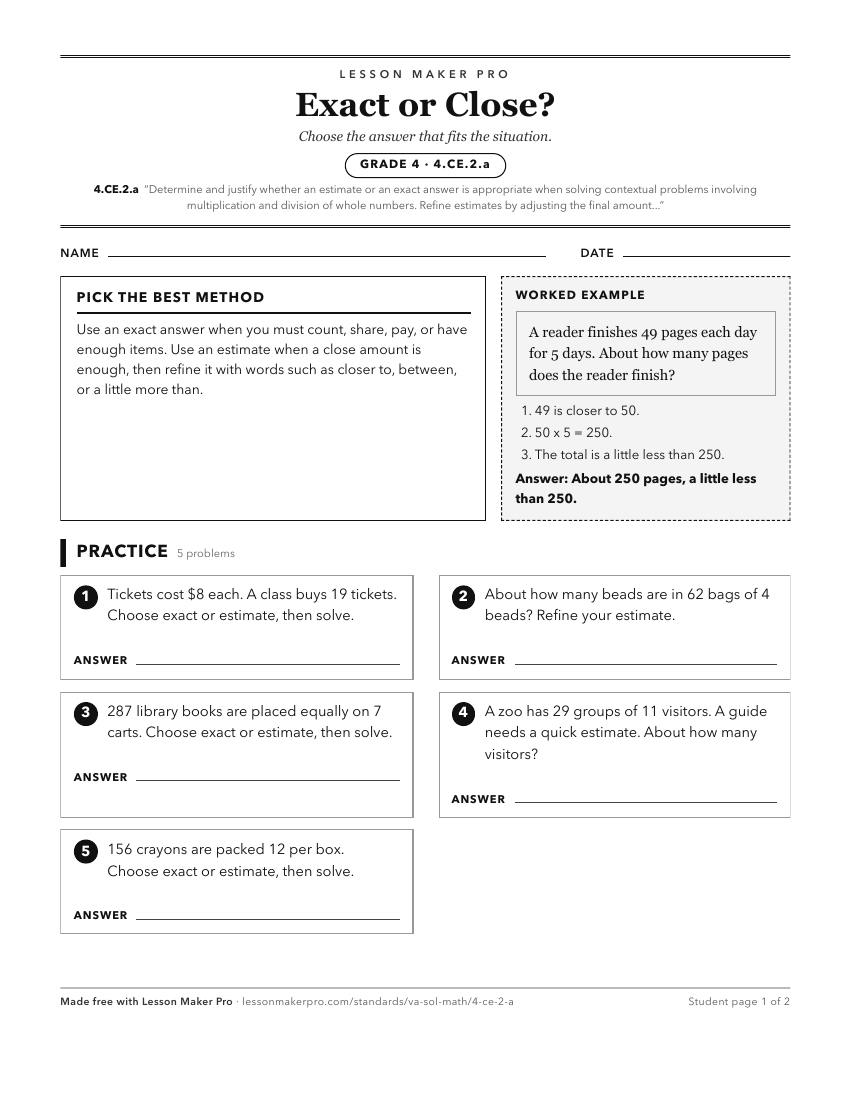
A ready-to-print activity worksheet aligned to 4.CE.2.a, with an answer key for the teacher on its own page. No account needed.
PDF, US Letter, prints cleanly in black and white.
Download the worksheetKeep exploring
Related Standards
- 4.CE.2.j
Estimate, represent, solve, and justify solutions to single-step contextual problems involving division with whole numbers.
- 3.CE.1.a
Determine and justify whether an estimate or an exact answer is appropriate when solving single-step and multistep contextual problems involving addition and su...
- 5.CE.3.a
Apply estimation strategies (e.g., rounding to the nearest whole number, tenth or hundredth; compatible numbers, place value) to determine a reasonable solution...
- 4.CE.1.a
Determine and justify whether an estimate or an exact answer is appropriate when solving contextual problems involving addition and subtraction with whole numbe...
Turn this exact standard into a lesson
Grade, subject, topic, and the complete standard are prefilled. Create one free, no account needed.
Also for this standard:Make a WorksheetMake a QuizMake a Sub Lesson