Virginia SOL 4.CE.1.a
The Standard
Determine and justify whether an estimate or an exact answer is appropriate when solving contextual problems involving addition and subtraction with whole numbers. Refine estimates by adjusting the final amount, using terms such as closer to, between, and a little more than.
Virginia Standards of Learning for Mathematics · The student will estimate, represent, solve, and justify solutions to single-step and multistep problems, including those in context, using addition and subtraction with whole numbers.
Teacher's field guide
What This Standard Means
What Students Need to Do
- Students decide whether a situation calls for an exact total or difference, or whether a nearby value is enough. They solve with whole numbers and explain their choice. They improve rough estimates by adjusting them and using phrases such as closer to, between, or a little more than.
What Mastery Looks Like
- Given a context, students choose an estimate or exact answer for a sensible reason. Their calculation fits the question, and they use an estimate to check whether an exact answer is reasonable. They make adjustments based on the original numbers rather than guessing.
Common Misconceptions
- Students may assume every problem needs an exact answer, or round automatically when a precise count is required. They may create an estimate that is too high or too low, then treat it as exact. Some adjust an estimate without using the original numbers as evidence.
How to Assess It
- Exit ticket: “A school has 1,487 pencils and buys 638 more. The principal asks whether about 2,000 pencils are available. Should you estimate or calculate exactly, and what refined estimate supports your choice?”
Lesson moves
Ways to Teach It
Give pairs store price cards and play money; they choose exact or estimated totals, build each amount, and explain any adjustment.
Ask, “When would a bus driver need an exact passenger count, and when would an estimate work?” Students defend both answers in writing.
Play Estimate or Exact: teams draw a context card, choose a method, solve, and earn a point only for a sound justification.
Use the class lunch count and school enrollment to compare when cafeteria staff need exact numbers and when planners can use estimates.
Free download
Printable 4.CE.1.a Worksheet
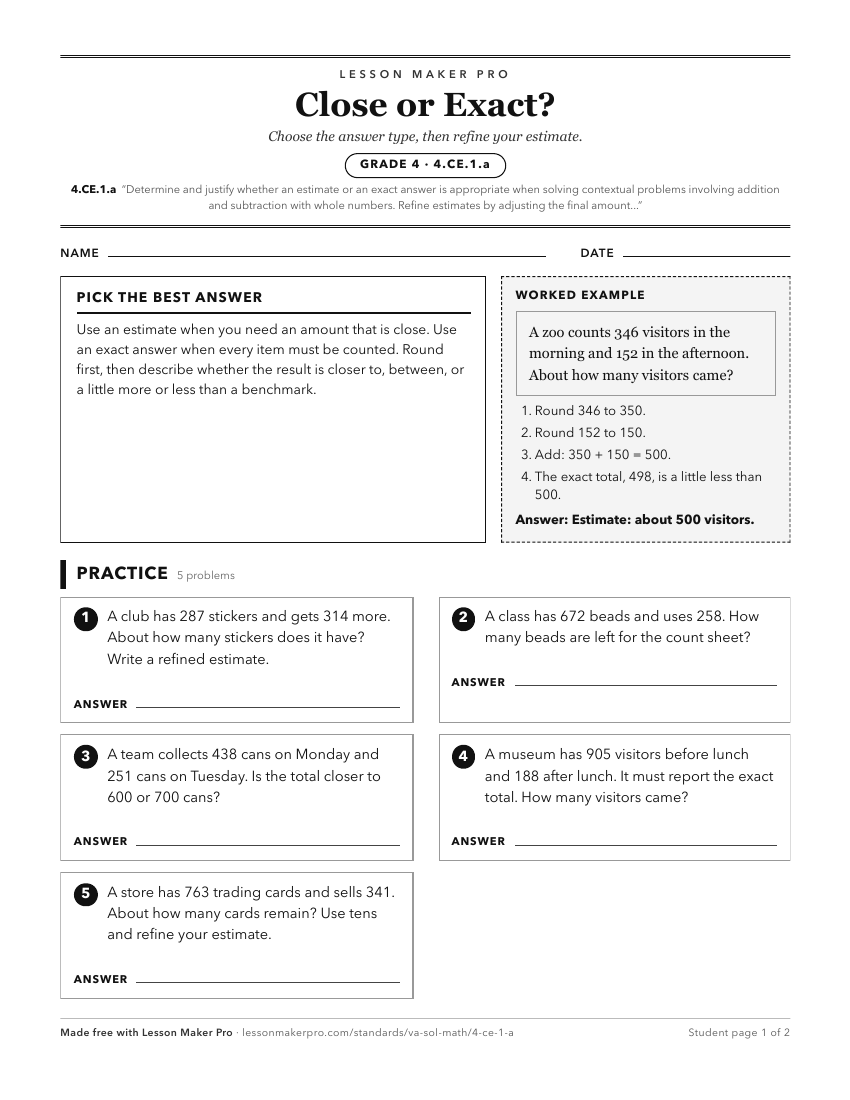
A ready-to-print activity worksheet aligned to 4.CE.1.a, with an answer key for the teacher on its own page. No account needed.
PDF, US Letter, prints cleanly in black and white.
Download the worksheetKeep exploring
Related Standards
- 6.CE.2.d
Estimate, determine, and justify the solution to one and two-step contextual problems, involving addition, subtraction, multiplication, and division with intege...
- 4.CE.2.a
Determine and justify whether an estimate or an exact answer is appropriate when solving contextual problems involving multiplication and division of whole numb...
- 3.CE.1.a
Determine and justify whether an estimate or an exact answer is appropriate when solving single-step and multistep contextual problems involving addition and su...
- 5.CE.3.a
Apply estimation strategies (e.g., rounding to the nearest whole number, tenth or hundredth; compatible numbers, place value) to determine a reasonable solution...
Turn this exact standard into a lesson
Grade, subject, topic, and the complete standard are prefilled. Create one free, no account needed.
Also for this standard:Make a WorksheetMake a QuizMake a Sub Lesson