Virginia SOL 5.MG.1.c.ii
The Standard
mass (grams and kilograms)
Virginia Standards of Learning for Mathematics · The student will reason mathematically to solve problems, including those in context, that involve length, mass, and liquid volume using metric units.
Teacher's field guide
What This Standard Means
What Students Need to Do
- Students convert masses between grams and kilograms in word problems. They use the given relationship between the units to decide whether to multiply or divide.
What Mastery Looks Like
- Students choose multiplication or division based on the unit change and calculate accurately. They label the answer in grams or kilograms and can explain why the number becomes larger or smaller.
Common Misconceptions
- Students may multiply when they should divide, or assume the number stays the same when the unit changes. They may also use 100 instead of 1,000 or label an answer with the wrong unit.
How to Assess It
- Give this exit ticket: “A bag of rice has a mass of 4 kilograms. Using 1 kilogram = 1,000 grams, what is its mass in grams? Explain your operation.”
Lesson moves
Ways to Teach It
Have students weigh classroom objects, record each mass in grams, then convert each measurement to kilograms using 1,000 grams per kilogram.
Ask students to explain why 3 kilograms and 3 grams cannot describe the same mass, using numbers and unit labels.
Play a matching game with cards showing equivalent masses, such as 2 kilograms, 2,000 grams, and 1,000 plus 1,000 grams.
Compare grocery package labels in grams and kilograms, then have students rewrite each mass using the other unit.
Free download
Printable 5.MG.1.c.ii Worksheet
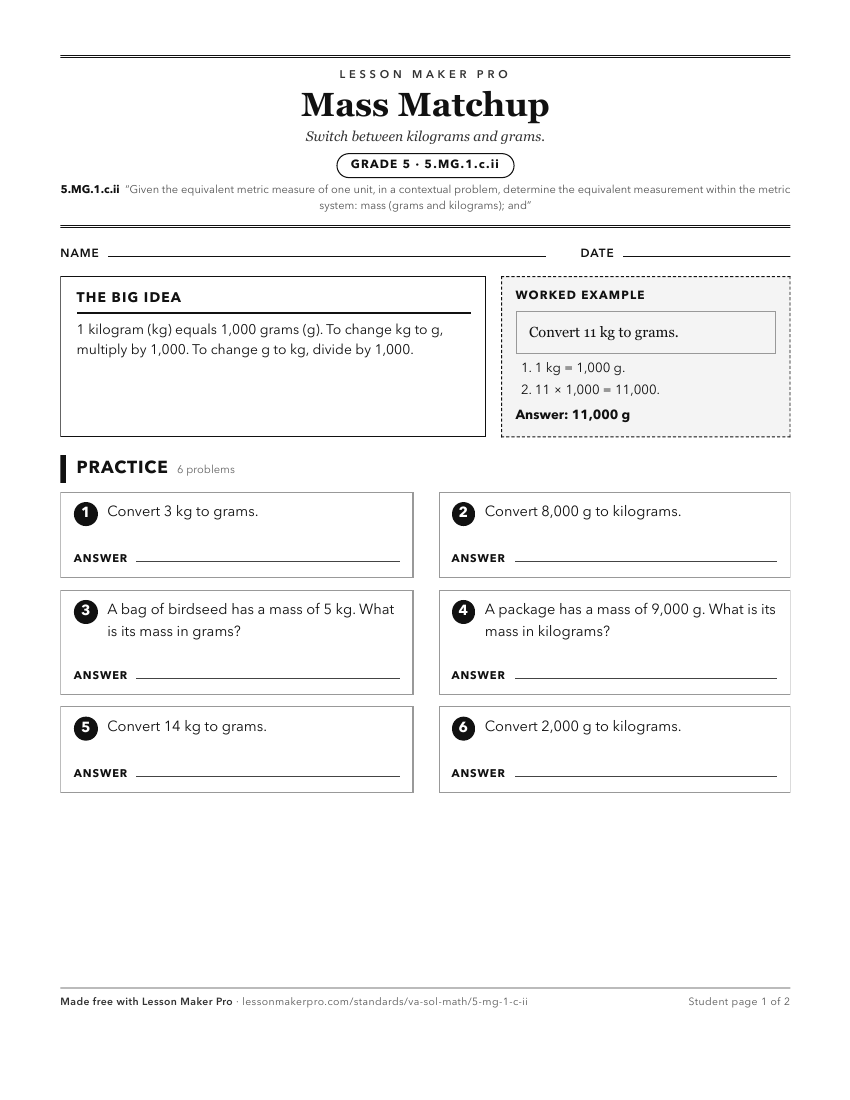
A ready-to-print activity worksheet aligned to 5.MG.1.c.ii, with an answer key for the teacher on its own page. No account needed.
PDF, US Letter, prints cleanly in black and white.
Download the worksheetKeep exploring
Related Standards
Turn this exact standard into a lesson
Grade, subject, topic, and the complete standard are prefilled. Create one free, no account needed.
Also for this standard:Make a WorksheetMake a QuizMake a Sub Lesson