Virginia SOL 5.MG.1.a.ii
The Standard
mass (grams and kilograms)
Virginia Standards of Learning for Mathematics · The student will reason mathematically to solve problems, including those in context, that involve length, mass, and liquid volume using metric units.
Teacher's field guide
What This Standard Means
What Students Need to Do
- Students decide whether grams or kilograms make sense for the mass of an object in a given situation. They use familiar objects and reasonable estimates to explain their choice.
What Mastery Looks Like
- Students select grams for lighter objects and kilograms for heavier objects in familiar situations. They justify the unit by describing a reasonable estimated mass or comparing the object with a known benchmark.
Common Misconceptions
- Students may choose kilograms for large-looking objects even when those objects are light. They may also treat grams and kilograms as interchangeable or choose grams because the number would be larger.
How to Assess It
- Give this exit ticket: “A backpack full of books has a mass of about 4 __. Choose g or kg and explain your choice.”
Lesson moves
Ways to Teach It
Weigh classroom objects on a digital scale, then sort object cards under grams or kilograms and explain each choice.
Ask, “Would you measure a paper clip in grams or kilograms?” Students write a claim and support it with an estimated mass.
Play Unit Match: teams pair picture cards with grams or kilograms, earning a point only when their spoken reason fits.
Examine grocery labels for rice, spices, and produce, then explain why each package lists mass in grams or kilograms.
Free download
Printable 5.MG.1.a.ii Worksheet
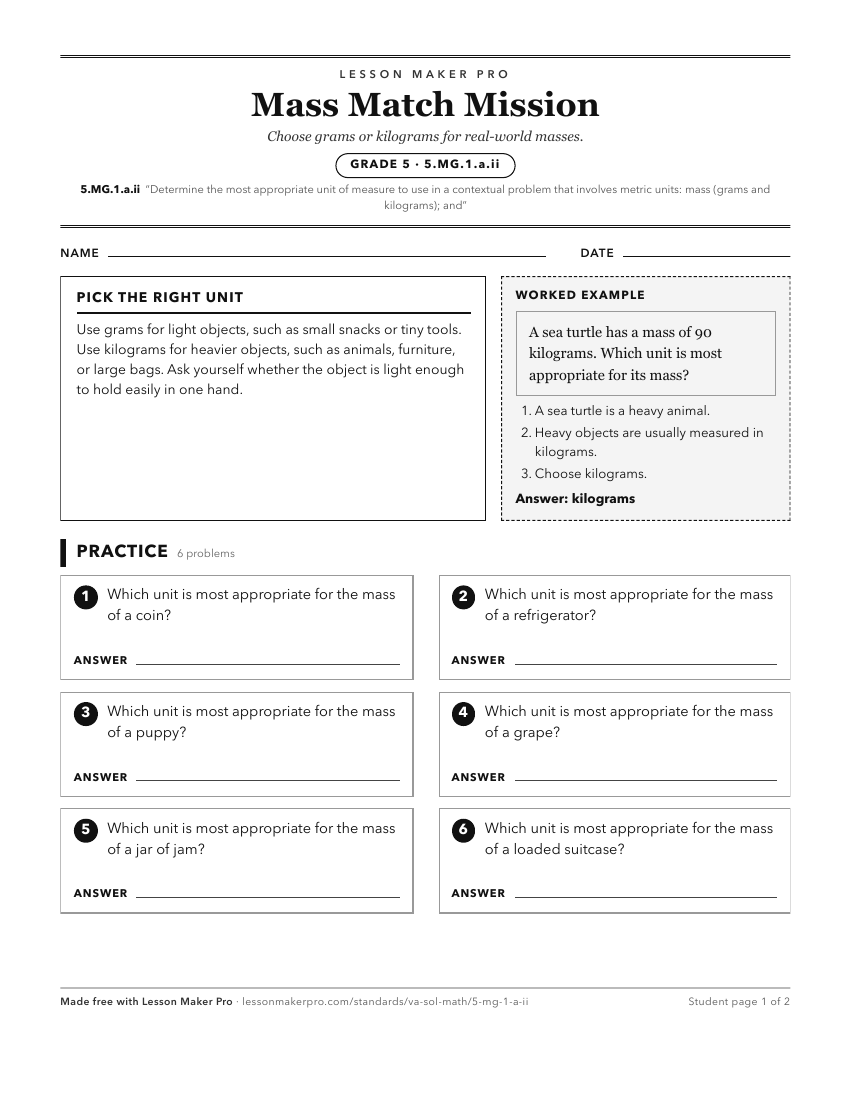
A ready-to-print activity worksheet aligned to 5.MG.1.a.ii, with an answer key for the teacher on its own page. No account needed.
PDF, US Letter, prints cleanly in black and white.
Download the worksheetKeep exploring
Related Standards
Turn this exact standard into a lesson
Grade, subject, topic, and the complete standard are prefilled. Create one free, no account needed.
Also for this standard:Make a WorksheetMake a QuizMake a Sub Lesson