Virginia SOL 5.MG.1.c.iii
The Standard
liquid volume (milliliters and liters).
Virginia Standards of Learning for Mathematics · The student will reason mathematically to solve problems, including those in context, that involve length, mass, and liquid volume using metric units.
Teacher's field guide
What This Standard Means
What Students Need to Do
- Students convert liquid volumes between liters and milliliters while solving real situations. They use the given unit relationship to decide whether to multiply or divide.
What Mastery Looks Like
- Students choose whether to multiply or divide by 1,000 based on the unit needed. They solve contextual problems accurately and label answers with liters or milliliters.
Common Misconceptions
- Students may use 100 instead of 1,000 as the conversion factor. They may multiply when changing milliliters to liters, or ignore decimal place value.
How to Assess It
- Give this exit ticket: “A cooler holds 3.5 liters of water. How many milliliters is that? Show your calculation and label the answer.”
Lesson moves
Ways to Teach It
Pour measured water between a one-liter container and graduated cylinders, then record each amount in liters and milliliters.
Ask students to explain why 2,500 milliliters equals 2.5 liters using words, numbers, or a place-value chart.
Play a card-matching game in which students pair equivalent liter and milliliter amounts, such as 0.75 liters and 750 milliliters.
Compare drink container labels, then calculate how many milliliters are in multipacks or how many liters are needed for a class event.
Free download
Printable 5.MG.1.c.iii Worksheet
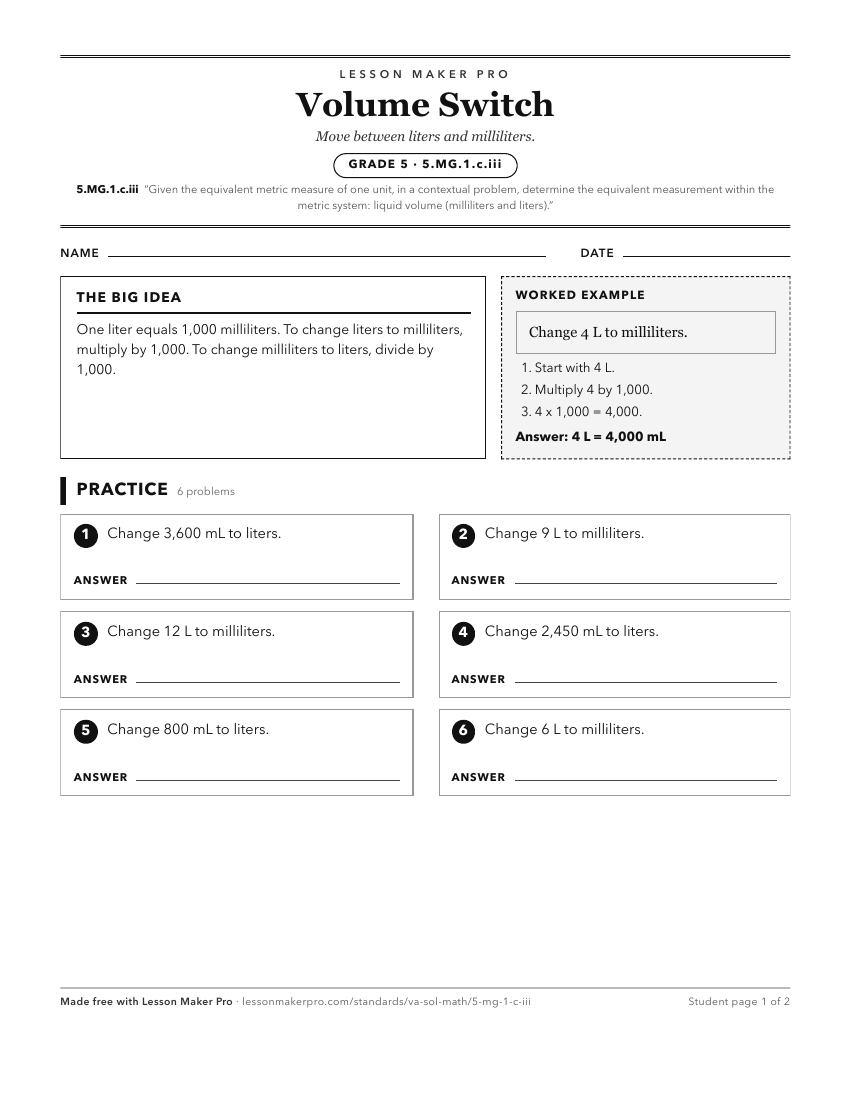
A ready-to-print activity worksheet aligned to 5.MG.1.c.iii, with an answer key for the teacher on its own page. No account needed.
PDF, US Letter, prints cleanly in black and white.
Download the worksheetKeep exploring
Related Standards
Turn this exact standard into a lesson
Grade, subject, topic, and the complete standard are prefilled. Create one free, no account needed.
Also for this standard:Make a WorksheetMake a QuizMake a Sub Lesson