Virginia SOL 1.NS.1
SOL Standard (Knowledge and Skills Cluster)
The student will utilize flexible counting strategies to determine and describe quantities up to 120.
Virginia Standards of Learning for Mathematics
Cluster contents
Knowledge and Skills in This Standard
1.NS.1 is a Standards of Learning standard. These are the knowledge and skills expectations under it.
- 1.NS.1.a
Count forward orally by ones from 0 to 120 starting at any number between 0 and 120.
- 1.NS.1.b
Count backward orally by ones when given any number between 1 and 30.
- 1.NS.1.c
Represent forward counting patterns when counting by groups of 5 and groups of 10 up to 120 using a variety of tools (e.g., objects, coins, 120 chart).
- 1.NS.1.d
Represent forward counting patterns when counting by groups of 2 up to at least 30 using a variety of tools (e.g., beaded number strings, number paths [a prelud...
- 1.NS.1.e
Group a collection of up to 120 objects into tens and ones, and count to determine the total (e.g., 5 groups of ten and 6 ones is equal to 56 total objects).
- 1.NS.1.f
Identify a penny, nickel, and dime by their attributes and describe the number of pennies equivalent to a nickel and a dime.
- 1.NS.1.g
Count by ones, fives, or tens to determine the value of a collection of like coins (pennies, nickels, or dimes), whose total value is 100 cents or less.
Teacher's field guide
What This Cluster Means
What Students Need to Do
- Students count forward from different starting numbers and count backward from numbers through 30. They show patterns for counting by 2s, 5s, and 10s, then organize objects into tens and ones. They identify pennies, nickels, and dimes, explain their values, and count sets of one coin type.
What Mastery Looks Like
- A student can start at 76 and continue accurately without returning to 1, then count backward from 28. The student shows equal jumps on a chart or number path and explains that 6 tens and 4 ones make 64. The student names common coins and finds, for example, that eight nickels are worth 40 cents.
Common Misconceptions
- Students may restart at 1, reverse digits after 100, or skip a number when crossing a decade. They may recite skip-counting patterns without matching each number to an equal group. They often confuse coin size with value, count coins as objects rather than cents, or combine tens and ones incorrectly.
How to Assess It
- Give each student a start card and ask for five numbers forward, then have them count backward from 24. Show 43 counters and seven nickels, then ask students to group and count the objects, name the coin, and find its value.
Lesson moves
Ways to Teach It
Give pairs 57 counters and cups; students make groups of ten, count leftovers, and write the total.
Ask, “How are counting by tens and counting dimes alike?” Students explain with a drawing and one sentence.
Play Number Path Relay: draw a start card, move forward by 2, 5, or 10, and say each landing number.
Set up a class store where students price items under one dollar and pay using only pennies, nickels, or dimes.
Free download
Printable 1.NS.1 Worksheet
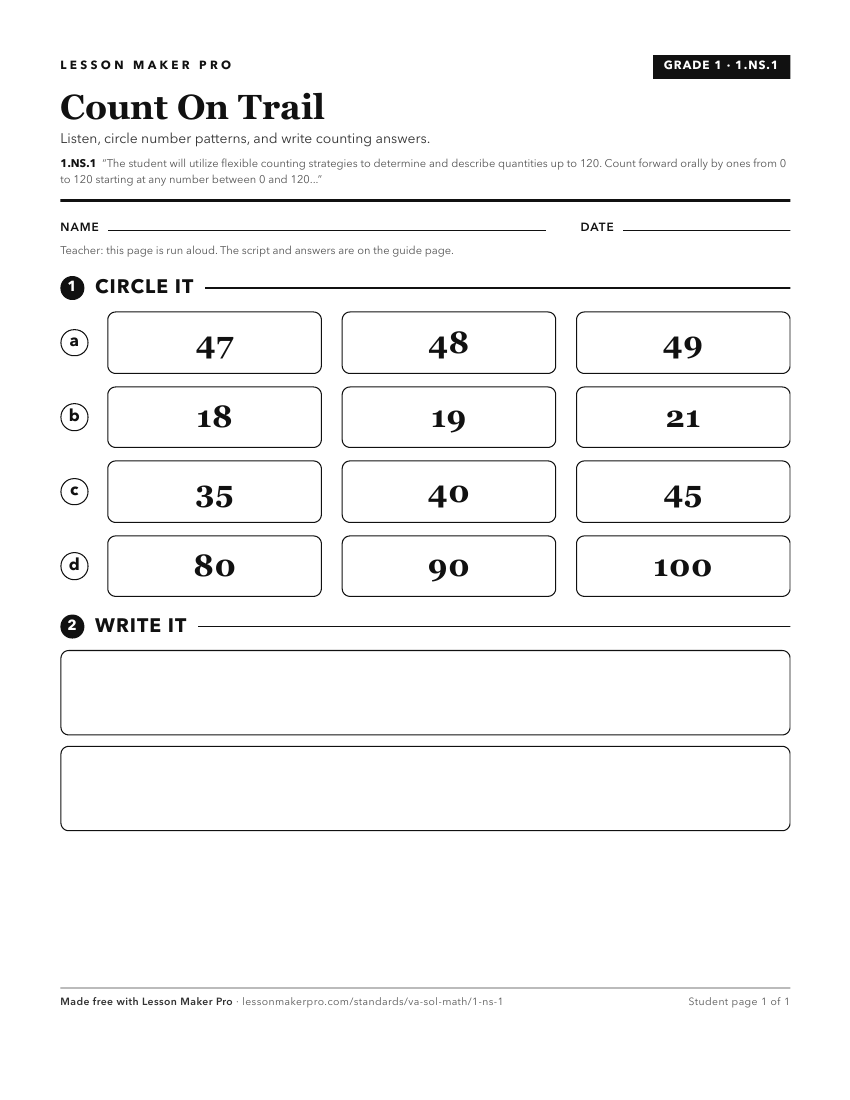
A ready-to-print activity worksheet aligned to 1.NS.1, with an answer key for the teacher on its own page. No account needed.
PDF, US Letter, prints cleanly in black and white.
Download the worksheetKeep exploring
Related Standards
- 2.NS.1
The student will utilize flexible counting strategies to determine and describe quantities up to 200.
- K.NS.1
The student will utilize flexible counting strategies to determine and describe quantities up to 100.
- 1.NS.2
The student will represent, compare, and order quantities up to 120.
- K.NS.2
The student will identify, represent, and compare quantities up to 30.
Turn this cluster into a lesson
Grade, subject, topic, and the complete cluster are prefilled. Create one free, no account needed.
Also for this cluster:Make a WorksheetMake a QuizMake a Sub Lesson