Virginia SOL 2.NS.1
SOL Standard (Knowledge and Skills Cluster)
The student will utilize flexible counting strategies to determine and describe quantities up to 200.
Virginia Standards of Learning for Mathematics
Cluster contents
Knowledge and Skills in This Standard
2.NS.1 is a Standards of Learning standard. These are the knowledge and skills expectations under it.
- 2.NS.1.a
Represent forward counting patterns when counting by groups of 2 up to at least 50, starting at various multiples of 2 and using a variety of tools (e.g., objec...
- 2.NS.1.b
Represent forward counting patterns created when counting by groups of 5s, 10s, and 25s starting at various multiples up to at least 200 using a variety of tool...
- 2.NS.1.c
Describe and use patterns in skip counting by multiples of 2 (to at least 50), and multiples of 5, 10, and 25 (to at least 200) to justify the next number in th...
- 2.NS.1.d
Represent forward counting patterns when counting by groups of 100 up to at least 1,000 starting at 0 using a variety of tools (e.g., objects, number lines, cal...
- 2.NS.1.e
Represent backward counting patterns when counting by groups of 10 from 200 or less using a variety of tools including objects, number lines, calculators, and h...
- 2.NS.1.f
Describe and use patterns in skip counting backwards by 10s (from at least 200) to justify the next number in the counting sequence.
- 2.NS.1.g
Choose a reasonable estimate up to 1,000 when given a contextual problem (e.g., What would be the best estimate for the number of students in our school – 5, 50...
- 2.NS.1.h
Represent even numbers (up to 50) with concrete objects, using two equal groups or two equal addends.
- 2.NS.1.i
Represent odd numbers (up to 50) with concrete objects, using two equal groups with one leftover or two equal addends plus 1.
- 2.NS.1.j
Determine whether a number (up to 50) is even or odd using concrete objects and justify reasoning (e.g., dividing collections of objects into two equal groups, ...
Teacher's field guide
What This Cluster Means
What Students Need to Do
- Students count forward by 2s to 50, by 5s, 10s, and 25s to 200, and by 100s to 1,000. They count backward by 10s from 200 or less and explain how the pattern gives the next number. They choose sensible estimates and use pairs or equal groups to decide whether numbers through 50 are odd or even.
What Mastery Looks Like
- A student can start at a given multiple, continue the count, and show it with counters, a number line, or a chart. They can describe digit patterns and use them to predict the next number. They can defend an estimate and prove odd or even by making pairs, equal groups, or equal addends.
Common Misconceptions
- Some students restart at zero instead of continuing from the given number, or change the ones digit when counting by 10. They may treat counting backward by 10 as subtracting 1. They may call 15 even because it appears when counting by 5s, or accept two unequal groups as equal.
How to Assess It
- Exit ticket: Complete 50, 75, __, __ and 160, 150, __, __. Then label 27 odd or even, draw pairs to prove it, and choose 5, 50, or 500 as a sensible school enrollment estimate.
Lesson moves
Ways to Teach It
Give students up to 50 counters; they make pairs, label the total odd or even, and record two equal addends when possible.
Ask students to explain what changes and what stays the same in 125, 150, 175, 200, then predict the next number.
Students draw start and step cards, then move forward by 2, 5, 10, 25, or 100, or backward by 10.
Show a photo of a school assembly; students choose 50, 200, or 800 attendees and defend the estimate using visible groups.
Free download
Printable 2.NS.1 Worksheet
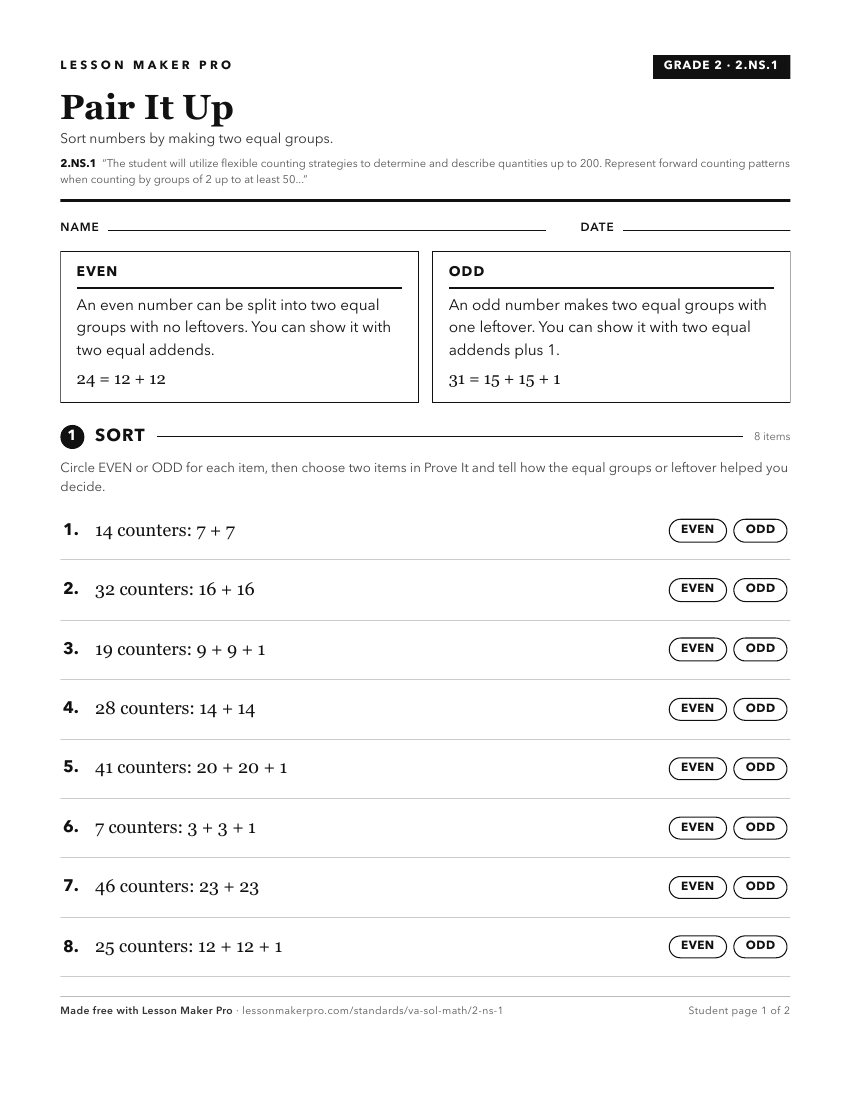
A ready-to-print activity worksheet aligned to 2.NS.1, with an answer key for the teacher on its own page. No account needed.
PDF, US Letter, prints cleanly in black and white.
Download the worksheetKeep exploring
Related Standards
- K.NS.1
The student will utilize flexible counting strategies to determine and describe quantities up to 100.
- 2.NS.4
The student will solve problems that involve counting and representing money amounts up to $2.00.
- 1.NS.1
The student will utilize flexible counting strategies to determine and describe quantities up to 120.
- K.NS.2
The student will identify, represent, and compare quantities up to 30.
Turn this cluster into a lesson
Grade, subject, topic, and the complete cluster are prefilled. Create one free, no account needed.
Also for this cluster:Make a WorksheetMake a QuizMake a Sub Lesson