Virginia SOL 2.NS.1.j
The Standard
Determine whether a number (up to 50) is even or odd using concrete objects and justify reasoning (e.g., dividing collections of objects into two equal groups, pairing objects).
Virginia Standards of Learning for Mathematics · The student will utilize flexible counting strategies to determine and describe quantities up to 200.
Teacher's field guide
What This Standard Means
What Students Need to Do
- Students arrange up to 50 objects into pairs or place them into two equal groups. They decide whether the number is even or odd and explain what the objects show.
What Mastery Looks Like
- A student can use counters to test any number through 50. The student correctly labels it even or odd and explains whether every object has a partner or the groups are equal.
Common Misconceptions
- Students may think odd numbers are larger or less common than even numbers. They may call a number even when most objects pair up but one object remains.
How to Assess It
- Give each student 17 counters and two paper plates. Ask, “Is 17 even or odd? Show two equal groups or pairs, then explain your answer.”
Lesson moves
Ways to Teach It
Give pairs counters and two paper plates, then call out numbers for students to build, split equally, and label even or odd.
Ask students to write: “I know 23 is odd because…” and support the claim with a labeled drawing of paired dots.
Play Pair It: students draw number cards through 50, pair that many cubes, and keep each card they classify correctly.
Count classroom items, such as chairs or pencils, then decide whether each amount can be shared equally between two students.
Free download
Printable 2.NS.1.j Worksheet
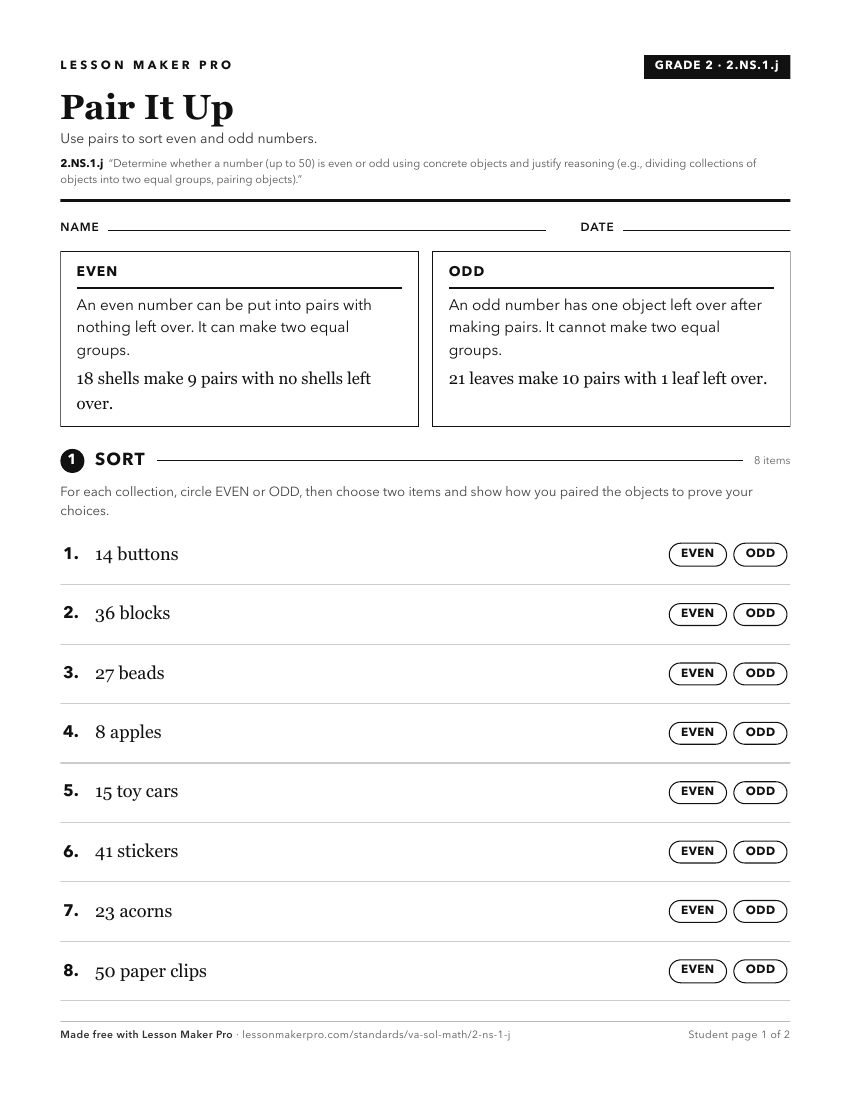
A ready-to-print activity worksheet aligned to 2.NS.1.j, with an answer key for the teacher on its own page. No account needed.
PDF, US Letter, prints cleanly in black and white.
Download the worksheetKeep exploring
Related Standards
- 2.NS.2.g
Compare two whole numbers, each 999 or less, represented concretely, pictorially, or symbolically, using words (greater than, less than, or equal to) and symbol...
- K.CE.1.d
Use objects, drawings, words, or numbers to compose and decompose numbers less than or equal to 10 in multiple ways.
- 2.NS.1.h
Represent even numbers (up to 50) with concrete objects, using two equal groups or two equal addends.
- 2.NS.1.i
Represent odd numbers (up to 50) with concrete objects, using two equal groups with one leftover or two equal addends plus 1.
Turn this exact standard into a lesson
Grade, subject, topic, and the complete standard are prefilled. Create one free, no account needed.
Also for this standard:Make a WorksheetMake a QuizMake a Sub Lesson