Virginia SOL 1.NS.2
SOL Standard (Knowledge and Skills Cluster)
The student will represent, compare, and order quantities up to 120.
Virginia Standards of Learning for Mathematics
Cluster contents
Knowledge and Skills in This Standard
1.NS.2 is a Standards of Learning standard. These are the knowledge and skills expectations under it.
- 1.NS.2.a
Read and write numerals 0-120 in sequence and out of sequence.
- 1.NS.2.b
Estimate the number of objects (up to 120) in a given collection and justify the reasonableness of an answer.
- 1.NS.2.c
Create a concrete or pictorial representation of a number using tens and ones and write the corresponding numeral up to 120 (e.g., 47 can be represented as 47 o...
- 1.NS.2.d
Describe the number of groups of tens and ones when given a two-digit number and justify reasoning.
- 1.NS.2.e
Compare two numbers between 0 and 120 represented pictorially or with concrete objects using the terms greater than, less than, or equal to.
- 1.NS.2.f
Order three sets, each set containing up to 120 objects, from least to greatest, and greatest to least.
Teacher's field guide
What This Cluster Means
What Students Need to Do
- Students connect numerals to collections and show numbers with groups of ten and leftover ones. They read and write numbers through 120, estimate collections, compare two quantities, and order three quantities. They explain how their models or estimates support their answers.
What Mastery Looks Like
- A student can build, draw, and label 73 as 7 tens and 3 ones. The student names missing or shuffled numerals, makes a sensible estimate, and uses comparison words correctly. Given three collections, the student orders them both ways and explains the choice.
Common Misconceptions
- Students may reverse digits, writing 41 for 14, or assume the digit with the greater value always makes the greater number. Some count a tens rod as one instead of ten or do not understand that ten loose objects can be regrouped. When estimating, students may guess without using visible groups or compare collections by object size rather than quantity.
How to Assess It
- Show 6 tens and 4 ones, along with collections of 58 and 71 dots. Ask students to write the modeled number, compare it with 58, order all three numbers, and estimate a separate dot collection with a reason.
Lesson moves
Ways to Teach It
Give pairs 120 counters and cups; call a number, then have students group tens, leave ones loose, and label the model.
Display a jar of linking cubes and ask, “What is your estimate, and what visible groups make it reasonable?”
Play Number Line Relay: teams place three numeral cards from least to greatest, then reverse them and explain one comparison.
Count library books for a class shelf, bundle tally marks into tens, record leftover ones, and compare totals from two shelves.
Free download
Printable 1.NS.2 Worksheet
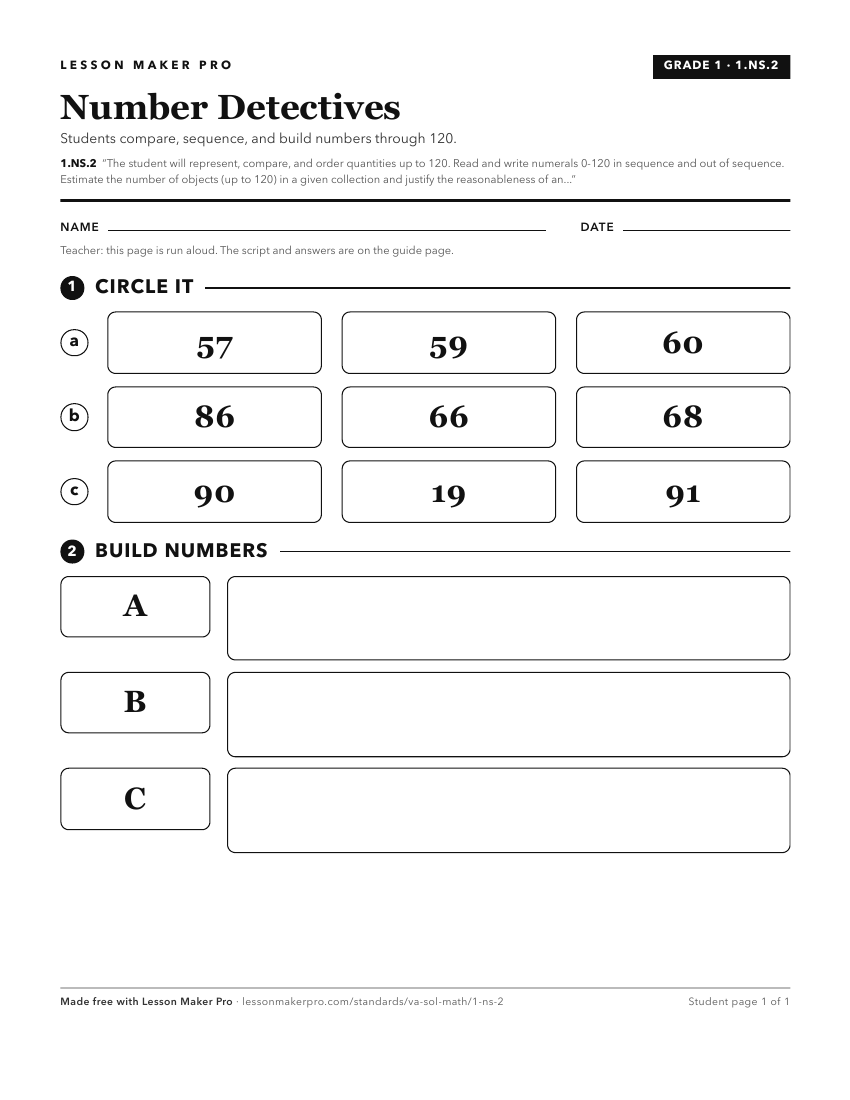
A ready-to-print activity worksheet aligned to 1.NS.2, with an answer key for the teacher on its own page. No account needed.
PDF, US Letter, prints cleanly in black and white.
Download the worksheetKeep exploring
Related Standards
- 2.NS.1
The student will utilize flexible counting strategies to determine and describe quantities up to 200.
- K.NS.1
The student will utilize flexible counting strategies to determine and describe quantities up to 100.
- 1.NS.1
The student will utilize flexible counting strategies to determine and describe quantities up to 120.
- K.NS.2
The student will identify, represent, and compare quantities up to 30.
Turn this cluster into a lesson
Grade, subject, topic, and the complete cluster are prefilled. Create one free, no account needed.
Also for this cluster:Make a WorksheetMake a QuizMake a Sub Lesson