Virginia SOL 1.NS.2.b
The Standard
Estimate the number of objects (up to 120) in a given collection and justify the reasonableness of an answer.
Virginia Standards of Learning for Mathematics · The student will represent, compare, and order quantities up to 120.
Teacher's field guide
What This Standard Means
What Students Need to Do
- Students look at a collection and make a sensible estimate without counting every object first. They explain their thinking using groups, benchmarks, or comparisons.
What Mastery Looks Like
- A student gives an estimate that is reasonably close to the actual amount. The student supports it by naming groups of ten, a known benchmark, or a useful comparison.
Common Misconceptions
- Students may think an estimate must match the exact count. They may guess without using visible groups, or explain that an answer is reasonable only because it looks right.
How to Assess It
- Show 64 counters on a tray for five seconds. Ask students to record an estimate and finish, "My estimate is reasonable because..."
Lesson moves
Ways to Teach It
Fill clear cups with different amounts of counters, then have students estimate, group by tens, and compare each estimate with the count.
Show 87 dots and ask, "Is 40, 80, or 110 the best estimate, and what do you notice?"
Play Estimate Match by pairing collection cards with number cards, then award a point when students explain each match using tens.
Estimate how many books are on a classroom shelf, explain the estimate, then count them in groups of ten to check.
Free download
Printable 1.NS.2.b Worksheet
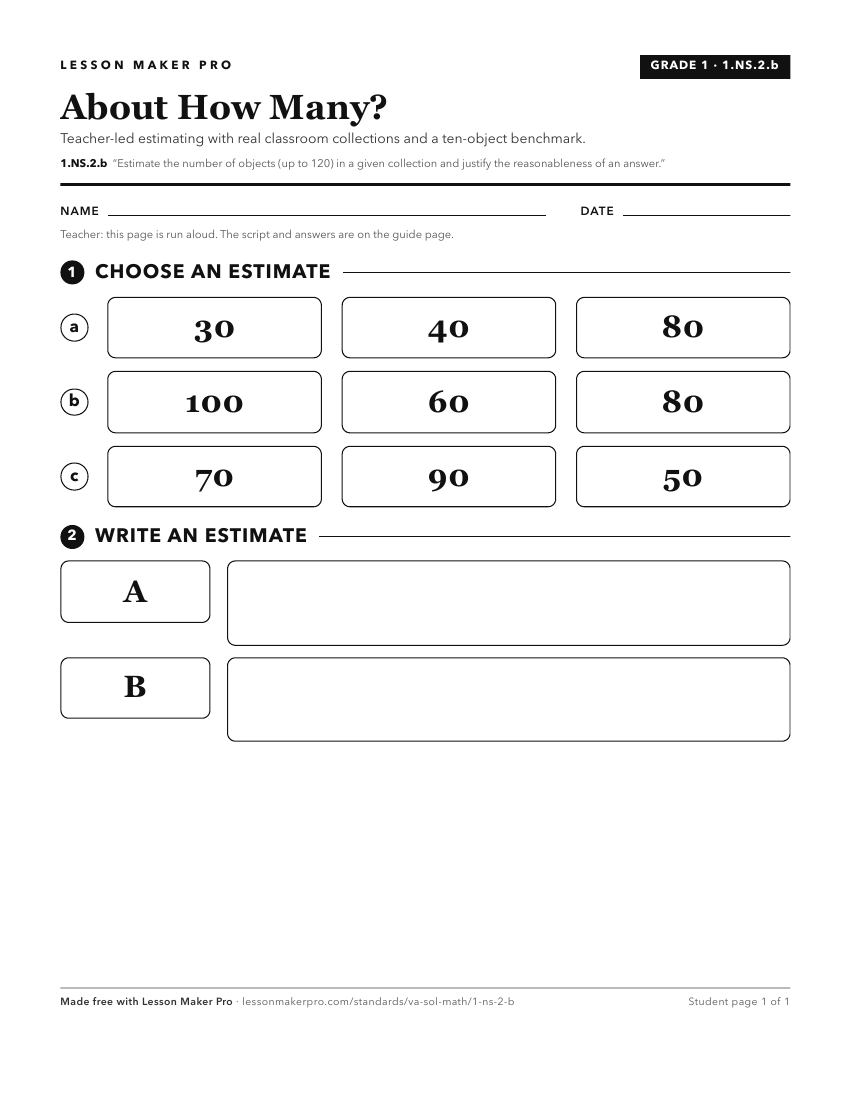
A ready-to-print activity worksheet aligned to 1.NS.2.b, with an answer key for the teacher on its own page. No account needed.
PDF, US Letter, prints cleanly in black and white.
Download the worksheetKeep exploring
Related Standards
- K.NS.2.c
Determine and write the numeral that corresponds to the total number of objects in a given set of 30 or fewer concrete objects or pictorial models.
- 2.NS.1.g
Choose a reasonable estimate up to 1,000 when given a contextual problem (e.g., What would be the best estimate for the number of students in our school – 5, 50...
- 1.NS.1.e
Group a collection of up to 120 objects into tens and ones, and count to determine the total (e.g., 5 groups of ten and 6 ones is equal to 56 total objects).
- K.NS.1.a
Use one-to-one correspondence to determine how many are in a given set containing 30 or fewer concrete objects (e.g., cubes, pennies, balls), and describe the l...
Turn this exact standard into a lesson
Grade, subject, topic, and the complete standard are prefilled. Create one free, no account needed.
Also for this standard:Make a WorksheetMake a QuizMake a Sub Lesson