Virginia SOL K.NS.1.a
The Standard
Use one-to-one correspondence to determine how many are in a given set containing 30 or fewer concrete objects (e.g., cubes, pennies, balls), and describe the last number named as the total number of objects counted.
Virginia Standards of Learning for Mathematics · The student will utilize flexible counting strategies to determine and describe quantities up to 100.
Teacher's field guide
What This Standard Means
What Students Need to Do
- Students match one number word to each object as they count sets of up to 30. They tell how many objects are present using the final number said.
What Mastery Looks Like
- A student can accurately count up to 30 objects, even when they are scattered. The student touches or moves each object once and states that the final number tells the total.
Common Misconceptions
- Students may skip objects, count an object twice, or say number words without matching them to objects. Some recount the set when asked how many. Others think rearranging the objects changes the total.
How to Assess It
- Give each student 27 counters and say, “Count these. Tell me how many there are and show how you counted each one once.”
Lesson moves
Ways to Teach It
Give pairs 24 counters and a counting mat; one student moves each counter into a box while the partner says the numbers.
Show 17 dots and ask, “How can you count each dot once, and what does the last number tell you?”
Play Count and Cover: students draw a card, count that many cubes onto a strip, then check with a partner.
Count 30 classroom items, such as crayons or books, to decide whether there are enough for everyone.
Free download
Printable K.NS.1.a Worksheet
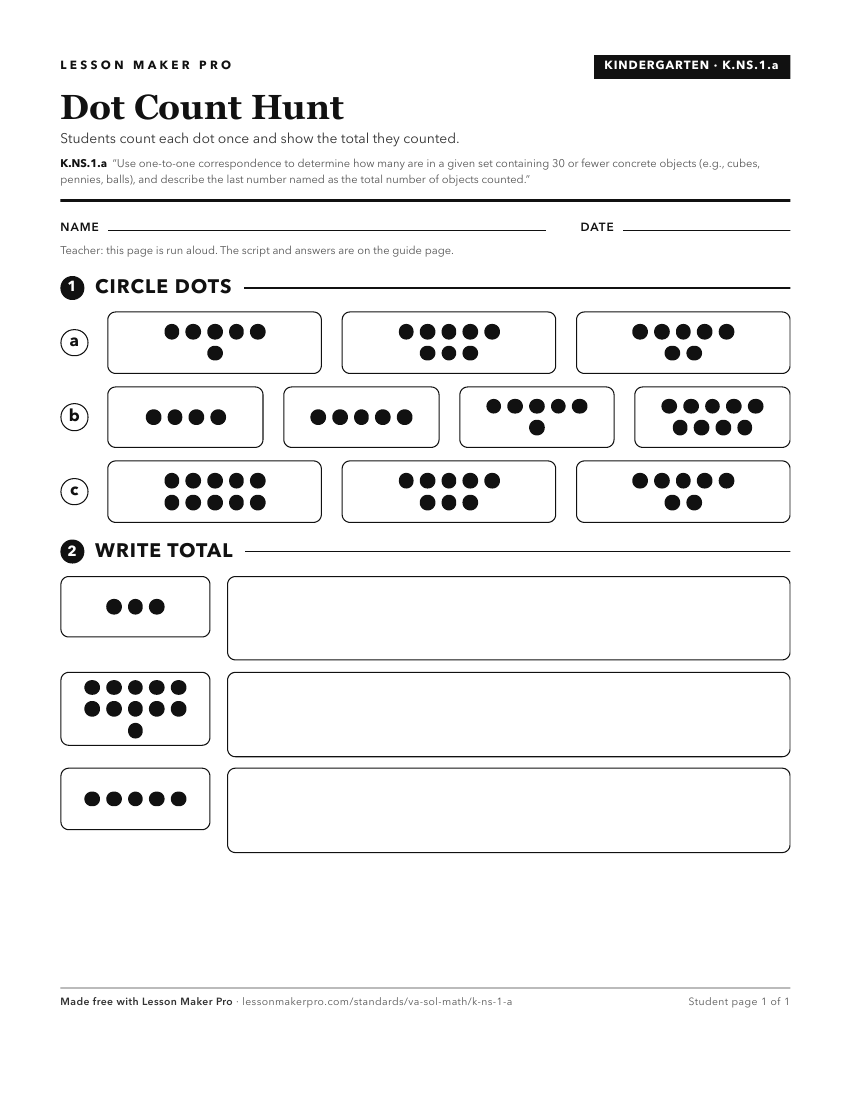
A ready-to-print activity worksheet aligned to K.NS.1.a, with an answer key for the teacher on its own page. No account needed.
PDF, US Letter, prints cleanly in black and white.
Download the worksheetKeep exploring
Related Standards
- K.NS.2.c
Determine and write the numeral that corresponds to the total number of objects in a given set of 30 or fewer concrete objects or pictorial models.
- K.NS.2.e
Given a numeral up to 30, construct a set which has more, fewer, or the same number of objects using concrete or pictorial models.
- K.NS.1.j
Group a collection of up to 100 objects (e.g., counters, pennies, cubes) into sets of ten and count by tens to determine the total (e.g., there are 3 groups of ...
- K.NS.2.d
Given a set of up to 30 objects, construct another set which has more, fewer, or the same number of objects using concrete or pictorial models.
Turn this exact standard into a lesson
Grade, subject, topic, and the complete standard are prefilled. Create one free, no account needed.
Also for this standard:Make a WorksheetMake a QuizMake a Sub Lesson