Virginia SOL 1.NS.1.f
The Standard
Identify a penny, nickel, and dime by their attributes and describe the number of pennies equivalent to a nickel and a dime.
Virginia Standards of Learning for Mathematics · The student will utilize flexible counting strategies to determine and describe quantities up to 120.
Teacher's field guide
What This Standard Means
What Students Need to Do
- Students identify a penny, nickel, and dime by features such as color, size, pictures, words, and value. They explain that one nickel has the same value as five pennies and one dime has the same value as ten pennies.
What Mastery Looks Like
- Students correctly name pennies, nickels, and dimes from either side and describe visible features such as color, size, words, and images. They show that five pennies equal one nickel and ten pennies equal one dime.
Common Misconceptions
- Students may assume a larger coin has greater value, so they think a nickel is worth more than a dime. They may confuse coin names or think five pennies equal five cents without connecting that amount to one nickel.
How to Assess It
- Give students pictures of a penny, nickel, and dime. Ask them to label each coin, then draw the pennies equal to one nickel and one dime.
Lesson moves
Ways to Teach It
Give pairs mixed coins and sorting mats, then have them sort pennies, nickels, and dimes and explain each choice.
Show a nickel and dime, then ask, "Why is the smaller coin worth more?" Students answer with pictures and words.
Play Coin Match Memory using coin picture cards, name cards, and penny-equivalent cards such as five pennies and ten pennies.
Set up a class store with five-cent and ten-cent items, and have students pay using pennies, nickels, or dimes.
Free download
Printable 1.NS.1.f Worksheet
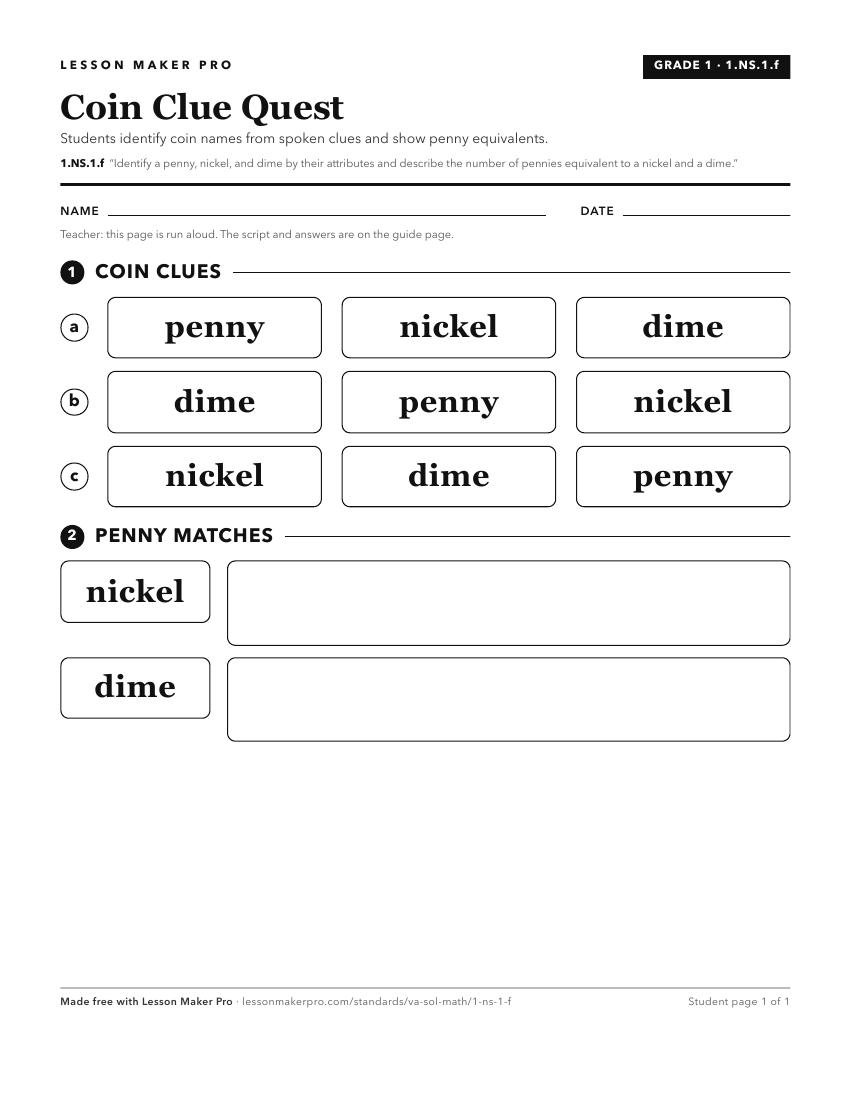
A ready-to-print activity worksheet aligned to 1.NS.1.f, with an answer key for the teacher on its own page. No account needed.
PDF, US Letter, prints cleanly in black and white.
Download the worksheetKeep exploring
Related Standards
- 1.NS.1.g
Count by ones, fives, or tens to determine the value of a collection of like coins (pennies, nickels, or dimes), whose total value is 100 cents or less.
- 2.NS.4.a
Identify a quarter and its value and determine multiple ways to represent the value of a quarter using pennies, nickels, and/or dimes.
- 2.NS.4.d
Represent the value of a collection of coins and one-dollar bills (limited to $2.00 or less) using the cent (¢) and dollar ($) symbols and decimal point (.).
- 2.NS.4.b
Count by ones, fives, tens, and twenty-fives to determine the value of a collection of mixed coins and one-dollar bills whose total value is $2.00 or less.
Turn this exact standard into a lesson
Grade, subject, topic, and the complete standard are prefilled. Create one free, no account needed.
Also for this standard:Make a WorksheetMake a QuizMake a Sub Lesson