Virginia SOL 4.RV
SOL Standard (Knowledge and Skills Cluster)
The student will systematically build vocabulary and word knowledge based on gradefour content and texts.
Virginia Standards of Learning for English
Cluster contents
Knowledge and Skills in This Standard
4.RV is a Standards of Learning standard. These are the knowledge and skills expectations under it.
- 4.RV.1
Vocabulary Development and Word Analysis
- 4.RV.1.A
Develop general academic language and content specific vocabulary by listening to, reading, and discussing a variety of texts relevant to a grade four topic or ...
- 4.RV.1.B
Discuss meanings of complex words and phrases acquired through conversations and literature.
- 4.RV.1.C
Determine the meaning of complex words using frequently occurring root words and inflectional affixes (e.g. -s, -ing, -ed).
- 4.RV.1.D
Use the context of a sentence to apply knowledge of homophones.
- 4.RV.1.E
Apply knowledge of morphology, synonyms, and antonyms to determine the meaning of complex words.
- 4.RV.1.F
Develop breadth of vocabulary knowledge by listening to and reading high quality, complex text.
- 4.RV.1.G
Distinguish shades of meaning among verbs and adjectives.
- 4.RV.1.H
Use strategies to infer word meanings.
- 4.RV.1.I
Use glossaries,beginning dictionaries, and thesauruses, both print and digital, to determine or clarify the meaning of words and phrases.
- 4.RV.1.J
Use newly learned words and phrases in discussions and speaking activities.
Teacher's field guide
What This Cluster Means
What Students Need to Do
- Students work out unfamiliar words by using sentence clues, word parts, word relationships, and reference tools. They compare close meanings among verbs and adjectives. They use new academic and subject words when speaking and writing.
What Mastery Looks Like
- A student can infer an unfamiliar word’s meaning and explain which clues helped. The student can use roots, endings, synonyms, antonyms, and reference tools to confirm the meaning. New words appear correctly in discussion and writing.
Common Misconceptions
- Students may choose a familiar definition without checking whether it fits the sentence. They may confuse homophones, treat similar words as exact matches, or overlook how endings change meaning. Some rely on a dictionary before trying context clues or word parts.
How to Assess It
- Give students: “The hikers trudged up the steep trail, moving slowly under their heavy packs.” Ask them to define “trudged,” underline a clue, name a synonym, and use the word in a new sentence.
Lesson moves
Ways to Teach It
Sort root, prefix, suffix, and ending cards to build words, then write each word’s meaning on a sticky note.
Read a short paragraph and discuss: Which word best shows the character’s feeling, and what weaker or stronger word could replace it?
Play Context Clue Bingo by matching sentence cards to possible meanings, then require players to explain the clue before covering a square.
Examine a weather report, define five subject words using context and a digital glossary, then use them in a spoken forecast.
Free download
Printable 4.RV Worksheet
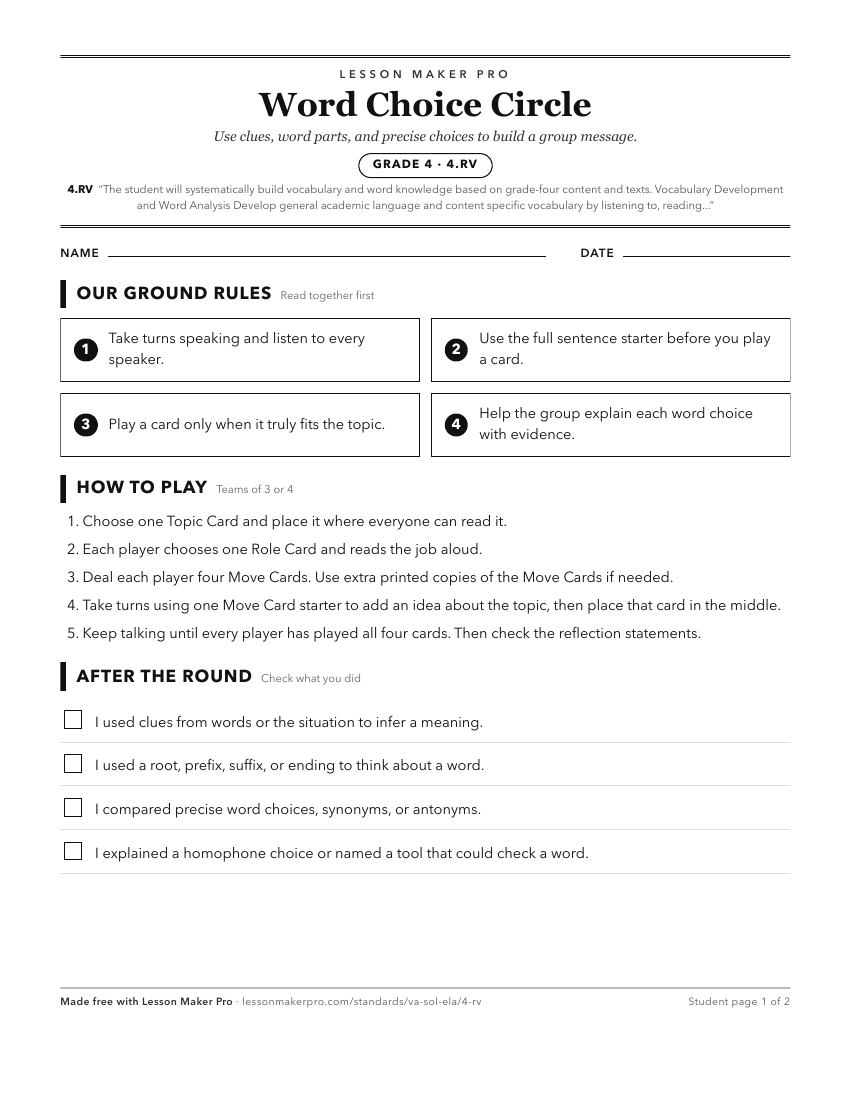
A ready-to-print activity worksheet aligned to 4.RV, with an answer key for the teacher on its own page. No account needed.
PDF, US Letter, prints cleanly in black and white.
Download the worksheetKeep exploring
Related Standards
- 2.RV
The student will systematically build vocabulary and word knowledge based on gradetwo content and texts heard or read.
- 5.RV
The student will systematically build vocabulary and word knowledge based on gradefive content and texts.
- 8.RV
The student will systematically build vocabulary and word knowledge based on grade eight content and texts.
- 3.RV
The student will systematically build vocabulary and word knowledge based on gradethree content and texts read or heard.
Turn this cluster into a lesson
Grade, subject, topic, and the complete cluster are prefilled. Create one free, no account needed.
Also for this cluster:Make a WorksheetMake a QuizMake a Sub Lesson