Texas TEKS 8.7
TEKS Knowledge Statement (Expectation Cluster)
History. The student understands how political, economic, and social factors led to the growth of sectionalism and the Civil War. The student is expected to: analyze the impact of tariff policies on sections of the United States before the Civil War; compare the effects of political, economic, and social factors on slaves and free Blacks; analyze the impact of the Fugitive Slave Act of 1850 on slavery, free Blacks, and abolitionists; analyze the impact of slavery on different sections of the United States; and identify the provisions and compare the effects of congressional conflicts and compromises prior to the Civil War, including the role of John Quincy Adams.
Texas Essential Knowledge and Skills for Social Studies
Cluster contents
Student Expectations in This Statement
8.7 is a TEKS knowledge and skills statement. These are the student expectations under it.
- 8.7.A
analyze the impact of tariff policies on sections of the United States before the Civil War
- 8.7.B
compare the effects of political, economic, and social factors on slaves and free Blacks
- 8.7.C
analyze the impact of the Fugitive Slave Act of 1850 on slavery, free Blacks, and abolitionists
- 8.7.D
analyze the impact of slavery on different sections of the United States
- 8.7.E
identify the provisions and compare the effects of congressional conflicts and compromises prior to the Civil War, including the role of John Quincy Adams.
Teacher's field guide
What This Cluster Means
What Students Need to Do
- Students trace how tariffs, slavery, labor systems, and political disputes affected the North, South, and West differently. They compare impacts on enslaved people, free Black people, and abolitionists, especially after the Fugitive Slave Act. They explain major congressional compromises and John Quincy Adams's opposition to the House gag rule.
What Mastery Looks Like
- A student can use maps, laws, speeches, or data to explain why one policy helped some groups and harmed others. The student connects each compromise to its provisions and short-term effects, then explains how repeated disputes deepened sectionalism. Claims about slavery and Black life include specific evidence.
Common Misconceptions
- Students often list tariffs and compromises without connecting them to slavery, western expansion, and sectional political power. They may assume every Northerner opposed slavery or that free Black people were safe from capture under the Fugitive Slave Act. They also confuse compromise provisions with outcomes and overlook John Quincy Adams's fight against the House gag rule.
How to Assess It
- Give an exit ticket: "Choose tariffs, the Fugitive Slave Act, or one congressional compromise, then explain how it affected two sections or groups differently using two specific facts."
Lesson moves
Ways to Teach It
Place tariff, labor, slavery, and compromise cards on a North, South, and West map, then connect each card to one sectional response.
Write a three-voice response from an enslaved person, a free Black person, and an abolitionist reacting to the Fugitive Slave Act.
Match compromise cards to their provisions and effects, then challenge a partner to explain how each changed sectional power.
Use a mock store receipt to calculate prices before and after a tariff, then write Northern and Southern customer reactions.
Free download
Printable 8.7 Worksheet
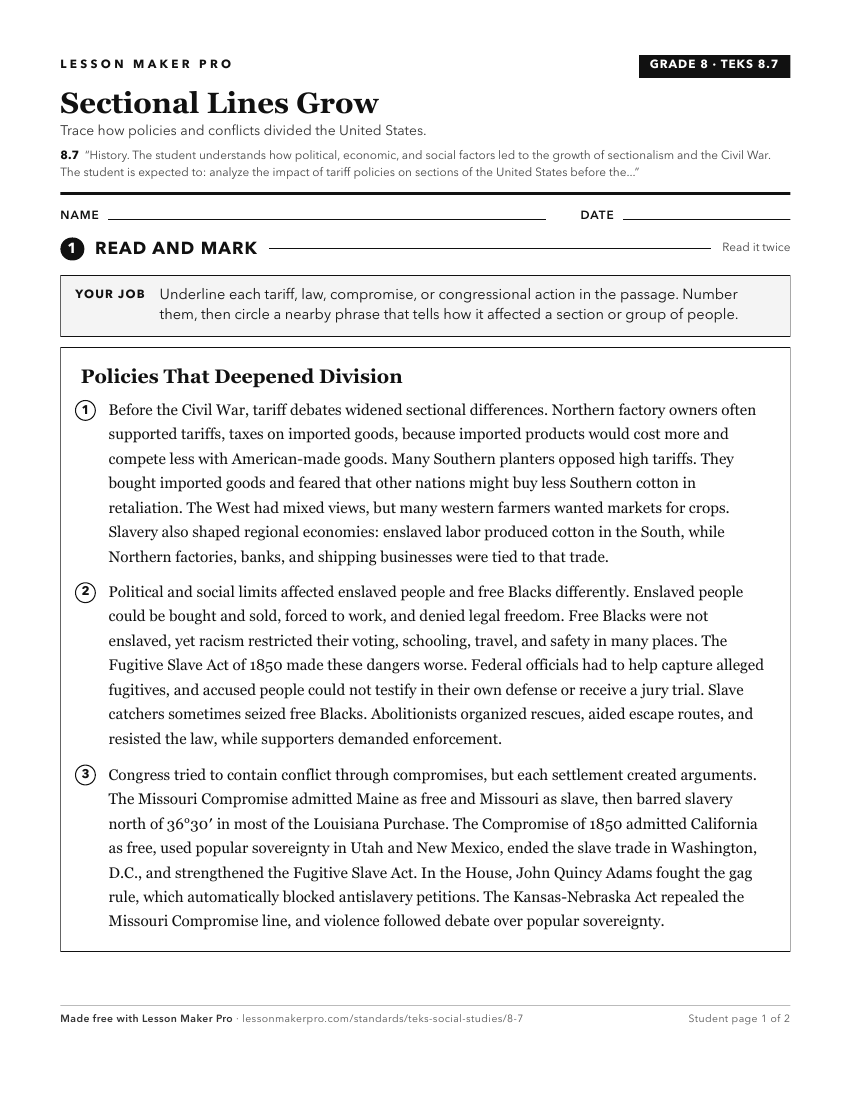
A ready-to-print activity worksheet aligned to 8.7, with an answer key for the teacher on its own page. No account needed.
PDF, US Letter, prints cleanly in black and white.
Download the worksheetKeep exploring
Related Standards
- 8.9
History. The student understands the effects of Reconstruction on the political, economic, and social life of the nation. The student is expected to:
- 7.5
History. The student understands how events and issues shaped the history of Texas during the Civil War and Reconstruction. The student is expected to:
- 8.8
History. The student understands individuals, issues, and events of the Civil War. The student is expected to:
- 8.6
History. The student understands westward expansion and its effects on the political, economic, and social development of the nation. The student is expected to...
Turn this cluster into a lesson
Grade, subject, topic, and the complete cluster are prefilled. Create one free, no account needed.
Also for this cluster:Make a WorksheetMake a QuizMake a Sub Lesson