Texas TEKS 8.7.E
The Standard
- 8.7
- History. The student understands how political, economic, and social factors led to the growth of sectionalism and the Civil War. The student is expected to:
identify the provisions and compare the effects of congressional conflicts and compromises prior to the Civil War, including the role of John Quincy Adams.
Texas Essential Knowledge and Skills for Social Studies
Teacher's field guide
What This Standard Means
What Students Need to Do
- Students identify the main terms of major congressional compromises and disputes over slavery. They compare short-term settlements with long-term effects and explain John Quincy Adams's opposition to the gag rule.
What Mastery Looks Like
- Students can match each measure with its provisions, date, and effect on sectional tensions. They can explain that Adams defended antislavery petitions while serving in Congress, not while serving as president.
Common Misconceptions
- Students may think the compromises ended the slavery debate rather than delayed or deepened it. They may think the gag rule banned slavery or all debate. Some confuse Adams's congressional actions with his presidency.
How to Assess It
- Exit ticket: For the Missouri Compromise and Compromise of 1850, list one provision and one effect. Then explain Adams's fight against the gag rule.
Lesson moves
Ways to Teach It
Give pairs provision, event, and effect cards to match for the Missouri Compromise, gag rule, Compromise of 1850, and Kansas-Nebraska Act.
Write six sentences answering: Which congressional action delayed sectional conflict, and which deepened it? Use two named provisions as evidence.
Play a timeline relay where teams place event cards, state one provision, and earn a point only after naming an effect.
Draft a school board compromise over a disputed policy, then label its short-term settlement and possible long-term conflict before comparing it with 1850.
Free download
Printable 8.7.E Worksheet
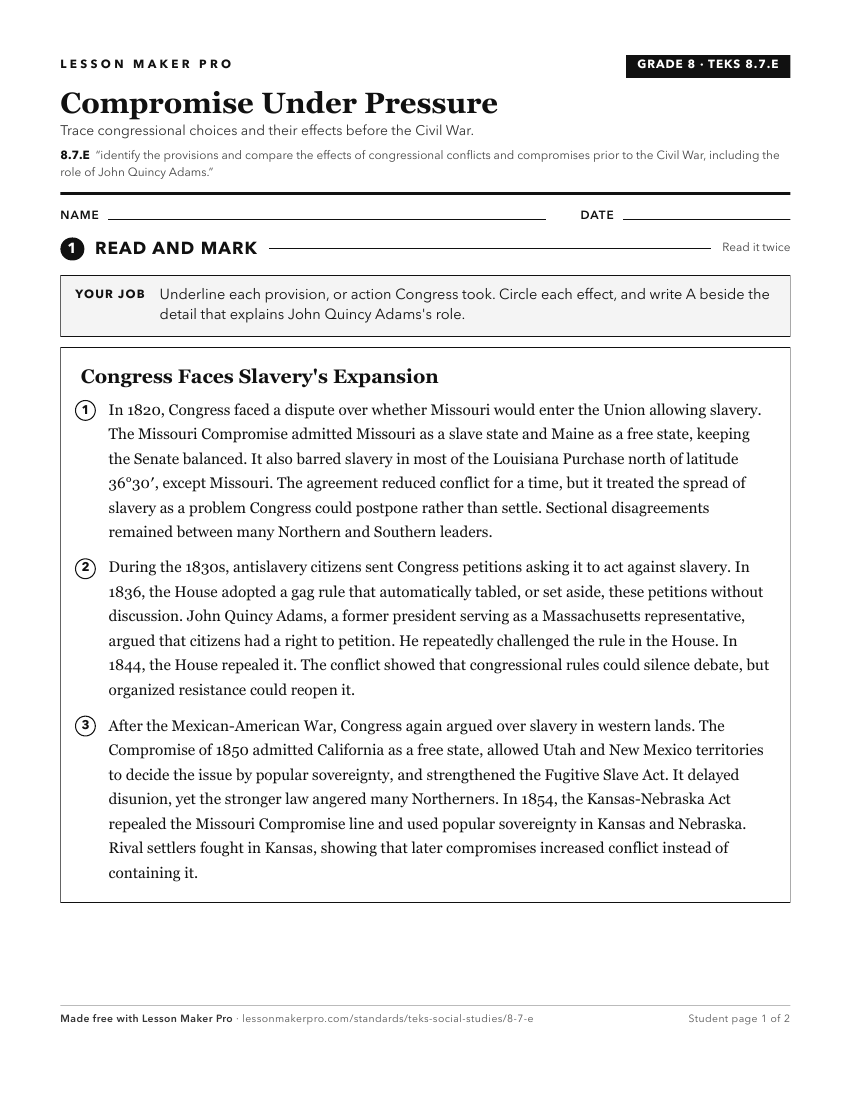
A ready-to-print activity worksheet aligned to 8.7.E, with an answer key for the teacher on its own page. No account needed.
PDF, US Letter, prints cleanly in black and white.
Download the worksheetKeep exploring
Related Standards
- 8.17.B
explain constitutional issues arising over the issue of states' rights, including the Nullification Crisis and the Civil War.
- 5.4.E
explain the effects of the Civil War, including Reconstruction and the 13th, 14th, and 15th amendments to the U.S. Constitution
- 8.4.D
analyze the issues of the Constitutional Convention of 1787, including the Great Compromise and the Three-Fifths Compromise.
- 8.7.A
analyze the impact of tariff policies on sections of the United States before the Civil War
Turn this exact standard into a lesson
Grade, subject, topic, and the complete standard are prefilled. Create one free, no account needed.
Also for this standard:Make a WorksheetMake a QuizMake a Sub Lesson