Texas TEKS 8.17.B
The Standard
- 8.17
- Government. The student understands the dynamic nature of the powers of the national government and state governments in a federal system. The student is expected to:
explain constitutional issues arising over the issue of states' rights, including the Nullification Crisis and the Civil War.
Texas Essential Knowledge and Skills for Social Studies
Teacher's field guide
What This Standard Means
What Students Need to Do
- Students explain how disputes over federal and state power shaped the Nullification Crisis and the Civil War. They connect each conflict to constitutional arguments, key actions, and consequences.
What Mastery Looks Like
- A student can compare South Carolina’s nullification claim with the federal government’s claim of constitutional supremacy. The student can explain how secession arguments, slavery, and federal authority contributed to the Civil War.
Common Misconceptions
- Students often treat nullification and secession as the same action. They may describe the Civil War as a vague states’ rights dispute without naming slavery or explaining the claimed state power.
How to Assess It
- Exit ticket: In four sentences, explain one constitutional dispute from each conflict, then identify one key difference between nullification and secession.
Lesson moves
Ways to Teach It
Give pairs tariff, nullification, Force Bill, secession, and federal response cards, then have them build and defend a two-event cause-and-effect timeline.
Ask, “Can a state reject a federal law it considers unconstitutional?” Students answer using the Supremacy Clause and one historical example.
Run a claim-sort game where teams label statements as federal supremacy, nullification, secession, or compromise, then correct one misplaced claim.
Use a current federal-state policy conflict, such as marijuana law, to compare modern legal challenges with nullification and secession claims.
Free download
Printable 8.17.B Worksheet
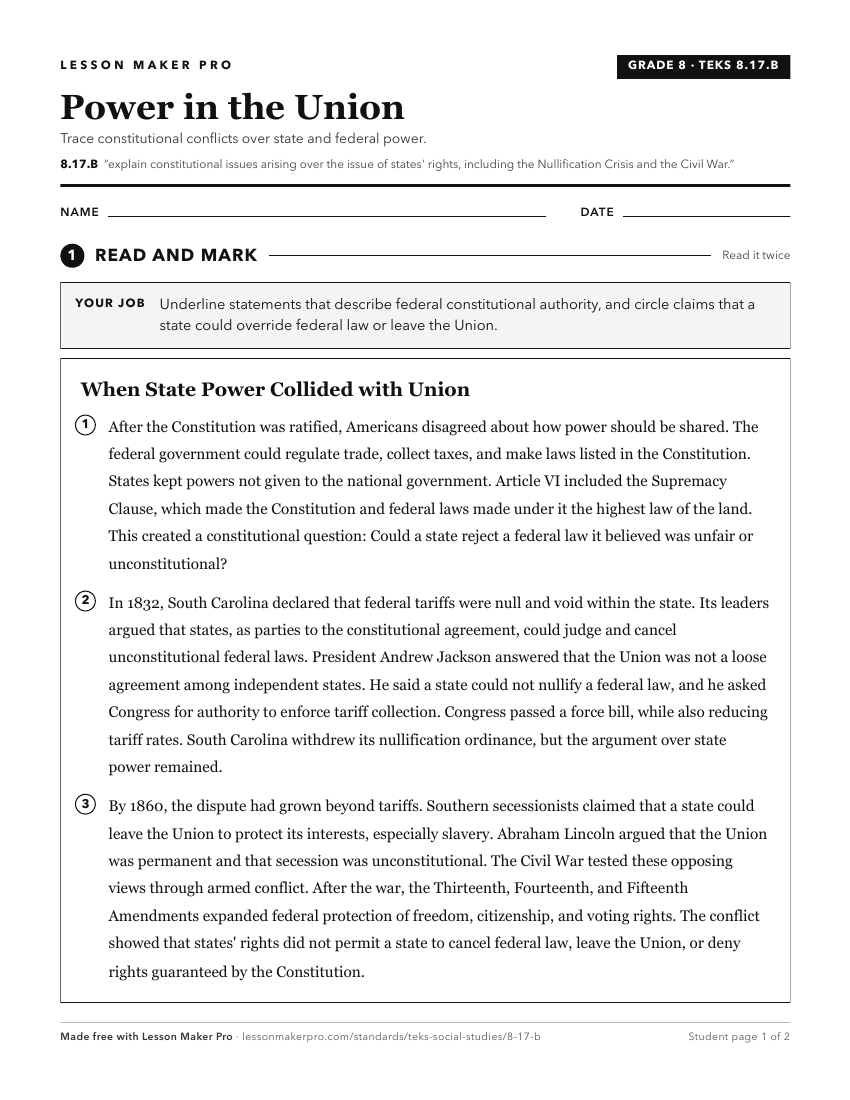
A ready-to-print activity worksheet aligned to 8.17.B, with an answer key for the teacher on its own page. No account needed.
PDF, US Letter, prints cleanly in black and white.
Download the worksheetKeep exploring
Related Standards
- 5.4.E
explain the effects of the Civil War, including Reconstruction and the 13th, 14th, and 15th amendments to the U.S. Constitution
- 8.8.B
explain the central role of the expansion of slavery in causing sectionalism, disagreement over states' rights, and the Civil War
- 5.4.D
explain the central role of the expansion of slavery in causing sectionalism, disagreement over states' rights, and the Civil War
- 8.15.D
analyze how the U.S. Constitution reflects the principles of limited government, republicanism, checks and balances, federalism, separation of powers, popular s...
Turn this exact standard into a lesson
Grade, subject, topic, and the complete standard are prefilled. Create one free, no account needed.
Also for this standard:Make a WorksheetMake a QuizMake a Sub Lesson