Texas TEKS 8.8
TEKS Knowledge Statement (Expectation Cluster)
History. The student understands individuals, issues, and events of the Civil War. The student is expected to: explain the roles played by significant individuals during the Civil War, including Jefferson Davis, Ulysses S. Grant, Robert E. Lee, and Abraham Lincoln, and heroes such as congressional Medal of Honor recipients William Carney and Philip Bazaar; explain the central role of the expansion of slavery in causing sectionalism, disagreement over states' rights, and the Civil War; explain significant events of the Civil War, including the firing on Fort Sumter; the battles of Antietam, Gettysburg, and Vicksburg; the Emancipation Proclamation; Lee's surrender at Appomattox Court House; and the assassination of Abraham Lincoln; and analyze Abraham Lincoln's ideas about liberty, equality, union, and government as contained in his first and second inaugural addresses and the Gettysburg Address and contrast them with the ideas contained in Jefferson Davis's inaugural address.
Texas Essential Knowledge and Skills for Social Studies
Cluster contents
Student Expectations in This Statement
8.8 is a TEKS knowledge and skills statement. These are the student expectations under it.
- 8.8.A
explain the roles played by significant individuals during the Civil War, including Jefferson Davis, Ulysses S. Grant, Robert E. Lee, and Abraham Lincoln, and h...
- 8.8.B
explain the central role of the expansion of slavery in causing sectionalism, disagreement over states' rights, and the Civil War
- 8.8.C
explain significant events of the Civil War, including the firing on Fort Sumter; the battles of Antietam, Gettysburg, and Vicksburg; the Emancipation Proclamat...
- 8.8.D
analyze Abraham Lincoln's ideas about liberty, equality, union, and government as contained in his first and second inaugural addresses and the Gettysburg Addre...
Teacher's field guide
What This Cluster Means
What Students Need to Do
- Students connect major leaders to their actions and explain why key battles and political events mattered. They trace how slavery’s expansion drove sectional conflict and disputes over states’ rights. They also compare Lincoln’s political ideas with Jefferson Davis’s ideas.
What Mastery Looks Like
- Students can place major events in order and explain their effects on the war. They accurately describe the roles of Davis, Grant, Lee, Lincoln, Carney, and Bazaar. They support comparisons of speeches with specific evidence.
Common Misconceptions
- Students may treat states’ rights as separate from slavery rather than asking which rights states sought to protect. They often confuse Union and Confederate leaders or assume the Emancipation Proclamation ended slavery everywhere. They may also mistake Gettysburg or Vicksburg for the war’s final battle.
How to Assess It
- Use this exit ticket: Choose one leader, one event, and one speech, then explain how all three connect to the war’s causes, course, or outcome.
Lesson moves
Ways to Teach It
Give groups person, event, speech, and cause cards to arrange on a floor timeline, then add labeled arrows showing connections.
Have students compare short excerpts from Lincoln and Davis, then write which words reveal each leader’s view of union and government.
Run a four-corner review using the labels Union, Confederacy, cause, and turning point, with students defending each card placement.
Students examine Medal of Honor citations for William Carney and Philip Bazaar, then write a museum label explaining why each is remembered.
Free download
Printable 8.8 Worksheet
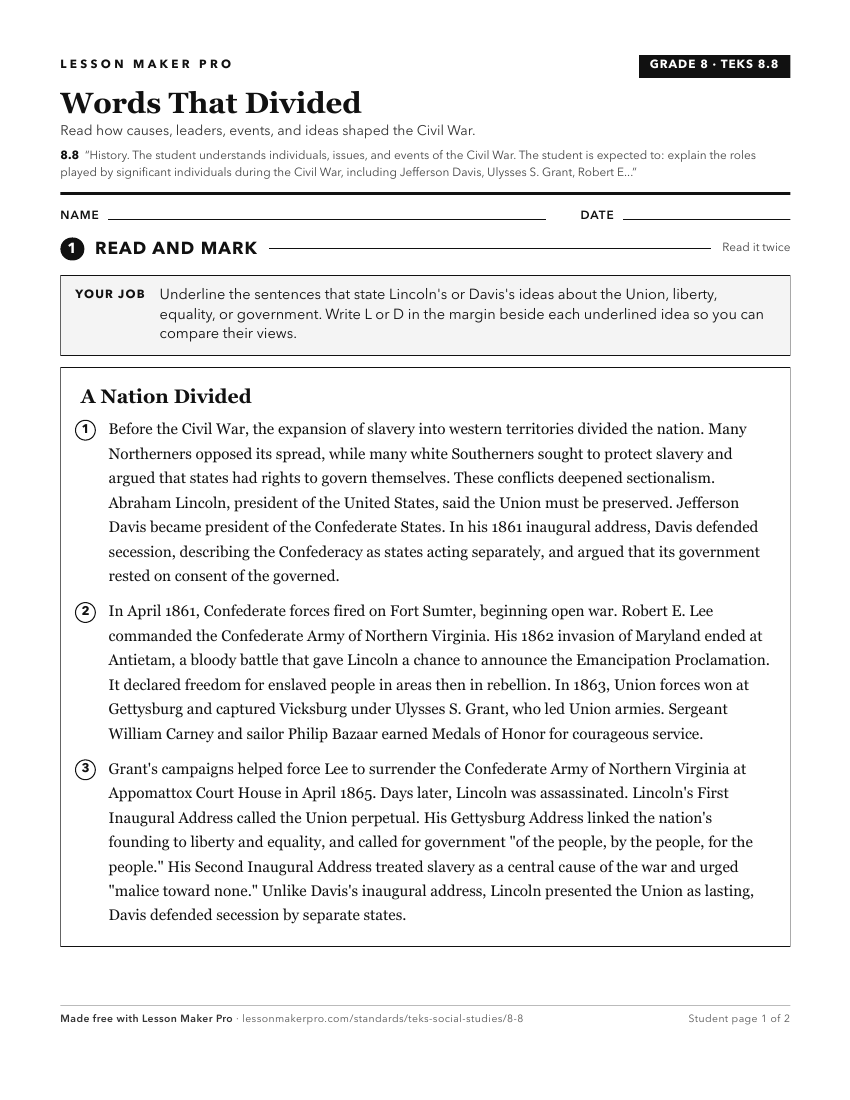
A ready-to-print activity worksheet aligned to 8.8, with an answer key for the teacher on its own page. No account needed.
PDF, US Letter, prints cleanly in black and white.
Download the worksheetKeep exploring
Related Standards
- 8.9
History. The student understands the effects of Reconstruction on the political, economic, and social life of the nation. The student is expected to:
- 8.7
History. The student understands how political, economic, and social factors led to the growth of sectionalism and the Civil War. The student is expected to:
- 8.4
History. The student understands significant political and economic issues of the revolutionary and Constitutional eras. The student is expected to:
- 7.5
History. The student understands how events and issues shaped the history of Texas during the Civil War and Reconstruction. The student is expected to:
Turn this cluster into a lesson
Grade, subject, topic, and the complete cluster are prefilled. Create one free, no account needed.
Also for this cluster:Make a WorksheetMake a QuizMake a Sub Lesson