Texas TEKS 8.4
TEKS Knowledge Statement (Expectation Cluster)
History. The student understands significant political and economic issues of the revolutionary and Constitutional eras. The student is expected to: analyze causes of the American Revolution, including the Proclamation of 1763, the Intolerable Acts, the Stamp Act, mercantilism, lack of representation in Parliament, and British economic policies following the French and Indian War; explain the roles played by significant individuals during the American Revolution, including Abigail Adams, John Adams, Wentworth Cheswell, Samuel Adams, Mercy Otis Warren, James Armistead, Benjamin Franklin, Crispus Attucks, King George III, Patrick Henry, Thomas Jefferson, the Marquis de Lafayette, Thomas Paine, and George Washington; explain the issues surrounding important events of the American Revolution, including declaring independence; fighting the battles of Lexington and Concord, Saratoga, and Yorktown; enduring the winter at Valley Forge; and signing the Treaty of Paris of 1783; and analyze the issues of the Constitutional Convention of 1787, including the Great Compromise and the Three-Fifths Compromise.
Texas Essential Knowledge and Skills for Social Studies
Cluster contents
Student Expectations in This Statement
8.4 is a TEKS knowledge and skills statement. These are the student expectations under it.
- 8.4.A
analyze causes of the American Revolution, including the Proclamation of 1763, the Intolerable Acts, the Stamp Act, mercantilism, lack of representation in Parl...
- 8.4.B
explain the roles played by significant individuals during the American Revolution, including Abigail Adams, John Adams, Wentworth Cheswell, Samuel Adams, Mercy...
- 8.4.C
explain the issues surrounding important events of the American Revolution, including declaring independence; fighting the battles of Lexington and Concord, Sar...
- 8.4.D
analyze the issues of the Constitutional Convention of 1787, including the Great Compromise and the Three-Fifths Compromise.
Teacher's field guide
What This Cluster Means
What Students Need to Do
- Students connect British debt, trade controls, taxes, settlement limits, and lack of representation to growing colonial resistance. They explain how key people and turning points shaped independence, military outcomes, and peace. They also compare Convention disputes over representation and political power.
What Mastery Looks Like
- Students can build an accurate chain from a British policy to colonial protest and explain why resistance moved toward independence. They can identify each listed person’s role and explain the significance of major events. They can compare the two compromises, including who gained political power and who was denied rights.
Common Misconceptions
- Students often treat one tax as the sole cause, assume all colonists supported independence, or confuse Parliament with colonial legislatures. They may think the Declaration ended the war, Yorktown legally ended it, or Valley Forge was a battle. Some mistake the Three-Fifths Compromise for granting enslaved people partial citizenship.
How to Assess It
- Give students a four-box exit ticket: trace one British policy to a colonial response, explain one person’s role, state one event’s significance, and compare the compromises. Require one specific fact in each box.
Lesson moves
Ways to Teach It
Sort policy, protest, person, battle, and outcome cards, then arrange them into a cause and effect timeline from 1763 to 1783.
Write a claim answering which British action most increased support for independence, then defend it with two specific pieces of evidence.
Play identity match by pairing each leader with an action, then earn a point by explaining how that action affected the Revolution.
Compare Convention debates over representation with how congressional seats are apportioned today, noting one continuity and one major difference.
Free download
Printable 8.4 Worksheet
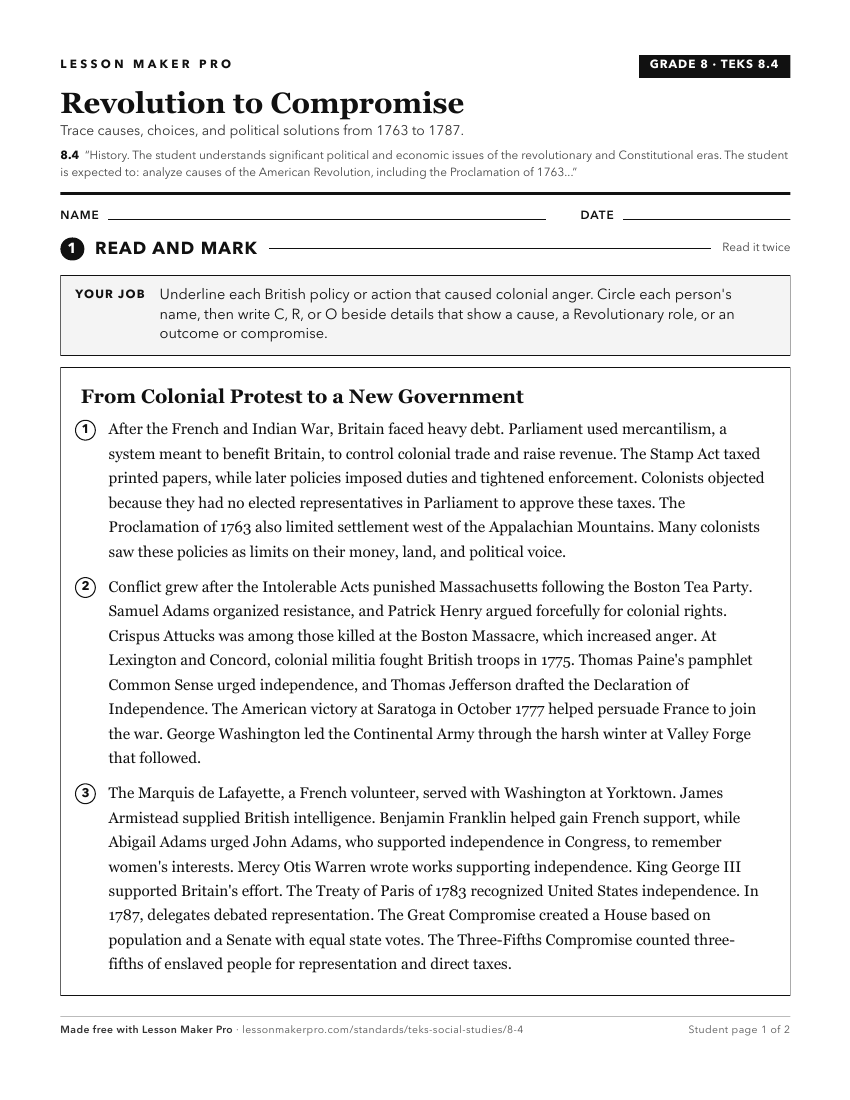
A ready-to-print activity worksheet aligned to 8.4, with an answer key for the teacher on its own page. No account needed.
PDF, US Letter, prints cleanly in black and white.
Download the worksheetKeep exploring
Related Standards
- 8.3
History. The student understands the foundations of representative government in the United States. The student is expected to:
- 8.9
History. The student understands the effects of Reconstruction on the political, economic, and social life of the nation. The student is expected to:
- 1.2
History. The student understands how historical figures helped shape the state and nation. The student is expected to:
- 5.4
History. The student understands political, economic, and social changes that occurred in the United States during the 19th century. The student is expected to:
Turn this cluster into a lesson
Grade, subject, topic, and the complete cluster are prefilled. Create one free, no account needed.
Also for this cluster:Make a WorksheetMake a QuizMake a Sub Lesson