Texas TEKS 8.7.D
The Standard
- 8.7
- History. The student understands how political, economic, and social factors led to the growth of sectionalism and the Civil War. The student is expected to:
analyze the impact of slavery on different sections of the United States
Texas Essential Knowledge and Skills for Social Studies
Teacher's field guide
What This Standard Means
What Students Need to Do
- Students compare how slavery shaped the economies, populations, politics, and daily life of the North, South, and West. They use maps, census tables, laws, and firsthand accounts to support cause-and-effect claims.
What Mastery Looks Like
- Students can explain both the direct effects of enslaved labor in the South and the connections Northern and Western communities had to slavery. They cite specific evidence and explain differences among regions.
Common Misconceptions
- Students may think slavery affected only the South or that all Northerners opposed it. They may also overlook how slavery shaped debates over western territories, trade, banking, shipping, and manufacturing.
How to Assess It
- Give students an 1860 population map and a cotton trade chart. Ask: Explain one way slavery affected the South and one way it affected another region, using both sources.
Lesson moves
Ways to Teach It
Give groups 12 source cards to sort by impact on the North, South, or West, then require evidence for each placement.
Have students write: Which region was most economically tied to slavery, and what two pieces of evidence support your answer?
Play a region match game using cards labeled cotton plantation, textile mill, shipping firm, fugitive slave law, and western territory.
Compare an 1860 cotton supply chain with a product tag from home, then mark who produced, transported, sold, and profited from each item.
Free download
Printable 8.7.D Worksheet
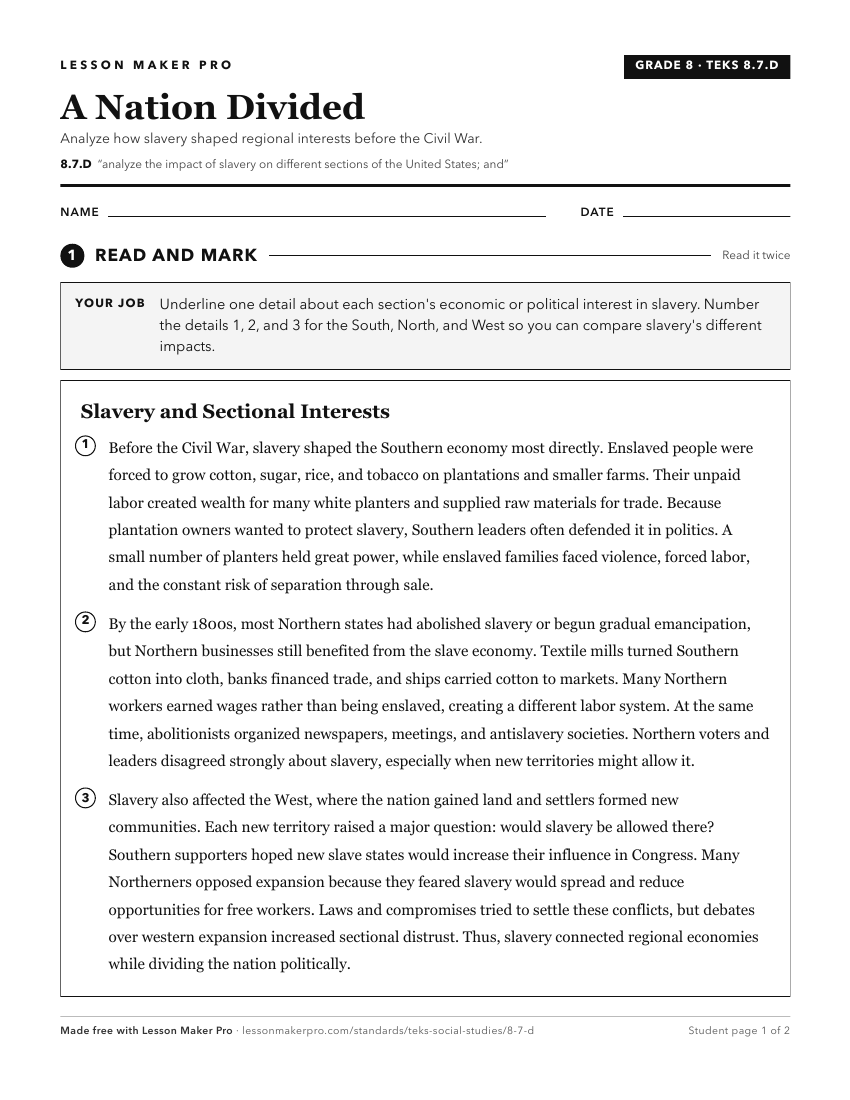
A ready-to-print activity worksheet aligned to 8.7.D, with an answer key for the teacher on its own page. No account needed.
PDF, US Letter, prints cleanly in black and white.
Download the worksheetKeep exploring
Related Standards
- 8.12.C
analyze the causes and effects of economic differences among different regions of the United States at selected times.
- 8.7.C
analyze the impact of the Fugitive Slave Act of 1850 on slavery, free Blacks, and abolitionists
- 8.7.A
analyze the impact of tariff policies on sections of the United States before the Civil War
- 8.7.B
compare the effects of political, economic, and social factors on slaves and free Blacks
Turn this exact standard into a lesson
Grade, subject, topic, and the complete standard are prefilled. Create one free, no account needed.
Also for this standard:Make a WorksheetMake a QuizMake a Sub Lesson