Texas TEKS 8.5
TEKS Knowledge Statement (Expectation Cluster)
History. The student understands the challenges confronted by the government and its leaders in the early years of the republic and the Age of Jackson. The student is expected to: describe major domestic problems faced by the leaders of the new republic, including maintaining national security, creating a stable economic system, and setting up the court system; explain the effects of the Fugitive Slave Act of 1793; summarize arguments regarding protective tariffs, taxation, and the banking system; explain the origin and development of American political parties; explain the causes, important events, and effects of the War of 1812; identify the foreign policies of presidents Washington through Monroe and explain the impact of Washington's Farewell Address and the Monroe Doctrine; explain the impact of the election of Andrew Jackson, including expanded suffrage; and analyze the reasons for the removal and resettlement of Cherokee Indians during the Jacksonian era, including the Indian Removal Act, Worcester v. Georgia, and the Trail of Tears.
Texas Essential Knowledge and Skills for Social Studies
Cluster contents
Student Expectations in This Statement
8.5 is a TEKS knowledge and skills statement. These are the student expectations under it.
- 8.5.A
describe major domestic problems faced by the leaders of the new republic, including maintaining national security, creating a stable economic system, and setti...
- 8.5.B
explain the effects of the Fugitive Slave Act of 1793
- 8.5.C
summarize arguments regarding protective tariffs, taxation, and the banking system
- 8.5.D
explain the origin and development of American political parties
- 8.5.E
explain the causes, important events, and effects of the War of 1812
- 8.5.F
identify the foreign policies of presidents Washington through Monroe and explain the impact of Washington's Farewell Address and the Monroe Doctrine
- 8.5.G
explain the impact of the election of Andrew Jackson, including expanded suffrage
- 8.5.H
analyze the reasons for the removal and resettlement of Cherokee Indians during the Jacksonian era, including the Indian Removal Act, Worcester v. Georgia, and ...
Teacher's field guide
What This Cluster Means
What Students Need to Do
- Students explain how early leaders handled national defense, the economy, courts, foreign affairs, slavery, and party conflict. They trace causes and effects from Washington’s presidency through Jackson’s election and Cherokee removal.
What Mastery Looks Like
- Students place key laws, court cases, elections, wars, and policies in order. They compare opposing views on tariffs, taxes, the national bank, and federal power. They support cause-and-effect claims with accurate historical evidence.
Common Misconceptions
- Students may assume expanded suffrage included women, Native Americans, and Black Americans, rather than mainly white men. They may think Worcester v. Georgia stopped removal or that Cherokee resettlement was voluntary. They may also confuse the Monroe Doctrine with Washington’s advice to avoid permanent alliances.
How to Assess It
- Give students four terms: War of 1812, Fugitive Slave Act, Monroe Doctrine, and Indian Removal Act. Ask them to choose two and explain one cause and one effect of each.
Lesson moves
Ways to Teach It
Have pairs sort event, policy, leader, and effect cards into a floor timeline, then defend three cause-and-effect links.
Ask students to write which issue most threatened the early republic, then support their choice with two named events or policies.
Run a matching relay using cards for leaders, court cases, laws, party beliefs, foreign policies, and historical effects.
Give students a current tariff news article and ask them to compare its arguments with early debates over protective tariffs.
Free download
Printable 8.5 Worksheet
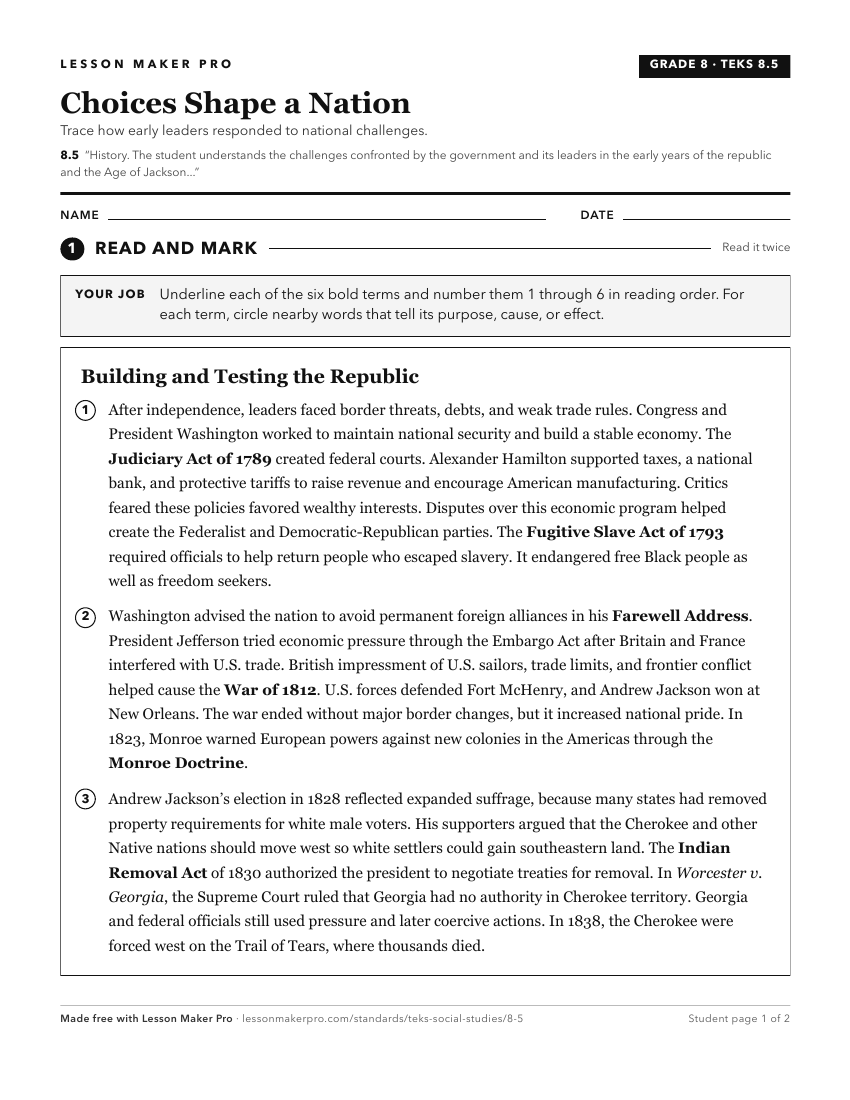
A ready-to-print activity worksheet aligned to 8.5, with an answer key for the teacher on its own page. No account needed.
PDF, US Letter, prints cleanly in black and white.
Download the worksheetKeep exploring
Related Standards
- 8.3
History. The student understands the foundations of representative government in the United States. The student is expected to:
- 1.2
History. The student understands how historical figures helped shape the state and nation. The student is expected to:
- 8.4
History. The student understands significant political and economic issues of the revolutionary and Constitutional eras. The student is expected to:
- 8.8
History. The student understands individuals, issues, and events of the Civil War. The student is expected to:
Turn this cluster into a lesson
Grade, subject, topic, and the complete cluster are prefilled. Create one free, no account needed.
Also for this cluster:Make a WorksheetMake a QuizMake a Sub Lesson