Texas TEKS 8.5.H
The Standard
- 8.5
- History. The student understands the challenges confronted by the government and its leaders in the early years of the republic and the Age of Jackson. The student is expected to:
analyze the reasons for the removal and resettlement of Cherokee Indians during the Jacksonian era, including the Indian Removal Act, Worcester v. Georgia, and the Trail of Tears.
Texas Essential Knowledge and Skills for Social Studies
Teacher's field guide
What This Standard Means
What Students Need to Do
- Students trace how demand for Cherokee land, cotton farming, Georgia gold, racism, and states' rights arguments drove federal policy. They connect federal law, the Supreme Court ruling, executive non-enforcement, and forced migration in a cause-and-effect chain.
What Mastery Looks Like
- A student can explain that Worcester v. Georgia supported Cherokee sovereignty, but the executive branch did not enforce the decision. The student can use evidence to connect government actions with detention, migration west, and mass death.
Common Misconceptions
- Students may think Cherokee people moved willingly or that all removal happened at once. They may assume Worcester stopped removal or that the Supreme Court enforced its own ruling. They may also blame only Jackson, overlooking Congress, Georgia officials, settlers, and Van Buren's administration.
How to Assess It
- Exit ticket: Write a four-link causal chain connecting one motive for removal, the Indian Removal Act, Worcester v. Georgia, and one Trail of Tears outcome. Explain each link.
Lesson moves
Ways to Teach It
Give pairs six event and motive cards to sort into causes, legal turning points, and consequences, then place them on a timeline.
Ask students to write: Which mattered more in removal, economic demand for land or political power, and what evidence supports your claim?
Run a cause-and-effect relay where teams match laws, court decisions, non-enforcement, stockades, and forced migration to accurate results.
Use current Cherokee Nation maps and census data to discuss how forced relocation still shapes where Cherokee communities live today.
Free download
Printable 8.5.H Worksheet
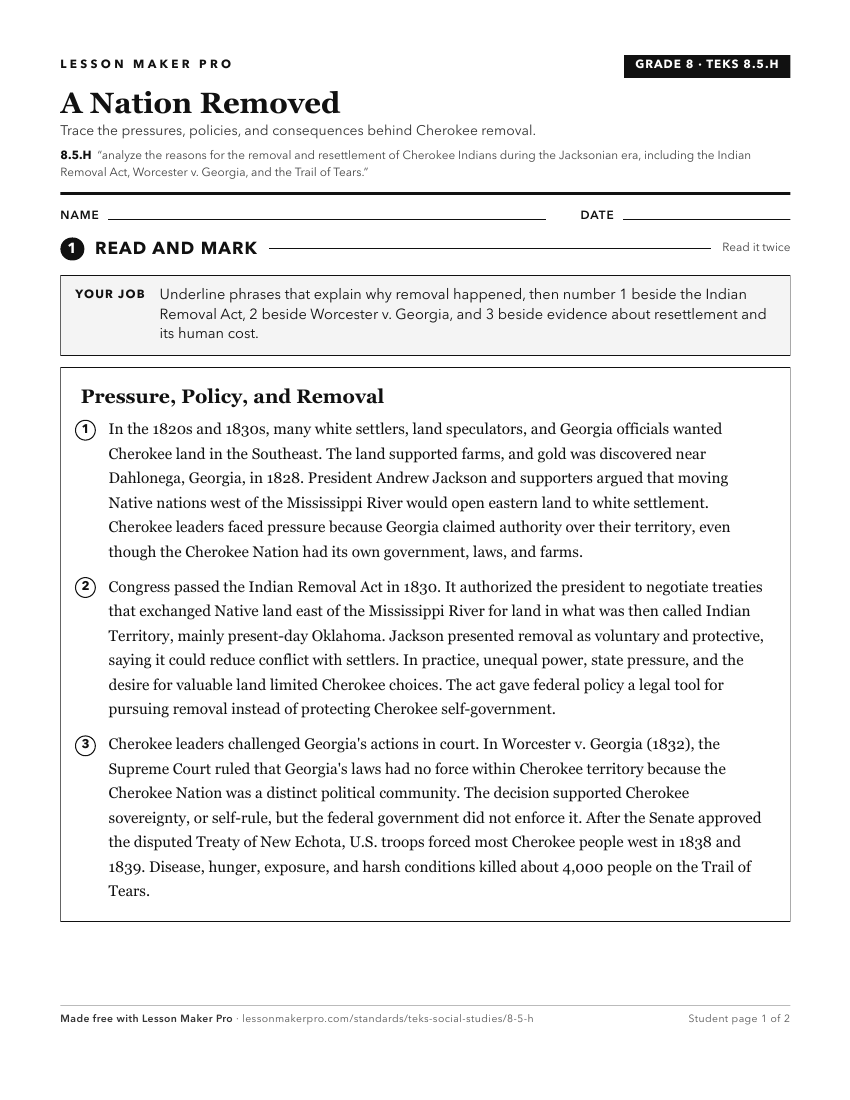
A ready-to-print activity worksheet aligned to 8.5.H, with an answer key for the teacher on its own page. No account needed.
PDF, US Letter, prints cleanly in black and white.
Download the worksheetKeep exploring
Related Standards
- 8.5.G
explain the impact of the election of Andrew Jackson, including expanded suffrage
- 5.4.F
identify the challenges, opportunities, and contributions of people from various American Indian and immigrant groups such as the settlement of the frontier and...
- 8.23.A
identify racial, ethnic, and religious groups that settled in the United States and explain their reasons for immigration
- 8.7.C
analyze the impact of the Fugitive Slave Act of 1850 on slavery, free Blacks, and abolitionists
Turn this exact standard into a lesson
Grade, subject, topic, and the complete standard are prefilled. Create one free, no account needed.
Also for this standard:Make a WorksheetMake a QuizMake a Sub Lesson