Texas TEKS 8.5.B
The Standard
- 8.5
- History. The student understands the challenges confronted by the government and its leaders in the early years of the republic and the Age of Jackson. The student is expected to:
explain the effects of the Fugitive Slave Act of 1793
Texas Essential Knowledge and Skills for Social Studies
Teacher's field guide
What This Standard Means
What Students Need to Do
- Students explain how the 1793 law helped enslavers pursue people across state lines. They connect it to kidnapping risks, resistance in Northern states, and growing sectional conflict.
What Mastery Looks Like
- Students identify at least two effects and support each with accurate historical details. They distinguish the 1793 law from the stricter 1850 law.
Common Misconceptions
- Students often confuse the 1793 law with the 1850 law. They may think it affected only escapees, ignoring the kidnapping of free Black people. Some assume every Northern state cooperated fully.
How to Assess It
- Use this exit ticket: Name two effects of the 1793 law, then explain how one increased conflict between Northern and Southern states.
Lesson moves
Ways to Teach It
Give pairs effect cards to sort under enslavers, escaped people, free Black people, and state governments, then require evidence for each placement.
Ask students to write: How could the law strengthen slavery while also increasing resistance to it?
Run a cause-and-effect matching game using law provisions, enforcement problems, kidnapping risks, state resistance, and sectional tension.
Have students compare the law's state and federal power conflict with a current dispute over which government level enforces a policy.
Free download
Printable 8.5.B Worksheet
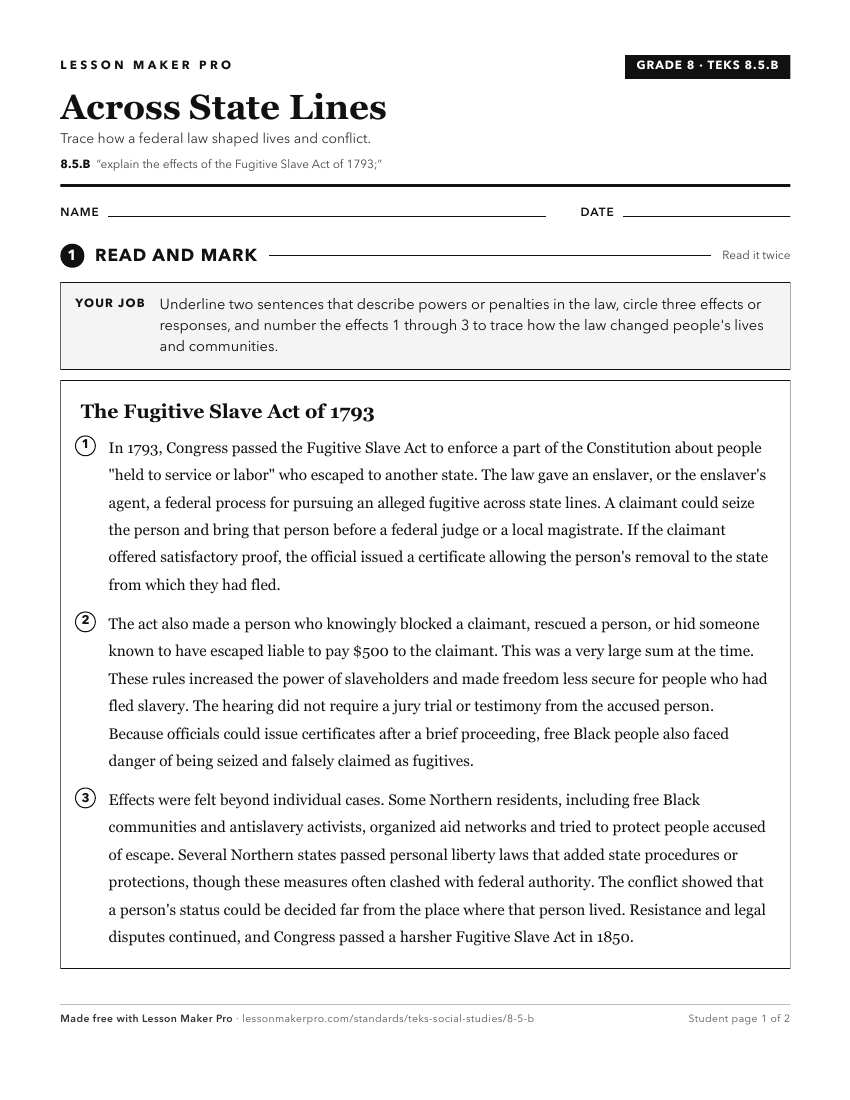
A ready-to-print activity worksheet aligned to 8.5.B, with an answer key for the teacher on its own page. No account needed.
PDF, US Letter, prints cleanly in black and white.
Download the worksheetKeep exploring
Related Standards
- 8.12.B
explain reasons for the development of the plantation system, the transatlantic slave trade, and the spread of slavery
- 8.7.D
analyze the impact of slavery on different sections of the United States
- 8.5.E
explain the causes, important events, and effects of the War of 1812
- 8.7.C
analyze the impact of the Fugitive Slave Act of 1850 on slavery, free Blacks, and abolitionists
Turn this exact standard into a lesson
Grade, subject, topic, and the complete standard are prefilled. Create one free, no account needed.
Also for this standard:Make a WorksheetMake a QuizMake a Sub Lesson