Texas TEKS 8.31
TEKS Knowledge Statement (Expectation Cluster)
Social studies skills. The student uses problem-solving and decision-making skills, working independently and with others. The student is expected to: describe governmental and democratic processes such as voting, due process, and caucuses using simulations and models; and use problem-solving and decision-making processes to identify a problem, gather information, list and consider options, consider advantages and disadvantages, choose and implement a solution, and evaluate the effectiveness of the solution.
Texas Essential Knowledge and Skills for Social Studies
Cluster contents
Student Expectations in This Statement
8.31 is a TEKS knowledge and skills statement. These are the student expectations under it.
Teacher's field guide
What This Cluster Means
What Students Need to Do
- Students participate in models of elections, fair hearings, and caucus meetings, then explain what happened and why. They define a public problem, research it, compare possible responses, act on one choice, and judge the result.
What Mastery Looks Like
- A student can follow the rules of a mock vote, hearing, or caucus and explain how those rules shape the outcome. Given a school or community problem, the student can use evidence to select a workable response and name a measure for checking success.
Common Misconceptions
- Students often treat voting as the whole democratic process, confuse a caucus with a general election, or think due process guarantees a favorable result. They may choose the first idea, list opinions as evidence, ignore drawbacks, or skip checking whether the plan worked.
How to Assess It
- Exit ticket: A school club must choose one service project. List two options, choose a decision process, defend one option with evidence, and name one sign of success.
Lesson moves
Ways to Teach It
Run a mock caucus using four school budget proposals, with small-group preference talks, delegate choices, a final vote, and a debrief.
Write: When should majority rule be limited by due process? Use an accused student's hearing as your example.
Give teams shuffled cards showing a problem-solving sequence, then award points for ordering the cards and explaining each step.
Examine a city council agenda item, compare two proposed responses, and create one measure officials could use to check results.
Free download
Printable 8.31 Worksheet
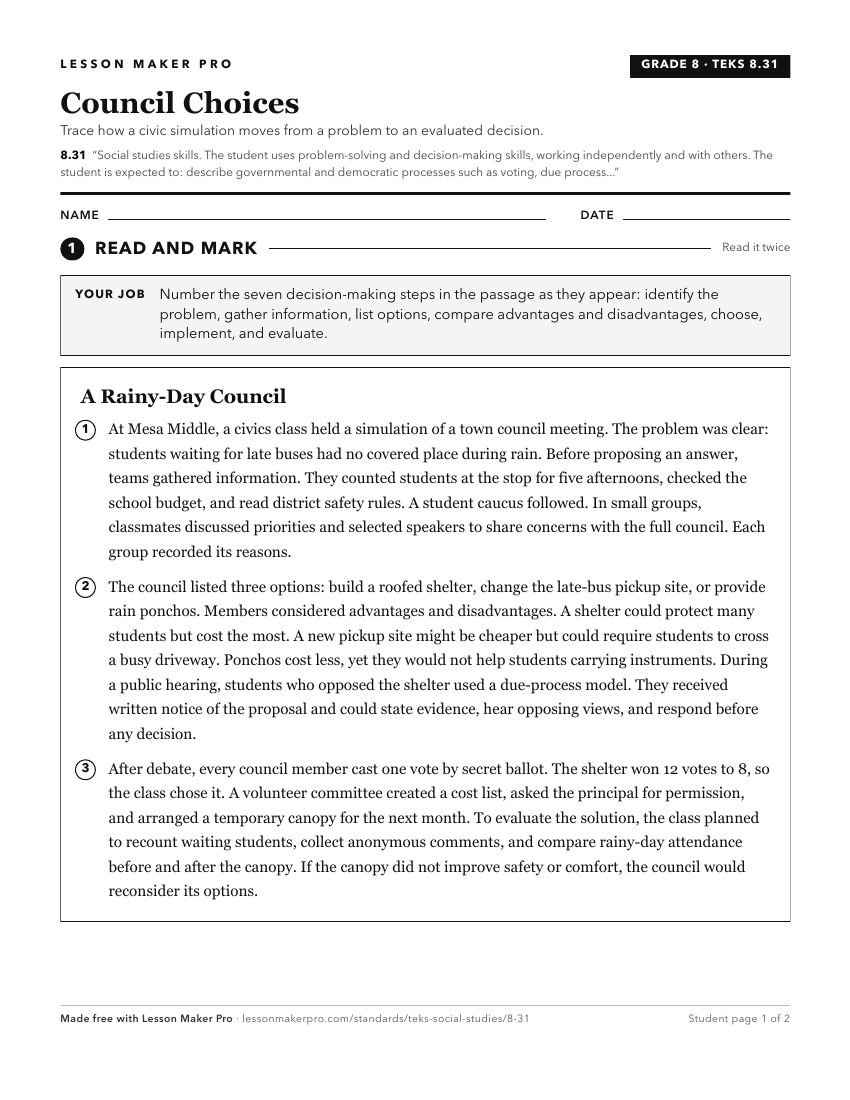
A ready-to-print activity worksheet aligned to 8.31, with an answer key for the teacher on its own page. No account needed.
PDF, US Letter, prints cleanly in black and white.
Download the worksheetKeep exploring
Related Standards
- 1.18
Social studies skills. The student uses problem-solving and decision-making skills, working independently and with others. The student is expected to:
- 2.17
Social studies skills. The student uses problem-solving and decision-making skills, working independently and with others. The student is expected to:
- 4.22
Social studies skills. The student uses problem-solving and decision-making skills, working independently and with others. The student is expected to:
- 3.16
Social studies skills. The student uses problem-solving and decision-making skills, working independently and with others. The student is expected to:
Turn this cluster into a lesson
Grade, subject, topic, and the complete cluster are prefilled. Create one free, no account needed.
Also for this cluster:Make a WorksheetMake a QuizMake a Sub Lesson