Texas TEKS 8.9
TEKS Knowledge Statement (Expectation Cluster)
Earth and space. The student describes the characteristics of the universe and the relative scale of its components. The student is expected to: describe the life cycle of stars and compare and classify stars using the Hertzsprung- Russell diagram; categorize galaxies as spiral, elliptical, and irregular and locate Earth's solar system within the Milky Way galaxy; and research and analyze scientific data used as evidence to develop scientific theories that describe the origin of the universe.
Texas Essential Knowledge and Skills for Science
Cluster contents
Student Expectations in This Statement
8.9 is a TEKS knowledge and skills statement. These are the student expectations under it.
- 8.9.A
describe the life cycle of stars and compare and classify stars using the Hertzsprung-Russell diagram
- 8.9.B
categorize galaxies as spiral, elliptical, and irregular and locate Earth's solar system within the Milky Way galaxy
- 8.9.C
research and analyze scientific data used as evidence to develop scientific theories that describe the origin of the universe
Teacher's field guide
What This Cluster Means
What Students Need to Do
- Students trace how low-mass and high-mass stars form, change, and end, then classify stars by temperature and luminosity on an H-R diagram. They identify galaxy types and place the solar system in the Orion Spur of the Milky Way. They interpret redshift, cosmic microwave background, and element abundance data as evidence for models of the universe's origin.
What Mastery Looks Like
- Given star data, students place stars on an H-R diagram and predict likely stages and outcomes. They classify galaxy images as spiral, elliptical, or irregular and locate the solar system within the Milky Way. They use specific data to explain why scientists support an expanding universe and the Big Bang model.
Common Misconceptions
- Students may treat an H-R diagram as a map of star locations rather than a graph of temperature and luminosity. They often assume every star follows the same life cycle or that color shows age alone. Some place the solar system at the Milky Way's center or picture the Big Bang as an explosion into empty space.
How to Assess It
- Give students an exit ticket with one H-R diagram, three galaxy images, and a small redshift table. Ask them to classify one star, label each galaxy, locate the solar system, and explain what the redshift pattern supports.
Lesson moves
Ways to Teach It
Arrange star-stage cards and colored beads into separate life-cycle paths for Sun-like and massive stars, then label each ending.
Write a claim explaining which evidence best supports an expanding universe, citing redshift or cosmic microwave background data.
Play a timed card sort matching star data to H-R regions and galaxy photos to spiral, elliptical, or irregular labels.
Use a NASA Milky Way map to locate the Orion Spur and estimate the solar system's distance from the galactic center.
Free download
Printable 8.9 Worksheet
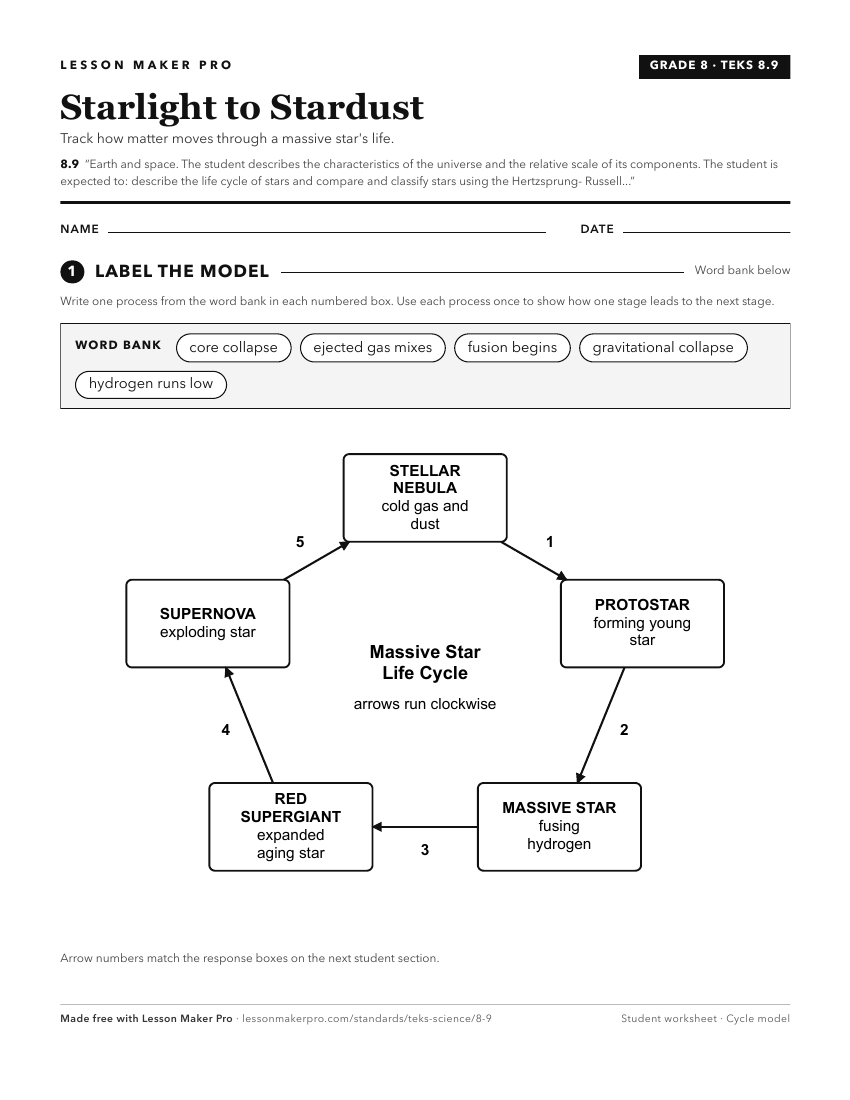
A ready-to-print activity worksheet aligned to 8.9, with an answer key for the teacher on its own page. No account needed.
PDF, US Letter, prints cleanly in black and white.
Download the worksheetKeep exploring
Related Standards
- 6.9
Earth and space. The student models the cyclical movements of the Sun, Earth, and Moon and describes their effects. The student is expected to:
- 7.9
Earth and space. The student understands the patterns of movement, organization, and characteristics of components of our solar system. The student is expected ...
- K.5.C
describe the properties of objects in terms of relative size (scale) and relative quantity
- 1.5.C
describe the properties of objects in terms of relative size (scale) and relative quantity
Turn this cluster into a lesson
Grade, subject, topic, and the complete cluster are prefilled. Create one free, no account needed.
Also for this cluster:Make a WorksheetMake a QuizMake a Sub Lesson