Texas TEKS 8.9.C
The Standard
- 8.9
- The student describes the characteristics of the universe and the relative scale of its components
research and analyze scientific data used as evidence to develop scientific theories that describe the origin of the universe.
Texas Essential Knowledge and Skills for Science
Teacher's field guide
What This Standard Means
What Students Need to Do
- Students find reliable sources and examine redshift, cosmic microwave background, and light-element abundance data. They explain how patterns in those data support models of the universe’s origin and expansion.
What Mastery Looks Like
- Students interpret a simple graph, spectrum, table, or map and identify the pattern it shows. They connect that pattern to a scientific claim and cite specific data as evidence.
Common Misconceptions
- Students may treat a scientific theory as a guess or picture the universe expanding from one central point into empty space. They may also confuse redshift with a galaxy changing color rather than light wavelengths stretching.
How to Assess It
- Give students a galaxy distance and redshift graph. Ask: “What pattern do you see, and how does it support an expanding universe?”
Lesson moves
Ways to Teach It
Mark dots on a balloon, measure distances before and after inflation, then compare the changes to galaxy movement.
Write a claim explaining which evidence, redshift or cosmic microwave background radiation, most strongly supports an expanding universe and why.
Sort evidence cards into redshift, background radiation, and element abundance groups, then match each group to the claim it supports.
Inspect a NASA galaxy spectrum and identify shifted lines that astronomers use to measure how fast the galaxy is moving away.
Free download
Printable 8.9.C Worksheet
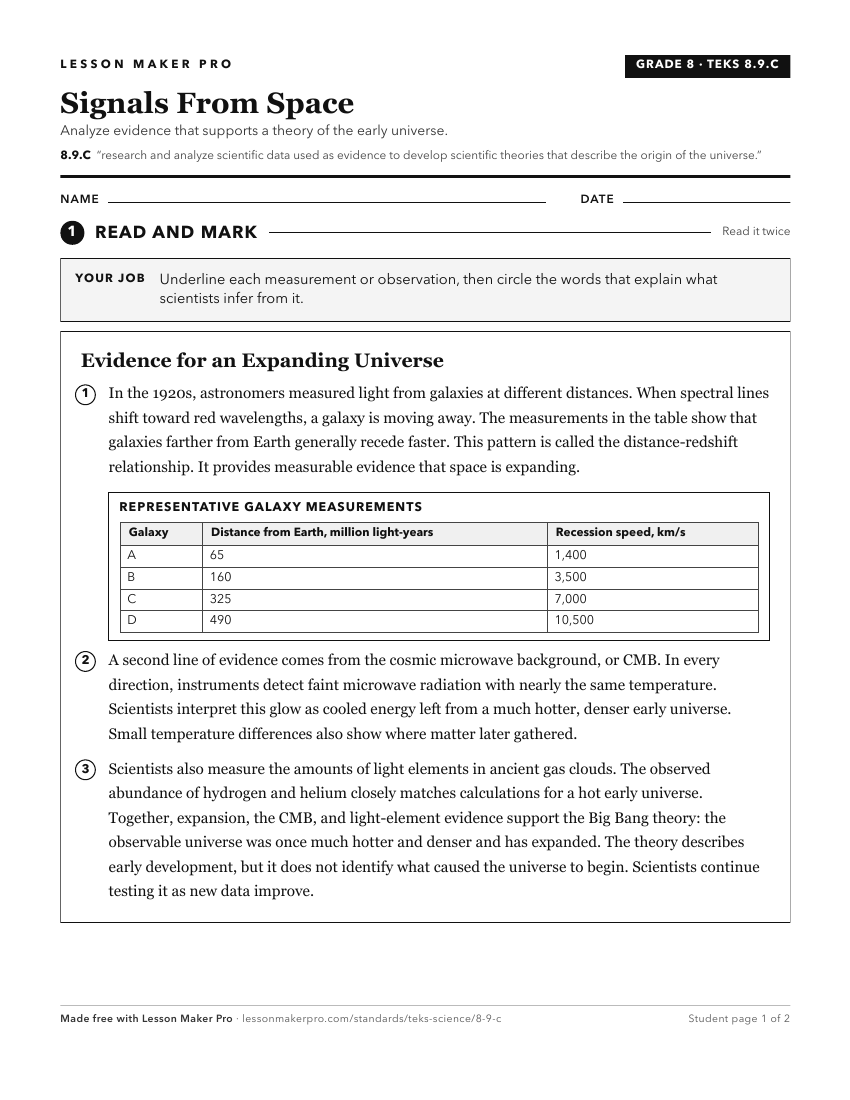
A ready-to-print activity worksheet aligned to 8.9.C, with an answer key for the teacher on its own page. No account needed.
PDF, US Letter, prints cleanly in black and white.
Download the worksheetKeep exploring
Related Standards
- 8.5.B
identify and investigate cause-and-effect relationships to explain scientific phenomena or analyze problems
- 8.3.C
engage respectfully in scientific argumentation using applied scientific explanations and empirical evidence
- 4.5.B
identify and investigate cause-and-effect relationships to explain scientific phenomena or analyze problems
- 8.11.A
use scientific evidence to describe how natural events, including volcanic eruptions, meteor impacts, abrupt changes in ocean currents, and the release and abso...
Turn this exact standard into a lesson
Grade, subject, topic, and the complete standard are prefilled. Create one free, no account needed.
Also for this standard:Make a WorksheetMake a QuizMake a Sub Lesson