Texas TEKS 7.9
TEKS Knowledge Statement (Expectation Cluster)
Earth and space. The student understands the patterns of movement, organization, and characteristics of components of our solar system. The student is expected to: describe the physical properties, locations, and movements of the Sun, planets, moons, meteors, asteroids, comets, Kuiper belt, and Oort cloud; describe how gravity governs motion within Earth's solar system; and analyze the characteristics of Earth that allow life to exist such as the proximity of the Sun, presence of water, and composition of the atmosphere.
Texas Essential Knowledge and Skills for Science
Cluster contents
Student Expectations in This Statement
7.9 is a TEKS knowledge and skills statement. These are the student expectations under it.
- 7.9.A
describe the physical properties, locations, and movements of the Sun, planets, moons, meteors, asteroids, comets, Kuiper belt, and Oort cloud
- 7.9.B
describe how gravity governs motion within Earth's solar system
- 7.9.C
Analyze the characteristics of Earth that allow life to exist such as the proximity of the Sun, presence of water, and composition of the atmosphere.
Teacher's field guide
What This Cluster Means
What Students Need to Do
- Students compare the properties, locations, and movements of objects and regions in the solar system. They explain how gravity keeps planets, moons, asteroids, and comets in predictable paths. They connect Earth's distance from the Sun, liquid water, and atmosphere to its ability to support life.
What Mastery Looks Like
- A student can label a solar system model and describe each object's composition, location, and movement. They can explain how gravity controls orbits and compare asteroids, comets, and meteors. They can use evidence to explain why Earth supports life.
Common Misconceptions
- Students may confuse asteroids, comets, meteoroids, and meteors, or place the Kuiper belt and Oort cloud in the same region. Some think gravity acts only near Earth or that planets move without the Sun's gravity. Others name oxygen alone as the reason Earth supports life.
How to Assess It
- Give students a blank solar system sketch and a word bank of major objects and regions. Ask them to place each term, add motion arrows, explain gravity's role, and list three Earth conditions that support life.
Lesson moves
Ways to Teach It
Use a hallway, string, and labeled cards to model planetary order, the asteroid belt, Kuiper belt, Oort cloud, and orbital paths.
Write a claim explaining why Earth supports life, using evidence about distance from the Sun, liquid water, and atmospheric composition.
Play a sorting relay with object cards, matching each Sun, planet, moon, meteor, asteroid, or comet to its properties and location.
Track the Moon or a visible planet for one week, then connect its changing position to orbit, rotation, and gravity.
Free download
Printable 7.9 Worksheet
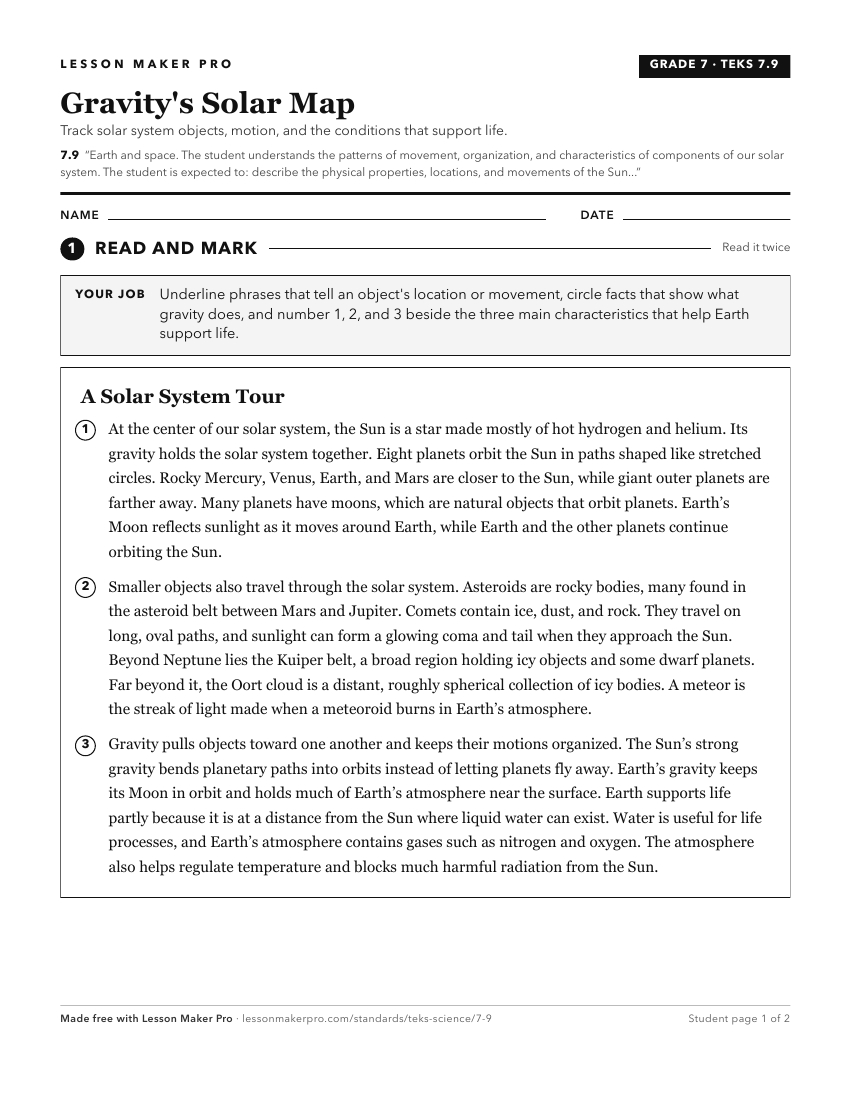
A ready-to-print activity worksheet aligned to 7.9, with an answer key for the teacher on its own page. No account needed.
PDF, US Letter, prints cleanly in black and white.
Download the worksheetKeep exploring
Related Standards
- 3.9
Earth and space. The student knows there are recognizable objects and patterns in Earth's solar system. The student is expected to:
- 2.9
Earth and space. The student knows that there are recognizable patterns in the natural world and among objects in the sky. The student is expected to:
- 4.9
Earth and space. The student recognizes patterns among the Sun, Earth, and Moon system and their effects. The student is expected to:
- 5.10
Earth and space. The student knows that there are recognizable patterns and processes on Earth. The student is expected to:
Turn this cluster into a lesson
Grade, subject, topic, and the complete cluster are prefilled. Create one free, no account needed.
Also for this cluster:Make a WorksheetMake a QuizMake a Sub Lesson