Texas TEKS 2.9
TEKS Knowledge Statement (Expectation Cluster)
Earth and space. The student knows that there are recognizable patterns in the natural world and among objects in the sky. The student is expected to: describe the Sun as a star that provides light and heat and explain that the Moon reflects the Sun's light; and observe objects in the sky using tools such as a telescope and compare how objects in the sky are more visible and can appear different with a tool than with an unaided eye.
Texas Essential Knowledge and Skills for Science
Cluster contents
Student Expectations in This Statement
2.9 is a TEKS knowledge and skills statement. These are the student expectations under it.
Teacher's field guide
What This Cluster Means
What Students Need to Do
- Students identify the Sun as a star and connect its energy to the light and warmth felt on Earth. They use a model or diagram to show that moonlight begins at the Sun and reflects from the Moon to our eyes. They compare unaided observations with telescope views and describe added details.
What Mastery Looks Like
- A student can explain why the Moon looks bright without saying it makes its own light. Given an image pair, the student traces the light path and names details, such as lunar craters, visible through a telescope. The student knows never to view the Sun directly through a telescope.
Common Misconceptions
- Students may call the Sun a planet or think every star must look like a tiny point. Many say the Moon makes its own light. They may think a telescope changes the object itself or is safe for viewing the Sun without a solar filter.
How to Assess It
- Exit ticket: Draw arrows showing how sunlight lets you see the Moon. Write what kind of object the Sun is, what it provides, and one Moon detail a telescope reveals.
Lesson moves
Ways to Teach It
Use a lamp as the Sun and a foil-covered ball as the Moon, then mark the lit side from three positions.
Show a bright Moon photo and ask, "Where did this light begin, and how did it reach your eyes?"
Match cards showing unaided-eye and telescope views of the Moon, planets, and stars, then explain each match to a partner.
Open a local observatory image gallery, choose one Moon image, and list two details a telescope reveals.
Free download
Printable 2.9 Worksheet
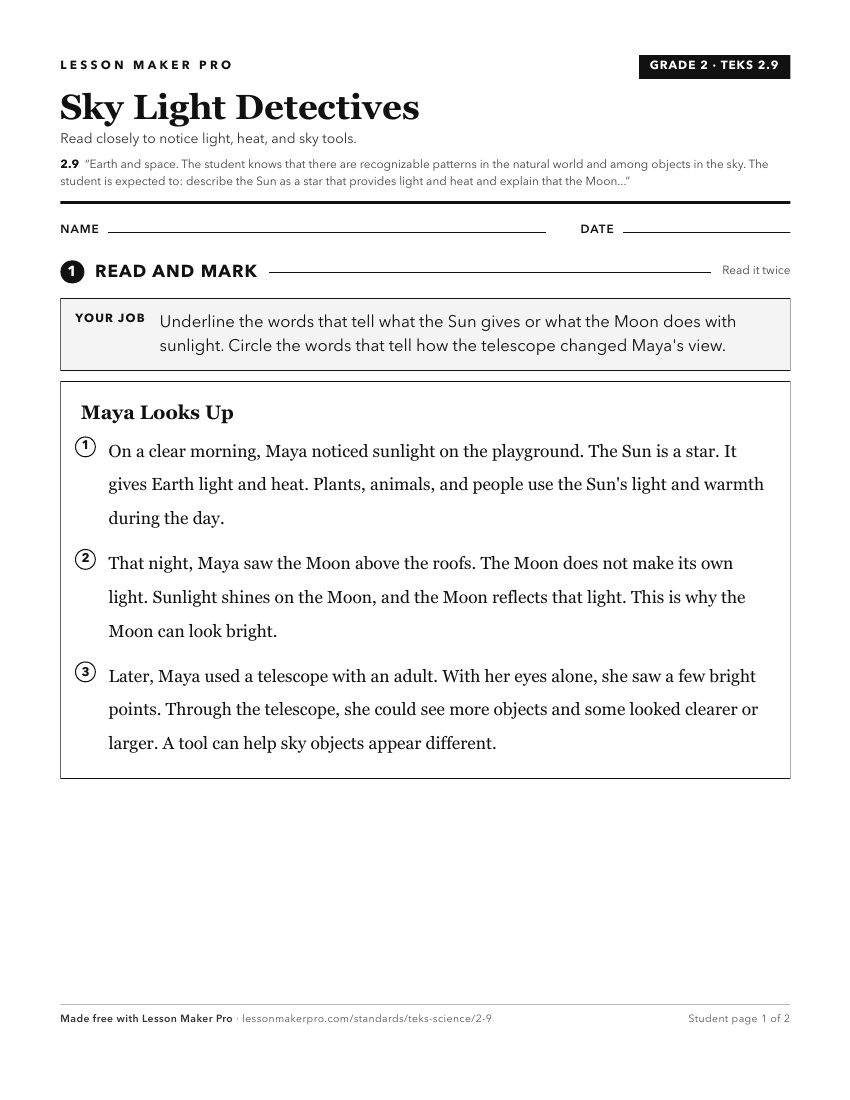
A ready-to-print activity worksheet aligned to 2.9, with an answer key for the teacher on its own page. No account needed.
PDF, US Letter, prints cleanly in black and white.
Download the worksheetKeep exploring
Related Standards
- 3.9
Earth and space. The student knows there are recognizable objects and patterns in Earth's solar system. The student is expected to:
- K.9
The Kindergarten version of this standard.
- 4.9
Earth and space. The student recognizes patterns among the Sun, Earth, and Moon system and their effects. The student is expected to:
- 5.10
Earth and space. The student knows that there are recognizable patterns and processes on Earth. The student is expected to:
Turn this cluster into a lesson
Grade, subject, topic, and the complete cluster are prefilled. Create one free, no account needed.
Also for this cluster:Make a WorksheetMake a QuizMake a Sub Lesson