Texas TEKS 2.9.A
The Standard
- 2.9
- Earth and space. The student knows that there are recognizable patterns in the natural world and among objects in the sky. The student is expected to:
describe the Sun as a star that provides light and heat and explain that the Moon reflects the Sun's light
Texas Essential Knowledge and Skills for Science
Teacher's field guide
What This Standard Means
What Students Need to Do
- Students identify the Sun as a star and connect it with the light and warmth felt on Earth. They explain that the Moon looks bright because sunlight bounces off its surface.
What Mastery Looks Like
- Students can label the Sun as the light source in a picture or model. They can trace sunlight from the Sun to the Moon and then toward Earth. They clearly state that the Moon does not make its own light.
Common Misconceptions
- Students may think the Moon produces light like the Sun. They may call the Sun a planet or believe it is made of fire. Some think moonlight reaches the Moon from Earth.
How to Assess It
- Give students a picture of the Sun, Earth, and Moon. Ask them to draw arrows showing how the Moon becomes visible and write one explaining sentence.
Lesson moves
Ways to Teach It
Use a flashlight as the Sun and a foam ball as the Moon, then observe how the ball appears bright only when illuminated.
Ask students to explain why the Moon can look bright even though it does not make light.
Sort picture cards into three groups: makes light, reflects light, and does neither, then explain each choice.
Place identical objects in sunlight and shade, compare their warmth, and connect the difference to heat from the Sun.
Free download
Printable 2.9.A Worksheet
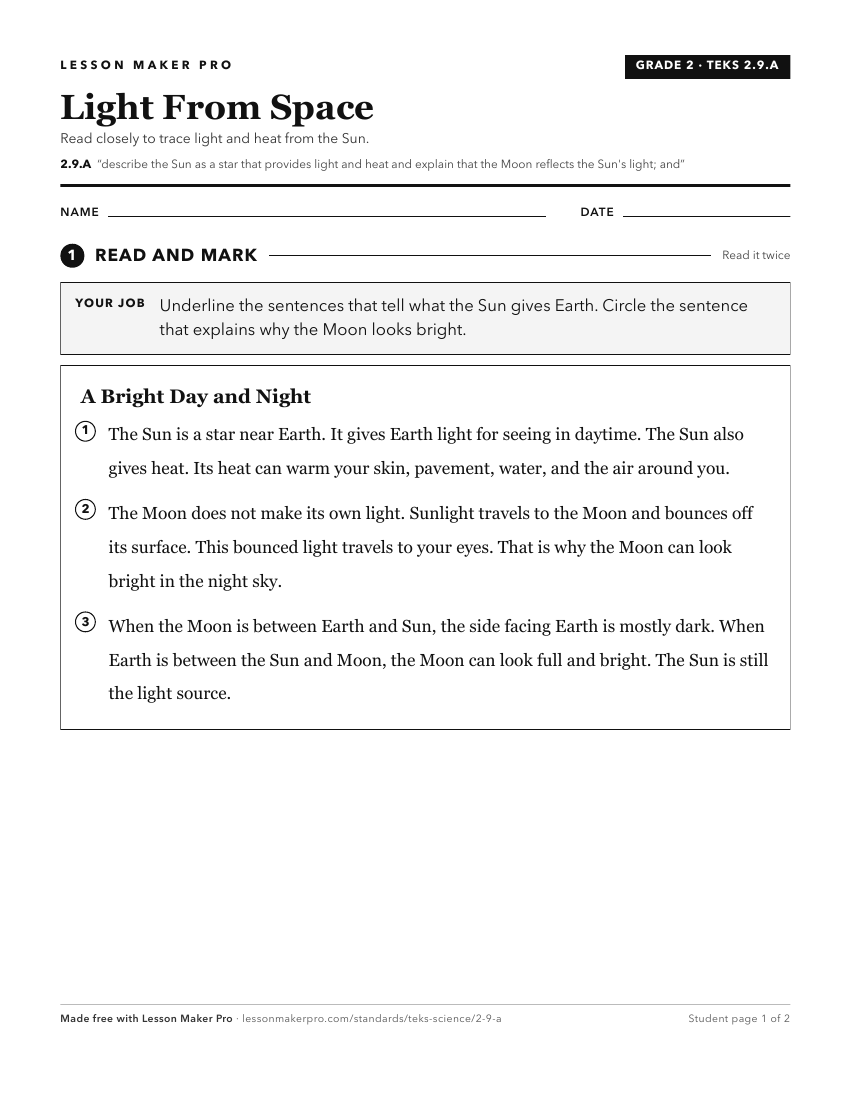
A ready-to-print activity worksheet aligned to 2.9.A, with an answer key for the teacher on its own page. No account needed.
PDF, US Letter, prints cleanly in black and white.
Download the worksheetKeep exploring
Related Standards
- 5.10.A
explain how the Sun and the ocean interact in the water cycle and affect weather
- 4.10.A
describe and illustrate the continuous movement of water above and on the surface of Earth through the water cycle and explain the role of the Sun as a major so...
- K.9.B
observe, describe, and illustrate the Sun, Moon, stars, and objects in the sky such as clouds.
- 3.9.A
construct models and explain the orbits of the Sun, Earth, and Moon in relation to each other
Turn this exact standard into a lesson
Grade, subject, topic, and the complete standard are prefilled. Create one free, no account needed.
Also for this standard:Make a WorksheetMake a QuizMake a Sub Lesson