Texas TEKS 4.10.A
The Standard
- 4.10
- Earth and space. The student knows that there are processes on Earth that create patterns of change. The student is expected to:
describe and illustrate the continuous movement of water above and on the surface of Earth through the water cycle and explain the role of the Sun as a major source of energy in this process
Texas Essential Knowledge and Skills for Science
Teacher's field guide
What This Standard Means
What Students Need to Do
- Students trace water as it evaporates, condenses, falls as precipitation, and collects or moves across land. They explain that sunlight provides energy for evaporation and keeps the cycle moving.
What Mastery Looks Like
- A student can draw a connected cycle with accurate labels and arrows showing water movement. The student can explain each change and identify the Sun as the main energy source.
Common Misconceptions
- Students may think evaporated water disappears or that clouds are made of smoke. They may show the cycle as a straight sequence with a fixed beginning and end. Some confuse condensation with precipitation.
How to Assess It
- Give students a blank page and ask them to draw water moving from a lake to a cloud and back to land. Require labels, arrows, and one sentence explaining the Sun's role.
Lesson moves
Ways to Teach It
Tape a sealed bag with colored water to a sunny window, then record evaporation, condensation, and droplet collection over several days.
Ask students to explain where a rain puddle goes after the storm ends and what part sunlight plays.
Give groups water cycle process cards and have them build a loop, then restart the explanation from different cards.
Compare wet paper towels placed in sunlight and shade, then connect drying rates to evaporation from lakes, soil, and puddles.
Free download
Printable 4.10.A Worksheet
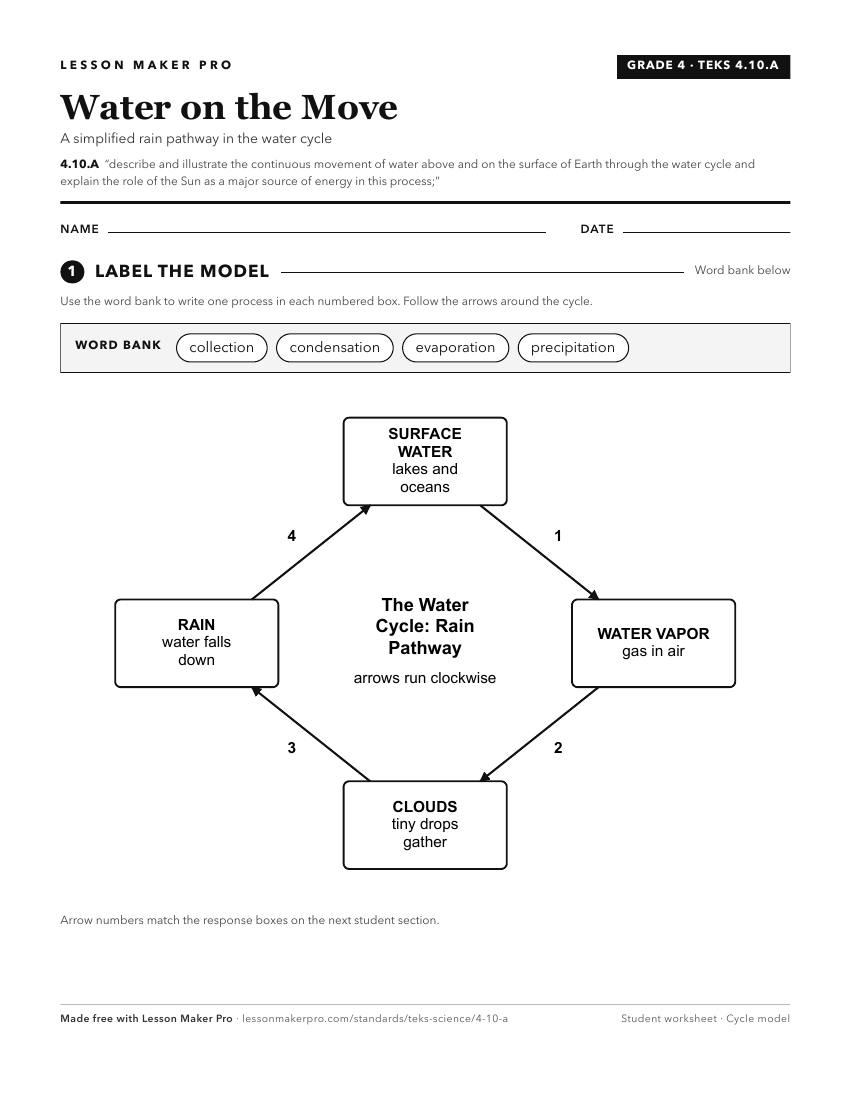
A ready-to-print activity worksheet aligned to 4.10.A, with an answer key for the teacher on its own page. No account needed.
PDF, US Letter, prints cleanly in black and white.
Download the worksheetKeep exploring
Related Standards
- 5.10.A
explain how the Sun and the ocean interact in the water cycle and affect weather
- 4.12.B
describe the cycling of matter and flow of energy through food webs, including the roles of the Sun, producers, consumers, and decomposers
- 6.9.A
model and illustrate how the tilted Earth revolves around the Sun, causing changes in seasons
- 8.10.A
describe how energy from the Sun, hydrosphere, and atmosphere interact and influence weather and climate
Turn this exact standard into a lesson
Grade, subject, topic, and the complete standard are prefilled. Create one free, no account needed.
Also for this standard:Make a WorksheetMake a QuizMake a Sub Lesson