Texas TEKS 6.9.A
The Standard
- 6.9
- Earth and space. The student models the cyclical movements of the Sun, Earth, and Moon and describes their effects. The student is expected to:
model and illustrate how the tilted Earth revolves around the Sun, causing changes in seasons
Texas Essential Knowledge and Skills for Science
Teacher's field guide
What This Standard Means
What Students Need to Do
- Students use a globe, lamp, or diagram to show Earth at different points in its orbit. They connect Earth’s fixed tilt to sunlight angle, daylight length, and opposite seasons in each hemisphere.
What Mastery Looks Like
- Students can place Earth correctly at four points in its orbit while keeping the axis pointed in the same direction. They identify each hemisphere’s season and explain it using sunlight angle and daylight length.
Common Misconceptions
- Students may think seasons happen because Earth moves closer to or farther from the Sun. They may also rotate the axis during the orbit or assign the same season to both hemispheres.
How to Assess It
- Give students a diagram showing a tilted Earth at one point in its orbit. Ask them to label each hemisphere’s season and cite two clues from the diagram.
Lesson moves
Ways to Teach It
Place a tilted foam-ball Earth beside a lamp, move it through four orbit positions, and record where light is most direct.
Ask, "Why is it summer in Australia when it is winter in Texas?" Require evidence about tilt, light angle, and daylight.
Play a card sort where teams match orbit positions, seasons, sunlight angles, and daylight lengths, then justify each set.
Compare monthly daylight and temperature graphs for Austin and Sydney, then explain why their warmest months occur at different times.
Free download
Printable 6.9.A Worksheet
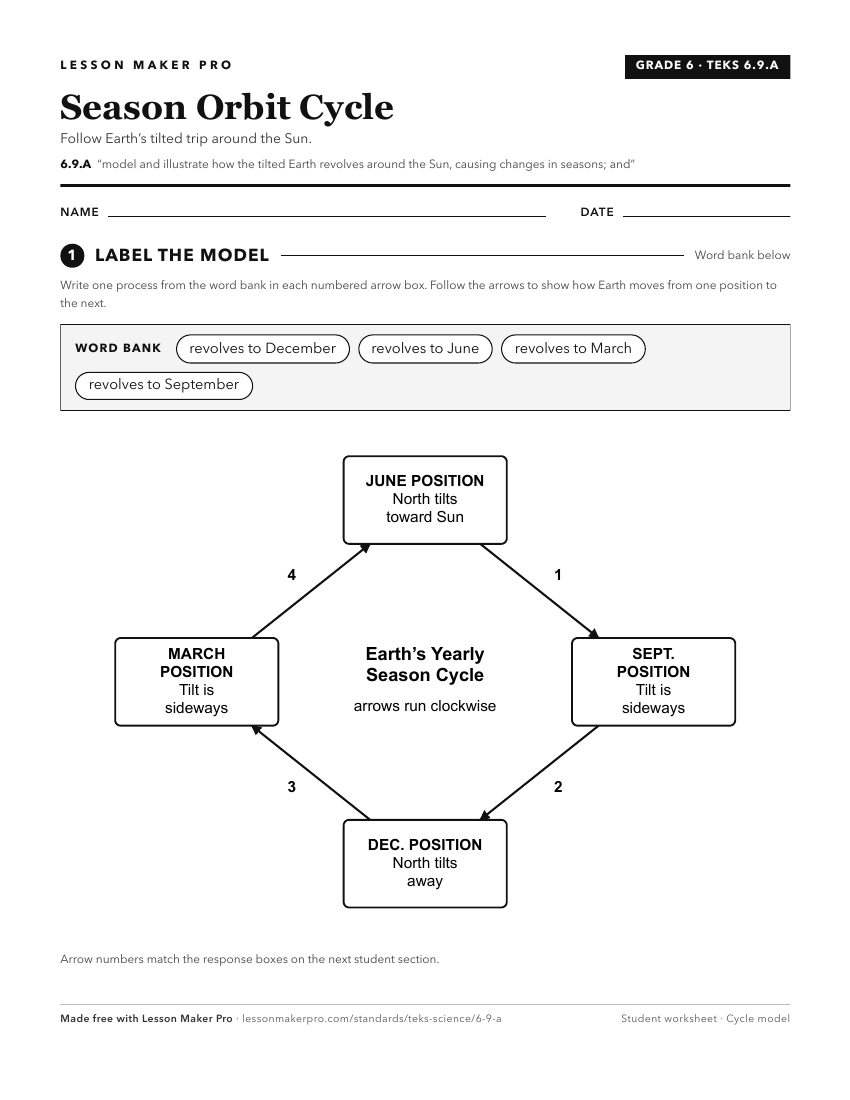
A ready-to-print activity worksheet aligned to 6.9.A, with an answer key for the teacher on its own page. No account needed.
PDF, US Letter, prints cleanly in black and white.
Download the worksheetKeep exploring
Related Standards
- 3.9.A
construct models and explain the orbits of the Sun, Earth, and Moon in relation to each other
- 6.9
Earth and space. The student models the cyclical movements of the Sun, Earth, and Moon and describes their effects. The student is expected to:
- 4.10.B
model and describe slow changes to Earth's surface caused by weathering, erosion, and deposition from water, wind, and ice
- 5.9
The student recognizes patterns among the Sun, Earth, and Moon system and their effects. The student is expected to demonstrate that Earth rotates on its axis o...
Turn this exact standard into a lesson
Grade, subject, topic, and the complete standard are prefilled. Create one free, no account needed.
Also for this standard:Make a WorksheetMake a QuizMake a Sub Lesson