Texas TEKS 5.9
TEKS Knowledge Statement (Expectation Cluster)
Earth and space. The student recognizes patterns among the Sun, Earth, and Moon system and their effects. The student is expected to demonstrate that Earth rotates on its axis once approximately every 24 hours and explain how that causes the day/night cycle and the appearance of the Sun moving across the sky, resulting in changes in shadow positions and shapes.
Texas Essential Knowledge and Skills for Science
Cluster contents
Student Expectations in This Statement
5.9 is a TEKS knowledge and skills statement. These are the student expectations under it.
- 5.9.Ademonstrate that Earth rotates on its axis once approximately every 24 hours and explain how that causes the day/night cycle and the appearance of the Sun moving across the sky, resulting in changes in shadow positions and shapes.
Teacher's field guide
What This Cluster Means
What Students Need to Do
- Students model Earth turning on its axis about once every 24 hours. They connect that rotation to day and night, the Sun’s apparent path, and changing shadows.
What Mastery Looks Like
- Students use a model or diagram to show why one side of Earth has daylight while the other has night. They explain how Earth’s rotation makes the Sun appear to move and changes a shadow’s direction, length, and shape.
Common Misconceptions
- Students may think the Sun travels around Earth each day or that Earth rotates once each year. They may also think shadows stay in one place or are always the same length. Some confuse Earth’s rotation with its orbit around the Sun.
How to Assess It
- Give students a diagram with morning, noon, and evening Sun positions. Ask them to draw each shadow and explain the pattern using Earth’s rotation.
Lesson moves
Ways to Teach It
Shine a lamp on a globe, rotate the globe slowly, and have students mark when Texas experiences day and night.
Ask students to explain why the Sun seems to cross the sky even though Earth is the object rotating.
Give groups Sun and shadow cards to sequence from morning to evening, then have them justify each placement.
Make a playground sundial with chalk and a meterstick, recording the shadow’s position, length, and shape three times during the day.
Free download
Printable 5.9 Worksheet
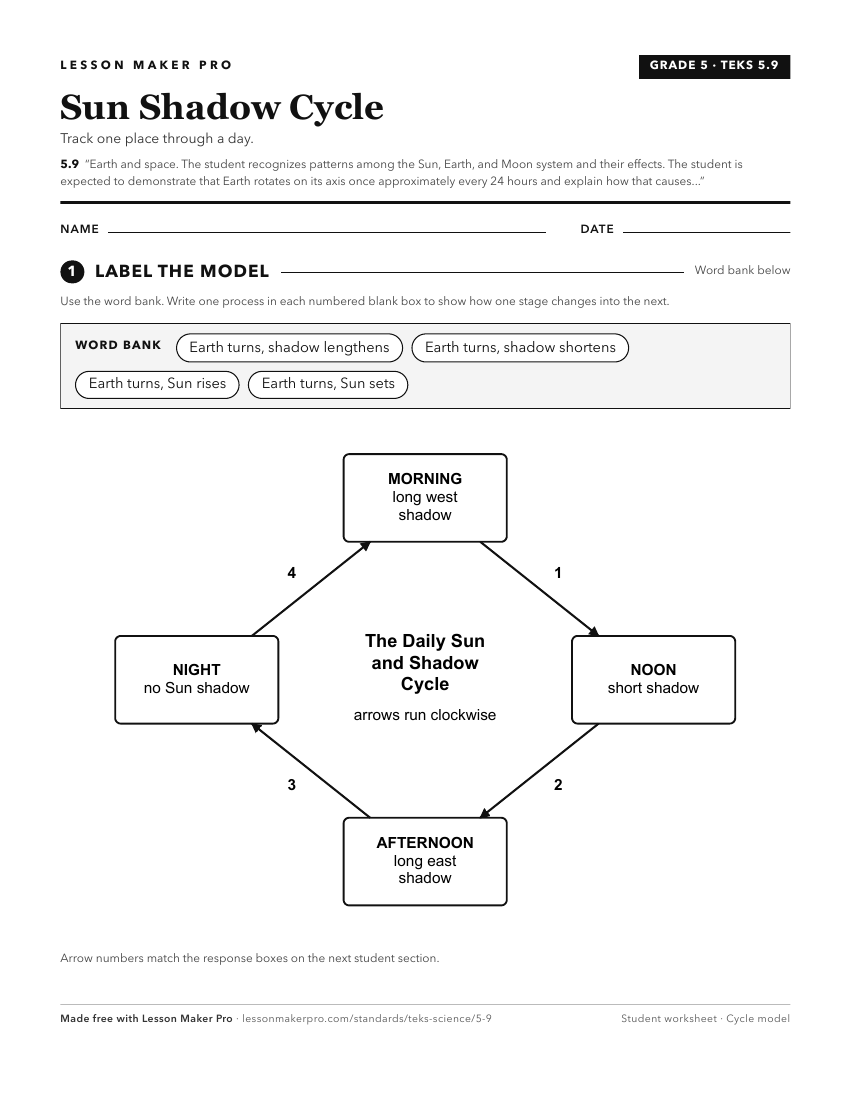
A ready-to-print activity worksheet aligned to 5.9, with an answer key for the teacher on its own page. No account needed.
PDF, US Letter, prints cleanly in black and white.
Download the worksheetKeep exploring
Related Standards
- 3.9
Earth and space. The student knows there are recognizable objects and patterns in Earth's solar system. The student is expected to:
- 4.9
Earth and space. The student recognizes patterns among the Sun, Earth, and Moon system and their effects. The student is expected to:
- 6.9
Earth and space. The student models the cyclical movements of the Sun, Earth, and Moon and describes their effects. The student is expected to:
- 7.9
Earth and space. The student understands the patterns of movement, organization, and characteristics of components of our solar system. The student is expected ...
Turn this cluster into a lesson
Grade, subject, topic, and the complete cluster are prefilled. Create one free, no account needed.
Also for this cluster:Make a WorksheetMake a QuizMake a Sub Lesson