Texas TEKS 6.9
TEKS Knowledge Statement (Expectation Cluster)
Earth and space. The student models the cyclical movements of the Sun, Earth, and Moon and describes their effects. The student is expected to: model and illustrate how the tilted Earth revolves around the Sun, causing changes in seasons; and describe and predict how the positions of the Earth, Sun, and Moon cause daily, spring, and neap cycles of ocean tides due to gravitational forces.
Texas Essential Knowledge and Skills for Science
Cluster contents
Student Expectations in This Statement
6.9 is a TEKS knowledge and skills statement. These are the student expectations under it.
Teacher's field guide
What This Cluster Means
What Students Need to Do
- Students build and read diagrams of the Sun, Earth, and Moon. They connect Earth’s tilt and orbit to sunlight angle, day length, and opposite seasons across hemispheres. They use relative positions to explain daily tides and predict spring or neap tidal ranges.
What Mastery Looks Like
- A student keeps Earth’s axis tilted in the same direction throughout an orbit model. The student identifies seasons from sunlight angle and day length, not distance from the Sun. Given a lunar position, the student traces daily tides and explains whether gravitational pulls produce spring or neap tides.
Common Misconceptions
- Students often say summer happens because Earth is closer to the Sun. They may think Earth’s axis changes direction as it orbits. They may connect spring tides to the spring season, expect one tide daily, or ignore the Sun’s gravitational pull.
How to Assess It
- Exit ticket: Draw a tilted Earth during Northern Hemisphere summer and label the sunlight angle. Then draw spring and neap tide alignments and show the expected tidal range for each.
Lesson moves
Ways to Teach It
Place a tilted globe at four points around a lamp, then record sunlight angle and day length for each hemisphere.
Ask students to explain why Australia has summer when Texas has winter using Earth’s tilt, sunlight angle, and day length.
Run a card sort matching Sun, Earth, and Moon position diagrams with spring tides, neap tides, and predicted tidal ranges.
Compare a coastal tide table with a Moon phase calendar, then mark dates when spring and neap tides should occur.
Free download
Printable 6.9 Worksheet
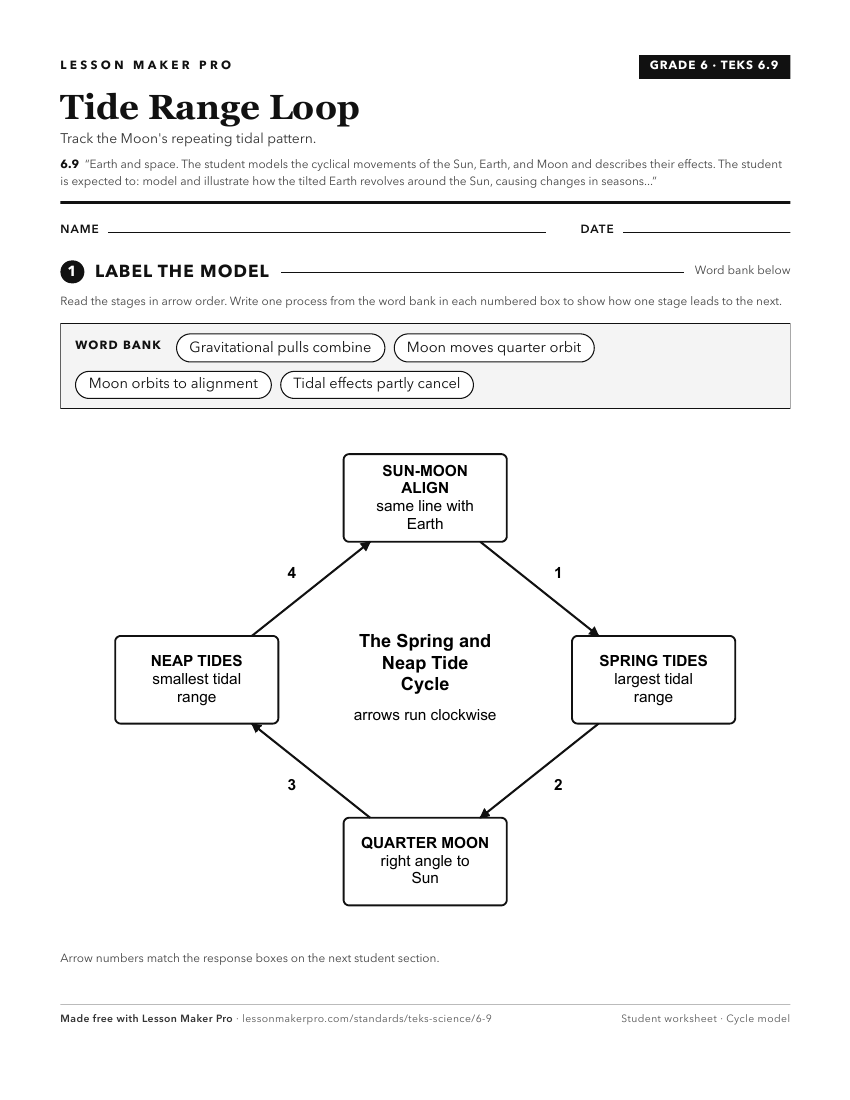
A ready-to-print activity worksheet aligned to 6.9, with an answer key for the teacher on its own page. No account needed.
PDF, US Letter, prints cleanly in black and white.
Download the worksheetKeep exploring
Related Standards
- 3.9
Earth and space. The student knows there are recognizable objects and patterns in Earth's solar system. The student is expected to:
- 4.10
Earth and space. The student knows that there are processes on Earth that create patterns of change. The student is expected to:
- 4.9
Earth and space. The student recognizes patterns among the Sun, Earth, and Moon system and their effects. The student is expected to:
- 7.9
Earth and space. The student understands the patterns of movement, organization, and characteristics of components of our solar system. The student is expected ...
Turn this cluster into a lesson
Grade, subject, topic, and the complete cluster are prefilled. Create one free, no account needed.
Also for this cluster:Make a WorksheetMake a QuizMake a Sub Lesson