Texas TEKS 6.9.B
The Standard
- 6.9
- Earth and space. The student models the cyclical movements of the Sun, Earth, and Moon and describes their effects. The student is expected to:
describe and predict how the positions of the Earth, Sun, and Moon cause daily, spring, and neap cycles of ocean tides due to gravitational forces.
Texas Essential Knowledge and Skills for Science
Teacher's field guide
What This Standard Means
What Students Need to Do
- Students explain how gravity from the Moon and Sun moves ocean water into tidal bulges. They connect Earth's rotation to daily high and low tides. They predict spring or neap tides from diagrams of the three bodies.
What Mastery Looks Like
- Students identify spring tides at new and full moons, when the Sun, Earth, and Moon align. They identify neap tides at quarter moons, when the pulls act at right angles. They use Earth's rotation to explain repeated high and low tides.
Common Misconceptions
- Students may think tides are waves caused by wind or that the Moon alone controls them. Some connect spring tides to the spring season. Others think every full moon creates only one unusually high tide.
How to Assess It
- Give students four Sun, Earth, and Moon diagrams showing new, full, and quarter moon positions. Ask them to label spring or neap tide and explain one choice using gravity.
Lesson moves
Ways to Teach It
Use a globe, Moon ball, Sun card, and clay ocean bulges to model daily rotation and changing tidal ranges.
Ask students to explain why spring tides occur during both new and full moons but not only during spring.
Have pairs sort position cards into spring tide, neap tide, and daily tide cycle groups, then justify each placement.
Give students a local tide table and ask them to identify daily highs, daily lows, and the dates with the greatest tidal range.
Free download
Printable 6.9.B Worksheet
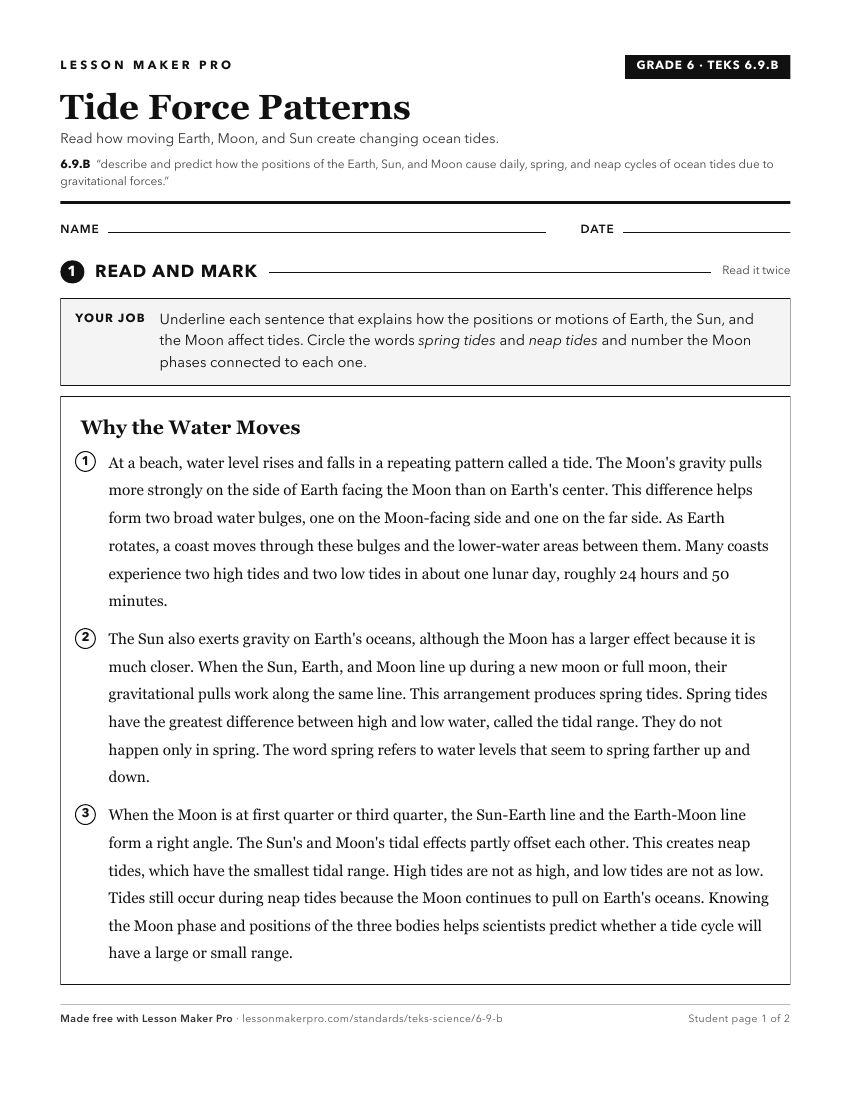
A ready-to-print activity worksheet aligned to 6.9.B, with an answer key for the teacher on its own page. No account needed.
PDF, US Letter, prints cleanly in black and white.
Download the worksheetKeep exploring
Related Standards
- 3.9.A
construct models and explain the orbits of the Sun, Earth, and Moon in relation to each other
- 6.9
Earth and space. The student models the cyclical movements of the Sun, Earth, and Moon and describes their effects. The student is expected to:
- 7.9.B
describe how gravity governs motion within Earth's solar system
- 5.9
The student recognizes patterns among the Sun, Earth, and Moon system and their effects. The student is expected to demonstrate that Earth rotates on its axis o...
Turn this exact standard into a lesson
Grade, subject, topic, and the complete standard are prefilled. Create one free, no account needed.
Also for this standard:Make a WorksheetMake a QuizMake a Sub Lesson