Texas TEKS 3.9.A
The Standard
- 3.9
- Earth and space. The student knows there are recognizable objects and patterns in Earth's solar system. The student is expected to:
construct models and explain the orbits of the Sun, Earth, and Moon in relation to each other
Texas Essential Knowledge and Skills for Science
Teacher's field guide
What This Standard Means
What Students Need to Do
- Students build a physical or drawn model showing how the Sun, Earth, and Moon move in relation to one another. They use arrows and labels to explain each path.
What Mastery Looks Like
- Students correctly show Earth traveling around the Sun and the Moon traveling around Earth. They can explain that both motions happen at the same time.
Common Misconceptions
- Students may show the Sun circling Earth or the Moon circling the Sun directly. They may confuse orbiting with spinning, or think the paths are perfect circles.
How to Assess It
- Ask students to draw the Sun, Earth, and Moon, add arrows for both orbits, and write one sentence explaining each arrow.
Lesson moves
Ways to Teach It
Use a lamp, globe, and foam ball to model Earth moving around the Sun while the Moon moves around Earth.
Ask students to explain why the Moon travels with Earth instead of being left behind as Earth circles the Sun.
Give pairs picture cards of orbital positions and have them arrange the cards into a correct repeating sequence.
Compare a monthly Moon observation calendar with the model and discuss how the Moon's changing position affects what people see.
Free download
Printable 3.9.A Worksheet
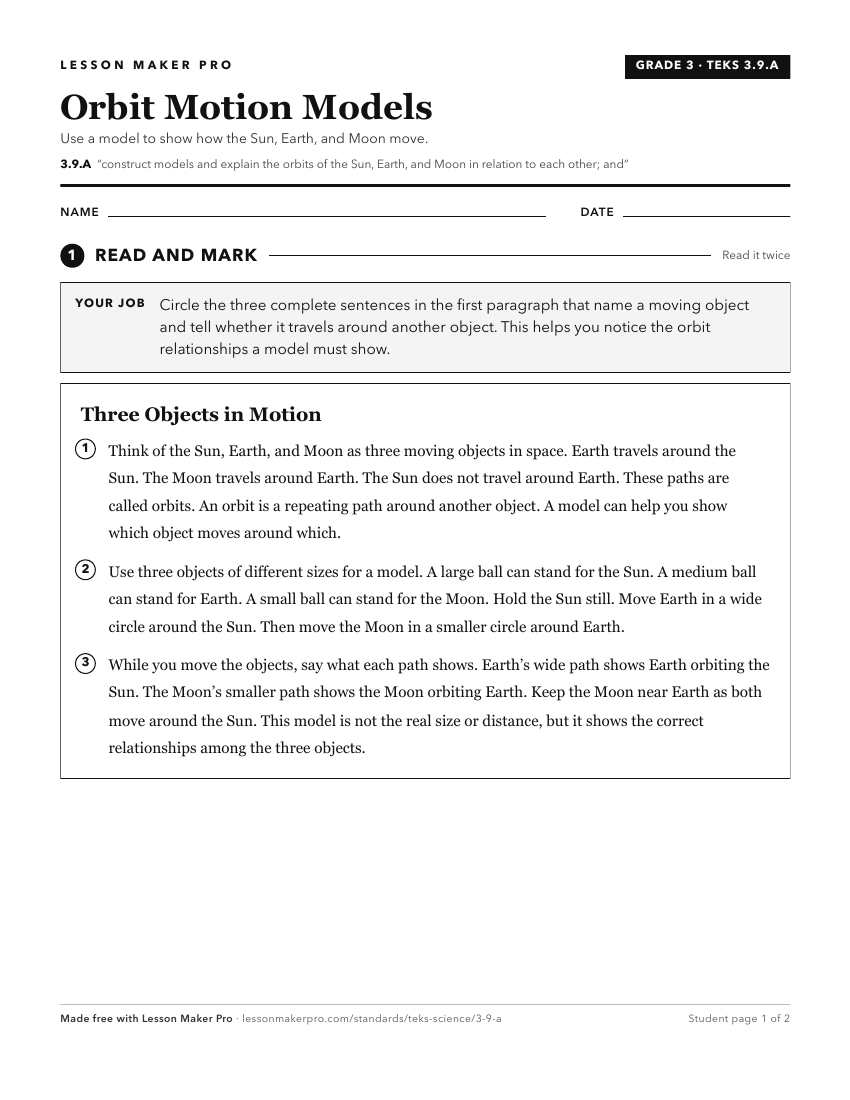
A ready-to-print activity worksheet aligned to 3.9.A, with an answer key for the teacher on its own page. No account needed.
PDF, US Letter, prints cleanly in black and white.
Download the worksheetKeep exploring
Related Standards
- 6.9.B
describe and predict how the positions of the Earth, Sun, and Moon cause daily, spring, and neap cycles of ocean tides due to gravitational forces.
- 6.9.A
model and illustrate how the tilted Earth revolves around the Sun, causing changes in seasons
- 4.9
Earth and space. The student recognizes patterns among the Sun, Earth, and Moon system and their effects. The student is expected to:
- 6.9
Earth and space. The student models the cyclical movements of the Sun, Earth, and Moon and describes their effects. The student is expected to:
Turn this exact standard into a lesson
Grade, subject, topic, and the complete standard are prefilled. Create one free, no account needed.
Also for this standard:Make a WorksheetMake a QuizMake a Sub Lesson