Texas TEKS 7.9.A
The Standard
- 7.9
- Earth and space. The student understands the patterns of movement, organization, and characteristics of components of our solar system. The student is expected to:
describe the physical properties, locations, and movements of the Sun, planets, moons, meteors, asteroids, comets, Kuiper belt, and Oort cloud
Texas Essential Knowledge and Skills for Science
Teacher's field guide
What This Standard Means
What Students Need to Do
- Students identify solar system bodies and regions by composition, size or form, location, and movement. They compare what rotates, what orbits the Sun, what orbits planets, and what enters Earth's atmosphere.
What Mastery Looks Like
- Given an unlabeled diagram and object clues, a student places the major bodies, belts, and distant cloud in the correct relative locations. They use size, shape, and composition clues to identify objects. They accurately describe rotation, revolution, and atmospheric entry.
Common Misconceptions
- Students may call every small rocky body a meteor, though a meteor is the streak produced when a meteoroid enters an atmosphere. They often swap the asteroid belt and Kuiper belt, or draw the Oort cloud as a flat ring. Some assume every orbit is circular and every object moves at the same speed.
How to Assess It
- Exit ticket: On a blank diagram, place the Sun, a planet with one moon, asteroid belt, Kuiper belt, and Oort cloud. Add an asteroid, comet, and meteor, then label one property and show each object's motion with arrows.
Lesson moves
Ways to Teach It
Arrange hoops and object cards on the floor, with Oort cloud cards on walls, then move planets, moons, asteroids, and comets.
Ask students to explain why a comet can appear near the Sun even if it came from far beyond Neptune.
Play a clue card sort where teams match each object to its physical properties, location, and movement, then defend one disputed match.
Read a local meteor shower forecast, identify its parent comet, and sketch how Earth crosses the debris stream.
Free download
Printable 7.9.A Worksheet
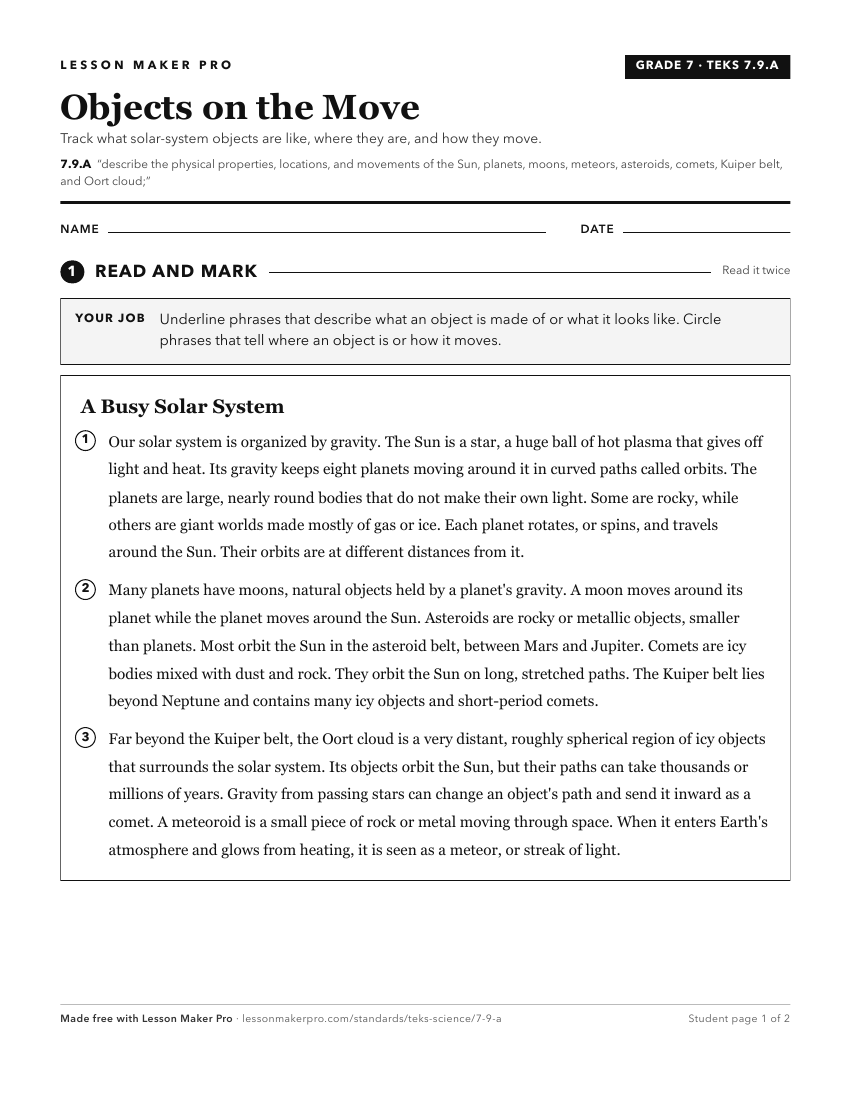
A ready-to-print activity worksheet aligned to 7.9.A, with an answer key for the teacher on its own page. No account needed.
PDF, US Letter, prints cleanly in black and white.
Download the worksheetKeep exploring
Related Standards
- K.9.B
observe, describe, and illustrate the Sun, Moon, stars, and objects in the sky such as clouds.
- 6.9
Earth and space. The student models the cyclical movements of the Sun, Earth, and Moon and describes their effects. The student is expected to:
- 7.9
Earth and space. The student understands the patterns of movement, organization, and characteristics of components of our solar system. The student is expected ...
- 7.9.B
describe how gravity governs motion within Earth's solar system
Turn this exact standard into a lesson
Grade, subject, topic, and the complete standard are prefilled. Create one free, no account needed.
Also for this standard:Make a WorksheetMake a QuizMake a Sub Lesson