Texas TEKS 8.9.A
The Standard
- 8.9
- The student describes the characteristics of the universe and the relative scale of its components
describe the life cycle of stars and compare and classify stars using the Hertzsprung- Russell diagram
Texas Essential Knowledge and Skills for Science
Teacher's field guide
What This Standard Means
What Students Need to Do
- Students trace how low-mass and high-mass stars change from a nebula to their final stages. They use surface temperature and luminosity to place stars on an H-R diagram. They identify main-sequence stars, giants, supergiants, and white dwarfs.
What Mastery Looks Like
- Given star data, students correctly plot and classify each star. They explain that a star’s mass affects its path and final stage. They distinguish the path to a white dwarf from the path to a neutron star or black hole.
Common Misconceptions
- Students often think hotter stars appear on the right, although temperature decreases from left to right. They may confuse luminosity with apparent brightness or think every star becomes a supernova. Some treat the diagram as a timeline rather than a classification graph.
How to Assess It
- Exit ticket: Give students an H-R diagram and data for two stars. Ask them to plot, classify, and predict the likely final stage of each star.
Lesson moves
Ways to Teach It
Give groups star cards with temperature and luminosity data, then have them place the cards on a large floor H-R diagram.
Ask students to write why the Sun and a blue supergiant will not have the same final stage.
Play a card-sorting race where teams match star descriptions to main sequence, giant, supergiant, or white dwarf regions.
Compare the Sun, Sirius, Betelgeuse, and Proxima Centauri using real temperature and luminosity data from a reference table.
Free download
Printable 8.9.A Worksheet
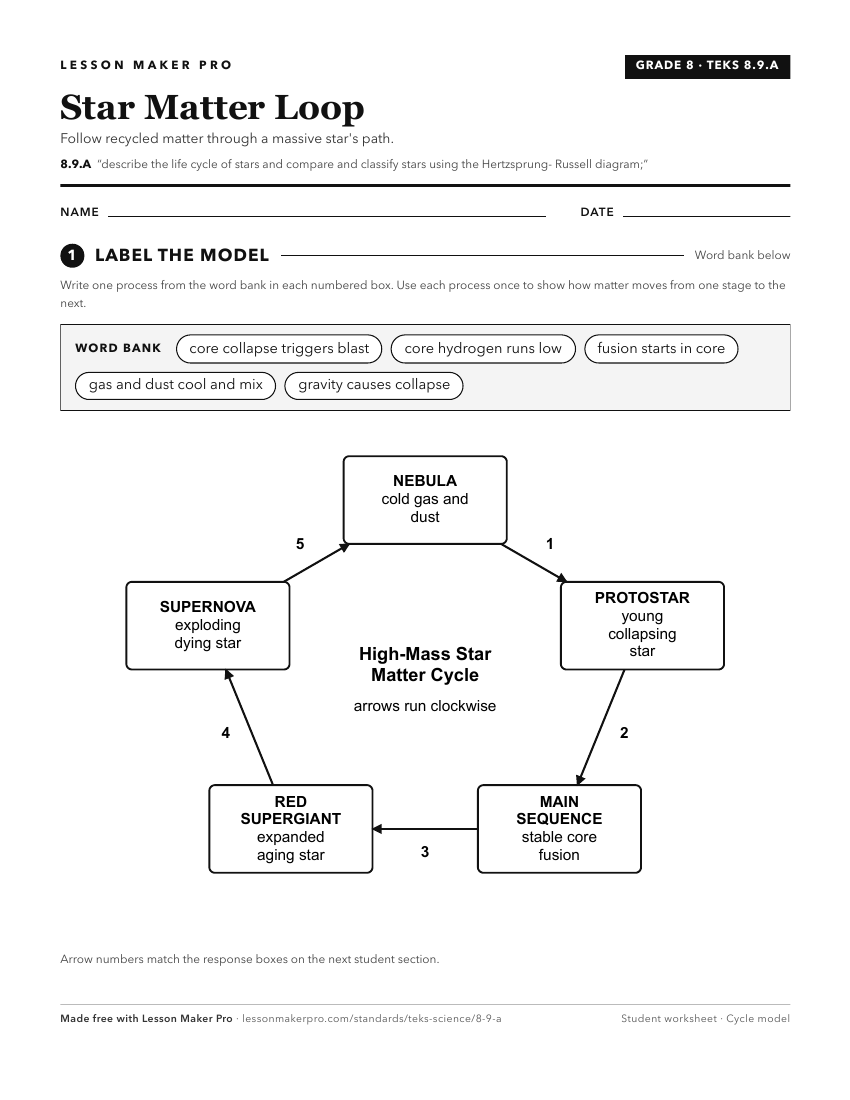
A ready-to-print activity worksheet aligned to 8.9.A, with an answer key for the teacher on its own page. No account needed.
PDF, US Letter, prints cleanly in black and white.
Download the worksheetKeep exploring
Related Standards
- K.9.B
observe, describe, and illustrate the Sun, Moon, stars, and objects in the sky such as clouds.
- K.10.A
describe and classify rocks by the observable properties of size, shape, color, and texture
- 8.9.B
categorize galaxies as spiral, elliptical, and irregular and locate Earth's solar system within the Milky Way galaxy
- 2.9.A
describe the Sun as a star that provides light and heat and explain that the Moon reflects the Sun's light
Turn this exact standard into a lesson
Grade, subject, topic, and the complete standard are prefilled. Create one free, no account needed.
Also for this standard:Make a WorksheetMake a QuizMake a Sub Lesson