Texas TEKS 2.10
TEKS Knowledge Statement (Expectation Cluster)
Earth and space. The student knows that the natural world includes earth materials that can be observed in systems and processes. The student is expected to: investigate and describe how wind and water move soil and rock particles across the Earth's surface such as wind blowing sand into dunes on a beach or a river carrying rocks as it flows; measure, record, and graph weather information, including temperature and precipitation; and investigate different types of severe weather events such as a hurricane, tornado, or flood and explain that some events are more likely than others in a given region.
Texas Essential Knowledge and Skills for Science
Cluster contents
Student Expectations in This Statement
2.10 is a TEKS knowledge and skills statement. These are the student expectations under it.
- 2.10.A
investigate and describe how wind and water move soil and rock particles across the Earth's surface such as wind blowing sand into dunes on a beach or a river c...
- 2.10.B
measure, record, and graph weather information, including temperature and precipitation
- 2.10.C
investigate different types of severe weather events such as a hurricane, tornado, or flood and explain that some events are more likely than others in a given ...
Teacher's field guide
What This Cluster Means
What Students Need to Do
- Students test how moving air and water carry soil, sand, and small rocks, then describe what changed. They measure temperature and rainfall, record the data, and make a graph. They also compare hurricanes, tornadoes, and floods to decide which are more likely in different regions.
What Mastery Looks Like
- Students can use a model to explain what moved earth materials and where the particles went. They can read weather tools, label a graph correctly, and describe a pattern in the data. They can name a likely severe weather event for a region and give a sensible reason.
Common Misconceptions
- Students may think wind and water move whole landforms at once rather than carrying particles over time. They may confuse temperature with rainfall or leave out units and graph labels. They may also think every severe weather event is equally likely everywhere.
How to Assess It
- Give students before-and-after stream tray pictures, a five-day rainfall table, and three short region descriptions. Ask them to identify what moved the particles, graph the rainfall, and match one severe event to its most likely region with a reason.
Lesson moves
Ways to Teach It
Use trays of sand and pebbles, then test a fan and poured water to observe, sketch, and compare particle movement.
Write which force moved larger particles in the tray, then support your answer with two observations.
Play Weather Reporter: teams read daily temperature and rain cards, add data to a class graph, and report patterns.
Compare local severe weather records with coastal and plains records, then identify which event residents in each place should prepare for.
Free download
Printable 2.10 Worksheet
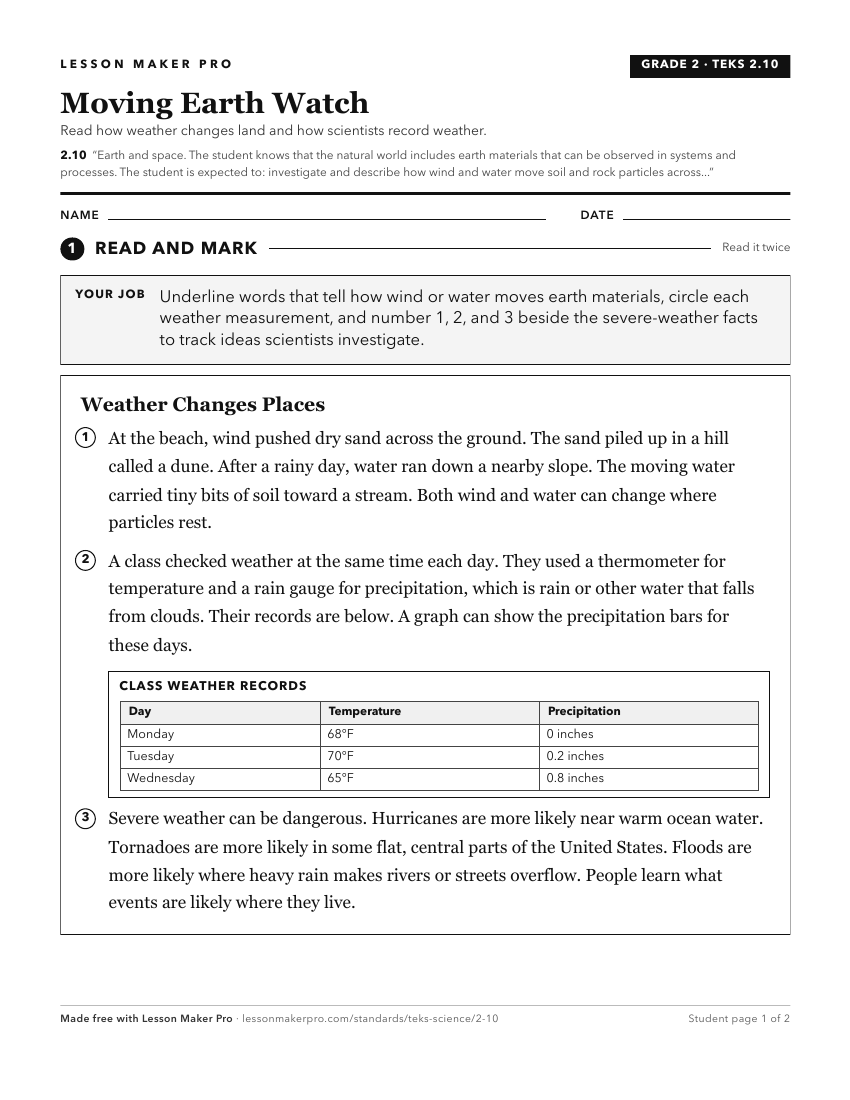
A ready-to-print activity worksheet aligned to 2.10, with an answer key for the teacher on its own page. No account needed.
PDF, US Letter, prints cleanly in black and white.
Download the worksheetKeep exploring
Related Standards
- 1.10
The 1st Grade version of this standard.
- K.10
Earth and space. The student knows that the natural world includes earth materials and systems that can be observed. The student is expected to:
- 3.10
Earth and space. The student knows that there are recognizable processes that change Earth over time. The student is expected to:
- 5.10
Earth and space. The student knows that there are recognizable patterns and processes on Earth. The student is expected to:
Turn this cluster into a lesson
Grade, subject, topic, and the complete cluster are prefilled. Create one free, no account needed.
Also for this cluster:Make a WorksheetMake a QuizMake a Sub Lesson