Texas TEKS 2.10.B
The Standard
- 2.10
- Earth and space. The student knows that the natural world includes earth materials that can be observed in systems and processes. The student is expected to:
measure, record, and graph weather information, including temperature and precipitation
Texas Essential Knowledge and Skills for Science
Teacher's field guide
What This Standard Means
What Students Need to Do
- Students use a thermometer and rain gauge to collect daily weather data. They record each reading in a table, make graphs, and compare different days.
What Mastery Looks Like
- Students accurately read each tool and record values with correct units. They create graphs with titles, labels, and equal intervals, then identify warmer or wetter days.
Common Misconceptions
- Students may confuse rainfall with the chance of rain or call clouds precipitation. They may omit units, misread tool scales, or use uneven intervals on a graph.
How to Assess It
- Give students this data: Monday 68°F and 0 inches, Tuesday 72°F and 1 inch, Wednesday 70°F and 2 inches. Have them create separate temperature and rainfall graphs with titles, labels, and units.
Lesson moves
Ways to Teach It
Set up a thermometer and rain gauge outdoors, then have pairs read each tool and add results to a class chart.
Have students answer this prompt: What pattern do you notice in our five-day weather graph, and what data supports your answer?
Play Weather Graph Match by pairing cards that show tool readings, data tables, and matching bar graphs.
Compare the class rainfall graph with a local forecast, then decide whether the school garden needs watering.
Free download
Printable 2.10.B Worksheet
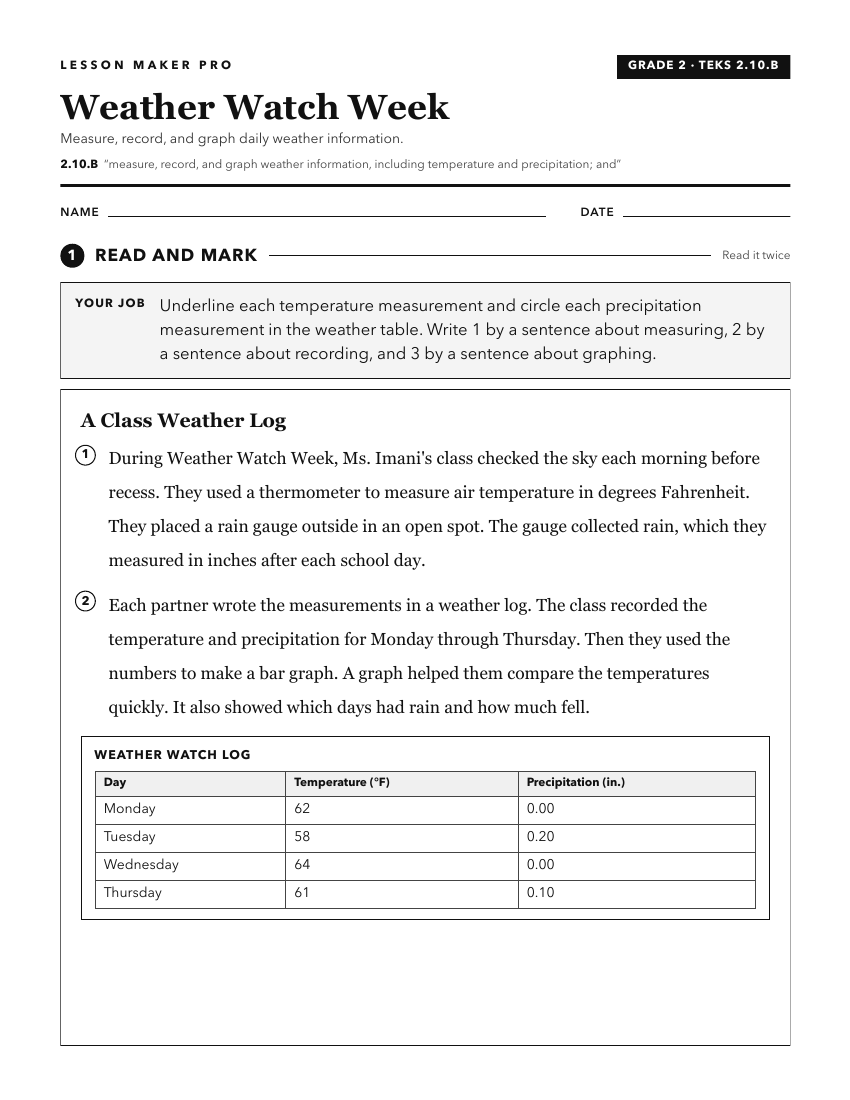
A ready-to-print activity worksheet aligned to 2.10.B, with an answer key for the teacher on its own page. No account needed.
PDF, US Letter, prints cleanly in black and white.
Download the worksheetKeep exploring
Related Standards
- 4.9.A
collect and analyze data to identify sequences and predict patterns of change in seasons such as change in temperature and length of daylight
- K.10.B
observe and describe weather changes from day to day and over seasons
- 3.10.A
compare and describe day-to-day weather in different locations at the same time, including air temperature, wind direction, and precipitation
- 7.7.C
measure, record, and interpret an object's motion using distance-time graphs
Turn this exact standard into a lesson
Grade, subject, topic, and the complete standard are prefilled. Create one free, no account needed.
Also for this standard:Make a WorksheetMake a QuizMake a Sub Lesson