Texas TEKS 2.10.C
The Standard
- 2.10
- Earth and space. The student knows that the natural world includes earth materials that can be observed in systems and processes. The student is expected to:
investigate different types of severe weather events such as a hurricane, tornado, or flood and explain that some events are more likely than others in a given region.
Texas Essential Knowledge and Skills for Science
Teacher's field guide
What This Standard Means
What Students Need to Do
- Students compare hurricanes, tornadoes, and floods by observing models, pictures, maps, and weather reports. They explain why location makes one event more likely than another.
What Mastery Looks Like
- Students can identify key features of each weather event and connect it to likely regions. They use evidence such as nearby oceans, rivers, or storm patterns.
Common Misconceptions
- Students may think every severe weather event is equally likely everywhere. They may believe an event cannot happen outside its most common region. They may also confuse strong wind, heavy rain, and flooding.
How to Assess It
- Show a map with a Gulf Coast city, a Great Plains city, and a town beside a river. Ask students to match each place with a likely event and explain one choice.
Lesson moves
Ways to Teach It
Build a flood model with soil, blocks, and water, then observe how water moves across high and low ground.
Ask students to write which severe weather event is most likely near their community and give one location clue.
Play a region-match game using cards for hurricanes, tornadoes, floods, coasts, plains, rivers, and low ground.
Check a local weather hazard map and have students identify the severe weather events listed for their county.
Free download
Printable 2.10.C Worksheet
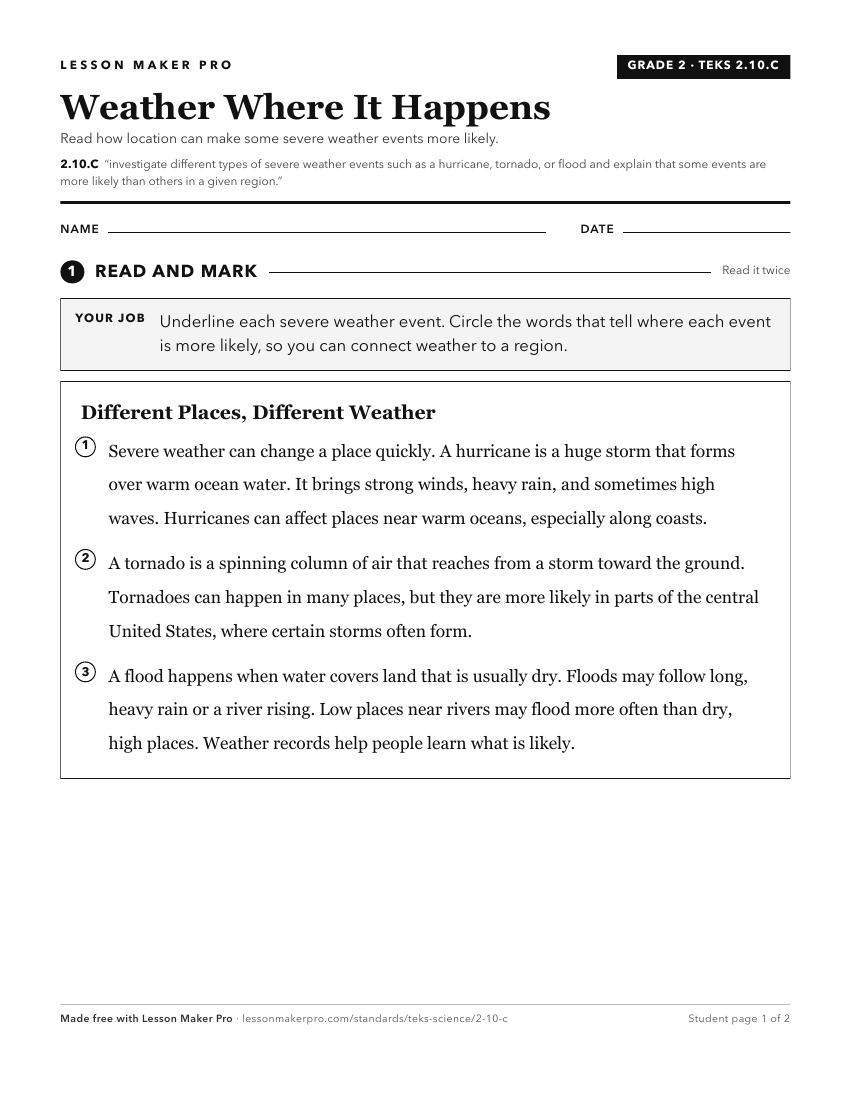
A ready-to-print activity worksheet aligned to 2.10.C, with an answer key for the teacher on its own page. No account needed.
PDF, US Letter, prints cleanly in black and white.
Download the worksheetKeep exploring
Related Standards
- 8.10.B
identify global patterns of atmospheric movement and how they influence local weather
- 1.10.D
describe and record observable characteristics of weather, including hot or cold, clear or cloudy, calm or windy, and rainy or icy, and explain the impact of we...
- K.10.B
observe and describe weather changes from day to day and over seasons
- 3.10.A
compare and describe day-to-day weather in different locations at the same time, including air temperature, wind direction, and precipitation
Turn this exact standard into a lesson
Grade, subject, topic, and the complete standard are prefilled. Create one free, no account needed.
Also for this standard:Make a WorksheetMake a QuizMake a Sub Lesson