TEKS Math 5.6
Knowledge and Skills Statement (Standard Cluster)
The student applies mathematical process standards to understand, recognize, and quantify volume
Texas Essential Knowledge and Skills for Mathematics
Cluster contents
Student Expectations in This Statement
5.6 is a knowledge and skills statement. These are the student expectations under it.
- 5.6.A
recognize a cube with side length of one unit as a unit cube having one cubic unit of volume and the volume of a three-dimensional figure as the number of unit ...
- 5.6.B
determine the volume of a rectangular prism with whole number side lengths in problems related to the number of layers times the number of unit cubes in the are...
Teacher's field guide
What This Cluster Means
What Students Need to Do
- Students treat a one-unit cube as one cubic unit of volume. They determine how many unit cubes fill a rectangular prism by multiplying cubes per layer by the number of layers.
What Mastery Looks Like
- Students explain that each unit cube takes up one cubic unit of space. They find the base area, multiply by the number of layers, and label the answer in cubic units.
Common Misconceptions
- Students may count only visible cubes or add edge lengths instead of finding volume. They may use square units, ignore hidden cubes, or confuse the base area with the total volume.
How to Assess It
- Give a drawing of a prism with a 4 by 3 base and 5 layers. Ask, “How many unit cubes fill it, and what unit labels your answer?”
Lesson moves
Ways to Teach It
Build rectangular prisms with linking cubes, then record the base dimensions, number of layers, and total volume.
Show a prism with hidden cubes and ask students to write how they can find the total without seeing every cube.
Play Volume Match with cards showing prism dimensions, base areas, layer counts, and volumes for students to pair.
Measure a small box, then calculate how many one-inch cubes would fill it without gaps or overlaps.
Free download
Printable 5.6 Worksheet
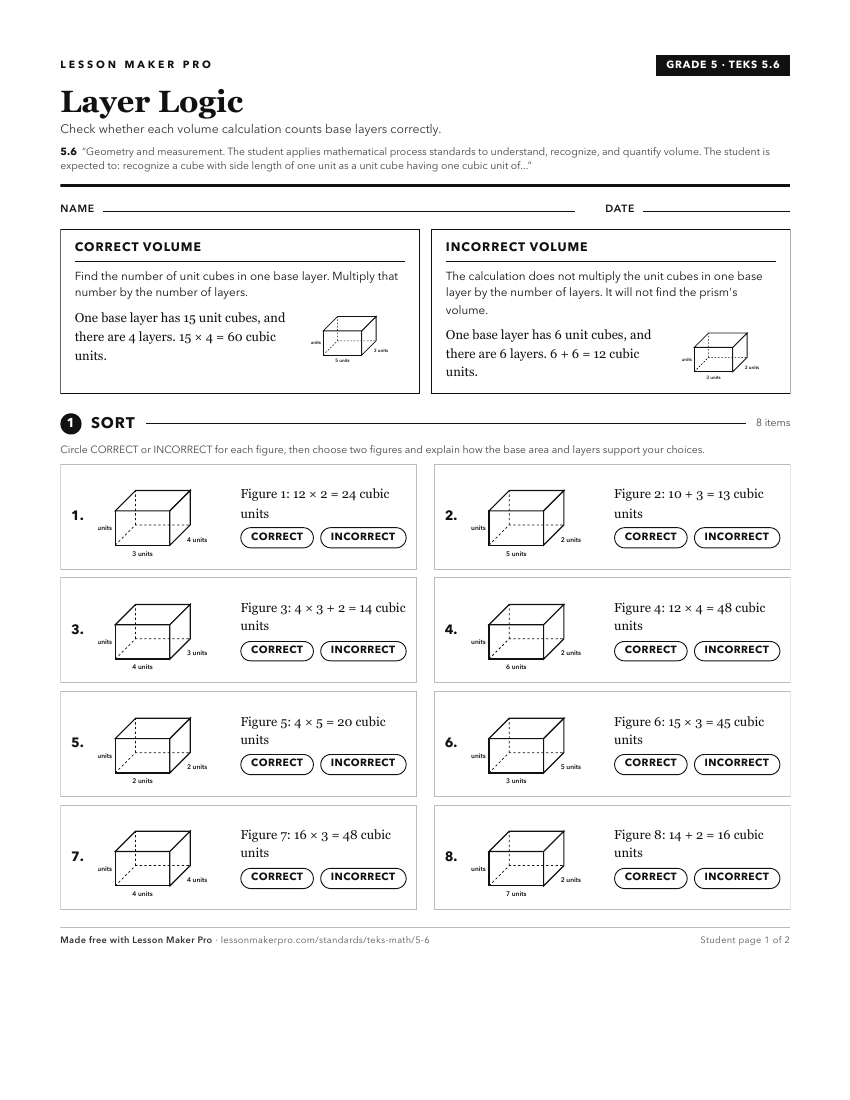
A ready-to-print activity worksheet aligned to 5.6, with an answer key for the teacher on its own page. No account needed.
PDF, US Letter, prints cleanly in black and white.
Download the worksheetKeep exploring
Related Standards
- 7.8
The student applies mathematical process standards to develop geometric relationships with volume
- 6.13
The student applies mathematical process standards to use numerical or graphical representations to solve problems
- 6.4
The student applies mathematical process standards to develop an understanding of proportional relationships in problem situations
- 6.12
The student applies mathematical process standards to use numerical or graphical representations to analyze problems
Turn this cluster into a lesson
Grade, subject, topic, and the complete cluster are prefilled. Create one free, no account needed.
Also for this cluster:Make a WorksheetMake a QuizMake a Sub Lesson