TEKS Math 7.8
Knowledge and Skills Statement (Standard Cluster)
The student applies mathematical process standards to develop geometric relationships with volume
Texas Essential Knowledge and Skills for Mathematics
Cluster contents
Student Expectations in This Statement
7.8 is a knowledge and skills statement. These are the student expectations under it.
- 7.8.A
model the relationship between the volume of a rectangular prism and a rectangular pyramid having both congruent bases and heights and connect that relationship...
- 7.8.B
explain verbally and symbolically the relationship between the volume of a triangular prism and a triangular pyramid having both congruent bases and heights and...
- 7.8.C
use models to determine the approximate formulas for the circumference and area of a circle and connect the models to the actual formulas
Teacher's field guide
What This Cluster Means
What Students Need to Do
- Students compare prisms and pyramids with matching base areas and heights, then show why a pyramid holds one-third as much as its prism. They write and explain the related volume formulas for rectangular and triangular bases. They use circle models to estimate pi and connect the results to circumference and area formulas.
What Mastery Looks Like
- Given dimensions, students identify base area and height, choose the correct volume formula, and calculate with cubic units. They explain the one-third factor using a matched prism and pyramid. They calculate circle circumference and area using radius or diameter correctly.
Common Misconceptions
- Students often forget the one-third factor for pyramids or use it for prisms. They may confuse radius with diameter, mix up circumference and area formulas, or use square units for volume.
How to Assess It
- Give an exit ticket with a matched prism and pyramid and a circle with a labeled diameter. Ask students to write each formula, calculate each measure, and label the units.
Lesson moves
Ways to Teach It
Fill a plastic pyramid with rice three times and pour it into a matching prism, then record the volume relationship.
Ask students to explain, in words and symbols, why changing a prism into a matching pyramid multiplies its volume by one-third.
Run a card sort matching solids and circles to dimensions, base areas, formulas, numerical answers, and correct units.
Measure jar lids with string and rulers, calculate circumference and area, then compare calculated circumference with the string measurement.
Free download
Printable 7.8 Worksheet
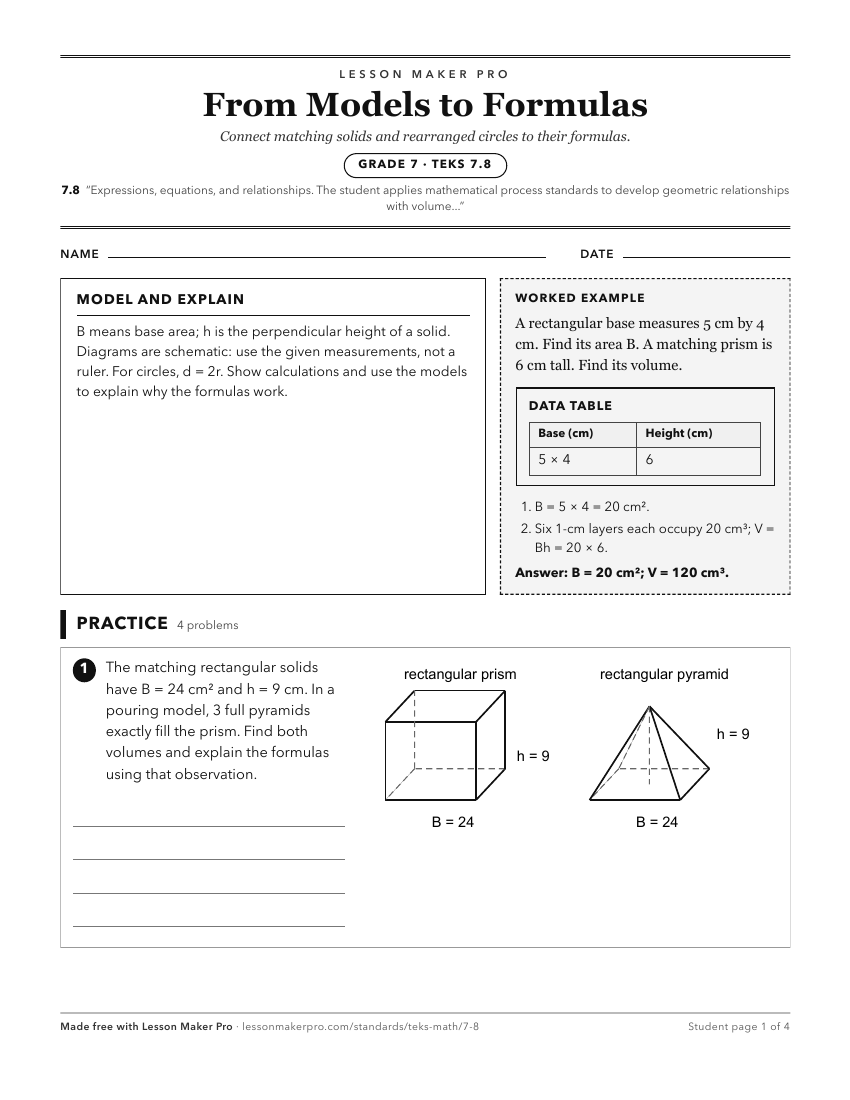
A ready-to-print activity worksheet aligned to 7.8, with an answer key for the teacher on its own page. No account needed.
PDF, US Letter, prints cleanly in black and white.
Download the worksheetKeep exploring
Related Standards
- 8.6
The student applies mathematical process standards to develop mathematical relationships and make connections to geometric formulas
- 7.9
The student applies mathematical process standards to solve geometric problems
- 5.6
The student applies mathematical process standards to understand, recognize, and quantify volume
- 6.8
The student applies mathematical process standards to use geometry to represent relationships and solve problems
Turn this cluster into a lesson
Grade, subject, topic, and the complete cluster are prefilled. Create one free, no account needed.
Also for this cluster:Make a WorksheetMake a QuizMake a Sub Lesson