TEKS Math 5.6.A
The Standard
recognize a cube with side length of one unit as a unit cube having one cubic unit of volume and the volume of a three-dimensional figure as the number of unit cubes (n cubic units) needed to fill it with no gaps or overlaps if possible
Texas Essential Knowledge and Skills for Mathematics
Teacher's field guide
What This Standard Means
What Students Need to Do
- Students connect one unit cube to one cubic unit of volume. They count the cubes needed to fill a solid completely, with no empty spaces or cubes occupying the same space.
What Mastery Looks Like
- Students identify a cube with one-unit edges as one cubic unit. They find a solid’s volume by counting all unit cubes, including cubes hidden from view, and label the result in cubic units.
Common Misconceptions
- Students may use square units instead of cubic units. They may count only visible cubes or assume cubes can leave gaps and still measure the full volume.
How to Assess It
- Show a drawing of a solid made from 12 unit cubes, including hidden cubes. Ask, “What is its volume, and how do you know?”
Lesson moves
Ways to Teach It
Give pairs unit cubes to build solids with volumes of 8, 12, and 16 cubic units, then sketch and label each solid.
Ask students to explain why counting only the top and front cubes may give an incorrect volume.
Play Volume Match by pairing solid drawings with volume cards, then have students justify each match by describing layers.
Measure a small box with unit cubes and discuss why packing boxes tightly helps shipping companies calculate storage space.
Free download
Printable 5.6.A Worksheet
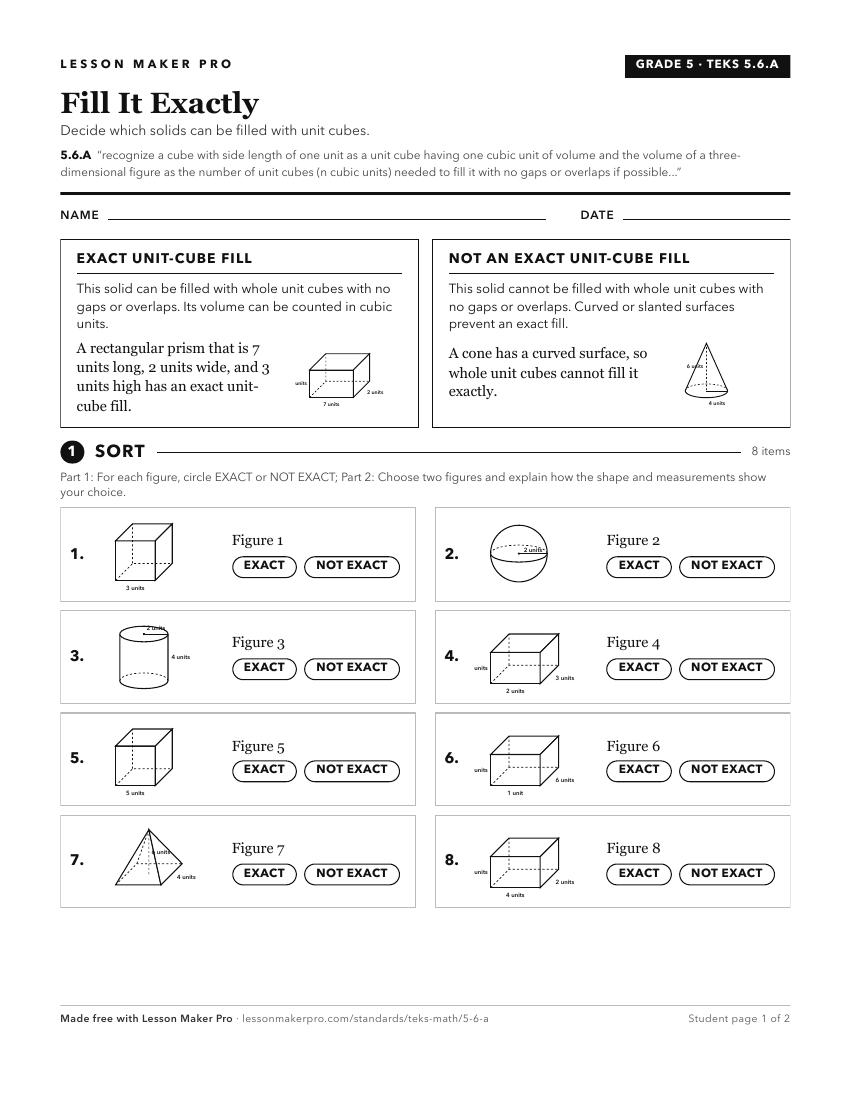
A ready-to-print activity worksheet aligned to 5.6.A, with an answer key for the teacher on its own page. No account needed.
PDF, US Letter, prints cleanly in black and white.
Download the worksheetKeep exploring
Related Standards
- 1.6.E
identify three-dimensional solids, including spheres, cones, cylinders, rectangular prisms (including cubes), and triangular prisms, and describe their attribut...
- K.6.B
identify three-dimensional solids, including cylinders, cones, spheres, and cubes, in the real world
- 5.6.B
determine the volume of a rectangular prism with whole number side lengths in problems related to the number of layers times the number of unit cubes in the are...
- 3.6.E
decompose two congruent two-dimensional figures into parts with equal areas and express the area of each part as a unit fraction of the whole and recognize that...
Turn this exact standard into a lesson
Grade, subject, topic, and the complete standard are prefilled. Create one free, no account needed.
Also for this standard:Make a WorksheetMake a QuizMake a Sub Lesson