TEKS ELAR 7.1
Knowledge and Skills Statement (Standard Cluster)
Developing and sustaining foundational language skills: listening, speaking, discussion, and thinking--oral language. The student develops oral language through listening, speaking, and discussion. The student is expected to: listen actively to interpret a message and ask clarifying questions that build on others' ideas; follow and give complex oral instructions to perform specific tasks, answer questions, or solve problems; present a critique of a literary work, film, or dramatic production, employing eye contact, speaking rate, volume, enunciation, a variety of natural gestures, and conventions of language to communicate ideas effectively; and engage in meaningful discourse and provide and accept constructive feedback from others.
Texas Essential Knowledge and Skills for English Language Arts and Reading
Cluster contents
Student Expectations in This Statement
7.1 is a knowledge and skills statement. These are the student expectations under it.
- 7.1.A
listen actively to interpret a message and ask clarifying questions that build on others' ideas
- 7.1.B
follow and give complex oral instructions to perform specific tasks, answer questions, or solve problems
- 7.1.C
present a critique of a literary work, film, or dramatic production, employing eye contact, speaking rate, volume, enunciation, a variety of natural gestures, a...
- 7.1.D
engage in meaningful discourse and provide and accept constructive feedback from others
Teacher's field guide
What This Cluster Means
What Students Need to Do
- Students identify a speaker's message, connect it to earlier comments, and ask questions that clear up or extend ideas. They carry out and give multistep spoken directions. They present supported critiques clearly, then exchange specific, useful feedback.
What Mastery Looks Like
- After listening, students give an accurate summary and ask a question tied to a specific detail. They complete multistep directions and clarify confusing steps. Their critiques use evidence, clear speech, natural eye contact, and respectful responses to feedback.
Common Misconceptions
- Students ask vague or off-topic questions instead of referring to a speaker's idea. They miss sequence words or conditions in spoken directions. They summarize a work instead of judging it, give unsupported opinions, or treat feedback as personal criticism.
How to Assess It
- Give these oral directions: choose a familiar book or film, name one strength or weakness, cite one scene, and present for 45 seconds. A partner records the claim and evidence, asks one clarifying question, and gives one specific suggestion.
Lesson moves
Ways to Teach It
Give pairs six plastic cups; one student views a model and gives spoken directions while the partner recreates it without seeing it.
Show a two-minute film clip, then discuss whether the director's choice was effective, using one scene detail and one follow-up question.
Play Direction Relay: read a four-step task once, let teams perform it, and allow each team one clarifying question.
Hold a mock production meeting where students pitch one change to a school play and exchange feedback using "effective because" and "consider."
Free download
Printable 7.1 Worksheet
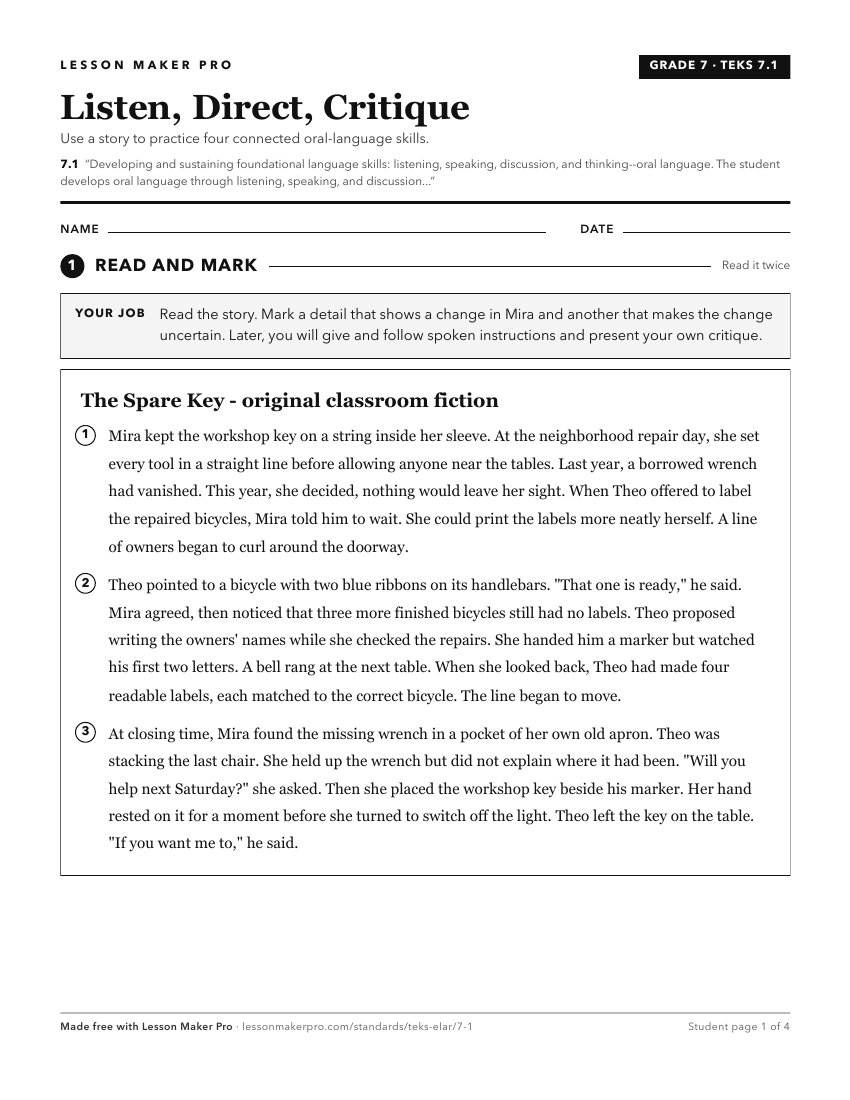
A ready-to-print activity worksheet aligned to 7.1, with an answer key for the teacher on its own page. No account needed.
PDF, US Letter, prints cleanly in black and white.
Download the worksheetKeep exploring
Related Standards
- 5.1
The student develops oral language through listening, speaking, and discussion.
- K.1
The student develops oral language through listening, speaking, and discussion.
- 6.1
The student develops oral language through listening, speaking, and discussion.
- 1.1
The student develops oral language through listening, speaking, and discussion.
Turn this cluster into a lesson
Grade, subject, topic, and the complete cluster are prefilled. Create one free, no account needed.
Also for this cluster:Make a WorksheetMake a QuizMake a Sub Lesson