TEKS ELAR 6.6
Knowledge and Skills Statement (Standard Cluster)
The student responds to an increasingly challenging variety of sources that are read, heard, or viewed.
Texas Essential Knowledge and Skills for English Language Arts and Reading
Cluster contents
Student Expectations in This Statement
6.6 is a knowledge and skills statement. These are the student expectations under it.
- 6.6.A
describe personal connections to a variety of sources, including self-selected texts
- 6.6.B
write responses that demonstrate understanding of texts, including comparing sources within and across genres
- 6.6.C
use text evidence to support an appropriate response
- 6.6.D
paraphrase and summarize texts in ways that maintain meaning and logical order
- 6.6.E
interact with sources in meaningful ways such as notetaking, annotating, freewriting, or illustrating
- 6.6.F
respond using newly acquired vocabulary as appropriate
- 6.6.G
discuss and write about the explicit or implicit meanings of text
- 6.6.H
respond orally or in writing with appropriate register, vocabulary, tone, and voice
- 6.6.I
reflect on and adjust responses as new evidence is presented.
Teacher's field guide
What This Cluster Means
What Students Need to Do
- Students make personal connections, compare sources, and explain both stated and implied ideas. They support spoken and written responses with evidence, paraphrase or summarize accurately, use new vocabulary, and revise their thinking when new evidence appears.
What Mastery Looks Like
- After reading, hearing, or viewing two sources, a student can annotate key details and give an organized response that compares them. The response uses relevant evidence, accurate paraphrasing, suitable vocabulary, and a tone that fits the audience. The student can revise a claim after considering new information.
Common Misconceptions
- Students may retell a source instead of explaining its meaning or comparing it with another source. They may copy sentences and call them paraphrases, cite unrelated details, or state an inference without evidence. They may also resist changing a response when new evidence challenges their first idea.
How to Assess It
- Give students a short article and infographic on the same topic. Ask, "What idea do both sources communicate, how do they differ, and what evidence supports your answer?" Then provide one new fact and require a revised final sentence.
Lesson moves
Ways to Teach It
Post a poem, photo, and article around the room; students rotate, annotate each source with sticky notes, then sort notes by connection.
Ask, "Which source changed your thinking most, and what exact detail caused the change?" Students discuss, then write a six-sentence response.
Run an evidence match game: teams pair claim cards with evidence cards, explain each match, and reject one tempting but irrelevant detail.
Use two school lunch reviews; students compare tone and claims, then write a recommendation for classmates using evidence from both.
Free download
Printable 6.6 Worksheet
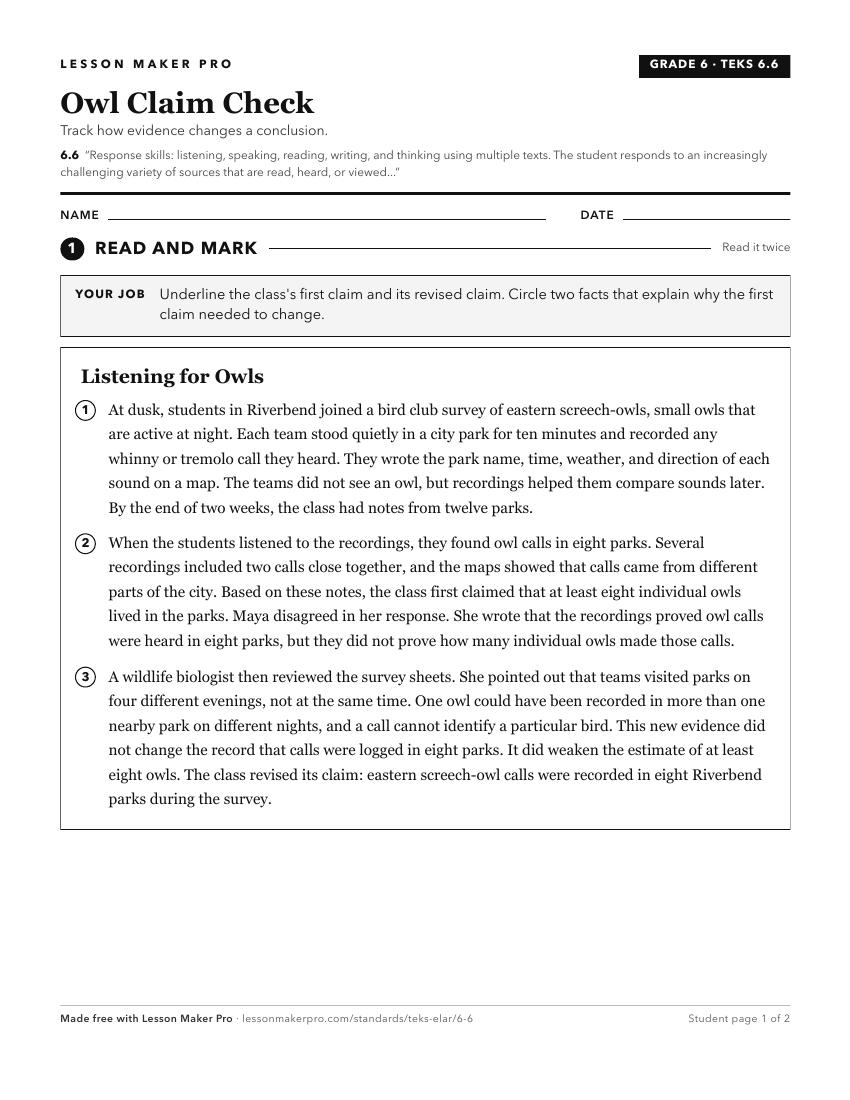
A ready-to-print activity worksheet aligned to 6.6, with an answer key for the teacher on its own page. No account needed.
PDF, US Letter, prints cleanly in black and white.
Download the worksheetKeep exploring
Related Standards
Turn this cluster into a lesson
Grade, subject, topic, and the complete cluster are prefilled. Create one free, no account needed.
Also for this cluster:Make a WorksheetMake a QuizMake a Sub Lesson